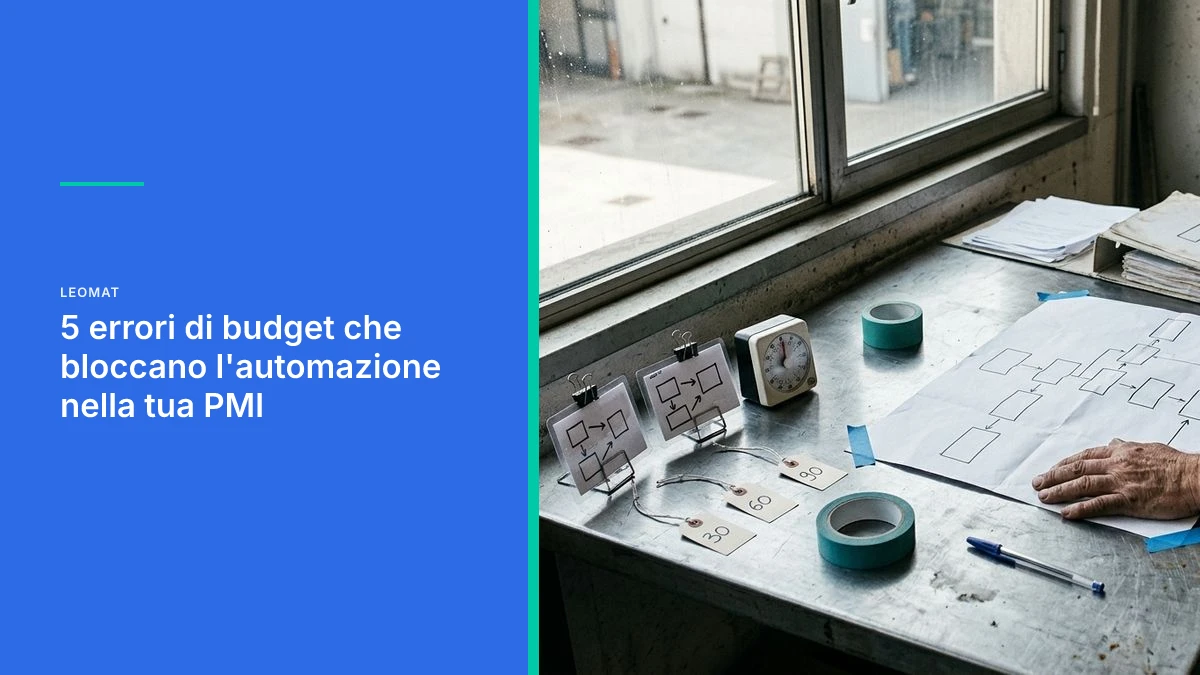
5 Budget Mistakes That Are Blocking Automation in Your SMB
Discover the 5 most common budget mistakes in SMB automation and how to avoid them to invest effectively, without waste.
5 Budget Mistakes That Block Automation in SMEs
Setting up automation properly in an SME requires a method by which the company maps its own processes, identifies bottlenecks, and decides where to automate in order to reduce time and costs. The minimum effective budget is not a fixed figure: it depends on the chosen process, the available data, and the ability to measure results before scaling the investment.
When a business owner hears about automation, the first question is almost always how much it costs. But that is the wrong starting point. Anyone who analyzes business processes (email, management software, shared spreadsheets) almost always finds the same gaps: data scattered across different tools, duplicated manual steps, information that does not flow between departments. Starting with the budget before mapping these gaps means buying a solution that solves the wrong problem, or that solves the right one in an oversized way.
Why Automation Fails When You Start with the Wrong Budget
Automation fails when the budget is set before knowing which process truly needs to be automated and how much time or money it is currently wasting.
This is a common and understandable mistake: you request a quote, compare the numbers, and choose the cheapest vendor or the one that promises the most. The problem is that without a clear process map, any figure is arbitrary. Two pieces of software with the same goal can cost very different amounts: the difference is not in the software itself, it is in exactly what it needs to do and what data it needs to work with.
An automation budget decided before mapping the process is not prudent: it is a bet without data.
How to Map SME Processes Before Investing in Automation
Mapping a process means writing down, step by step, who does what, with which tools, and how much time each phase requires.
All you need is a blank sheet of paper and the time to walk through the process with the people who carry it out. Take the most repetitive process in the company (generating a quote, managing an order, collecting documents for a client) and write down every step, including waiting times and manual checks. Steps that no one had ever questioned often come to light, simply because "it has always been done this way."
The Craftsman with a Catalog on a Spreadsheet
Consider a craftsman who sells custom furniture: by mapping the process, he may discover that every quote requires multiple steps across a spreadsheet, email, and a phone call. In a case like this, before thinking about an ERP, it may be enough to automate the document generation step.
The Manufacturing SME with Multiple Departments
Consider a manufacturing company where production and administration use two different systems that do not communicate. Here the problem is not a lack of automation, it is the absence of a shared data flow.
The 3 Most Common Mistakes That Waste the Automation Budget
The three most frequent mistakes are automating a broken process, buying generic technology instead of tailored solutions, and failing to define a metric to measure the result.
- Automating an inefficient process instead of fixing it first: speeding up a mistake only makes it faster, not more correct.
- Choosing generic software that "everyone uses" without verifying whether it truly fits your own workflow.
- Not defining in advance what you want to measure (time saved, errors avoided, hours freed up) and therefore being unable to evaluate whether the investment worked.
- Expecting automation to completely replace human oversight from day one.
- Investing the entire available budget in a single large project instead of starting with a pilot process.
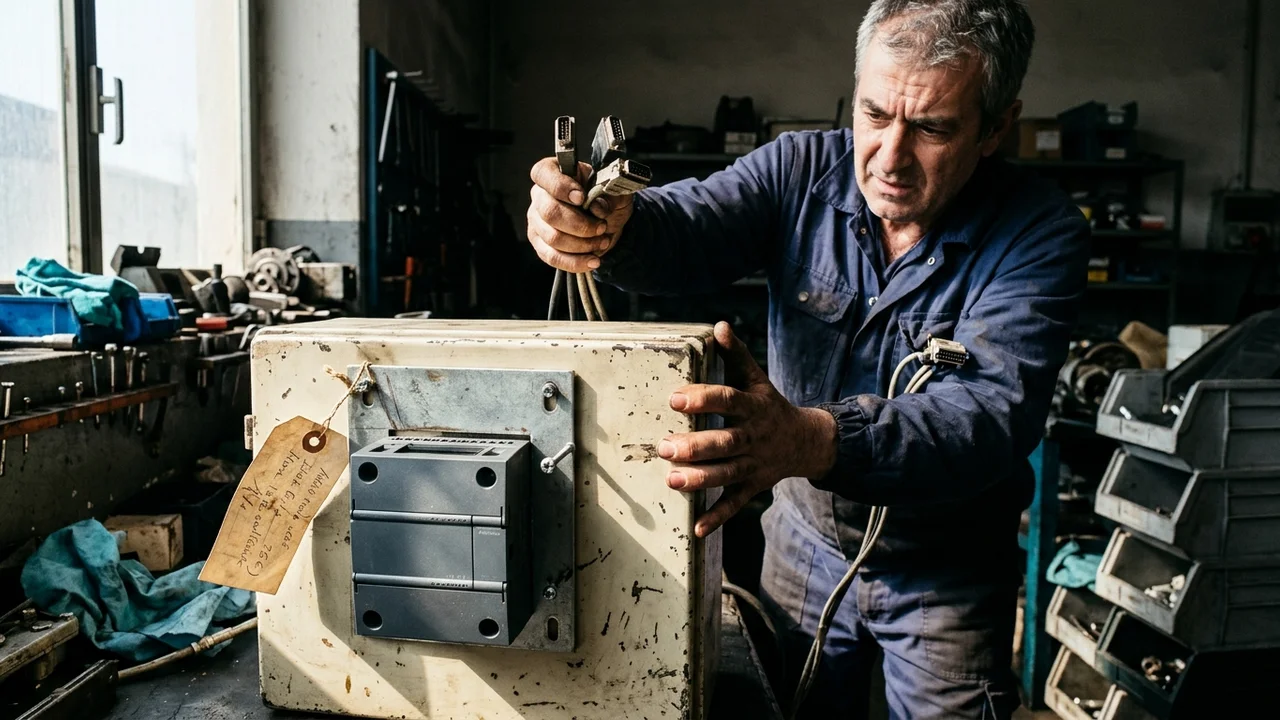
A Practical Method for Defining the Minimum Effective Budget
The minimum effective budget is defined by starting with a single pilot process, a measurable objective, and a defined verification timeframe.
The method is straightforward: choose one process, one metric (hours saved, documents generated more quickly, errors avoided), and a verification window, typically between thirty and ninety days. Only after seeing the result on that single process do you decide whether and how to scale the budget to other departments. This approach avoids tying up capital in a solution that you do not yet know will work for your specific situation.
Sub-case: The Quote That Takes Too Many Hours
Consider a construction company that spends several hours drafting a quote: automating the step from technical data to the final document is exactly the kind of pilot to start with before expanding the investment.
- Choose a repetitive, high-volume process.
- Define a single metric to measure.
- Set a verification window of 30 to 90 days.
- Only then, evaluate whether to scale the budget.
Where to Start: Low-Cost Quick Wins for Manufacturing SMEs
The most effective quick wins for a manufacturing SME involve repetitive documents, standard communications, and data collection that still pass through spreadsheets or email today.
Automatic quote generation, automated deadline reminders, centralized order collection: these are processes that do not require a large project, yet deliver a visible benefit within a few weeks. This is the ideal ground for testing automation without putting the year's budget at risk.
Internal FAQ: How Much Does It Cost to Get Started?
There is no standard figure that applies to every company: it depends on the chosen process and the complexity of the data involved. For this reason, a pilot project on a single process is always the safest starting point, before committing to larger figures.
When It Makes Sense to Move to an ERP or Custom Automation
It makes sense to move to a custom ERP when multiple individually automated processes begin to require shared data across different departments.
If the pilot works and the benefits multiply across several areas (production, administration, warehouse), the natural next step is a system that holds them together, rather than continuing to accumulate disconnected automations. This is the point at which the logic of the "single process" gives way to a platform designed around the company as a whole.
A custom ERP is not there to do everything: it is there to make processes that already work on their own talk to each other.
How Leomat Supports SMEs Along This Journey
Leomat was created to bring cutting-edge technology to businesses. Our approach always starts with mapping the company's real processes, without over-engineering solutions that the client has not asked for and does not need. When a company needs to go beyond individual automations, we offer the development of custom ERP systems built on real workflows, not generic templates. Among the cases we can mention: in the construction sector, ERP Costruzioni ("from 8 hours to 5 clicks for drafting a quote," in 30 days) and in the parapharmaceutical sector, About medically s.r.l. ("+85% document generation speed," in 90 days). The logic is always the same: start from a concrete process, measure the result, then decide whether and how to scale.
FAQ
Where Is It Best to Start with Automation If I Have No Internal IT Team?
Start by mapping a repetitive process, such as quote generation or order management, with no need for internal technical expertise. An external partner can guide this mapping and propose a low-risk pilot, measurable within a few weeks, before any larger investment.
What Is the Minimum Budget to Start an SME Automation Project?
There is no fixed figure that applies to every company: it depends on the chosen process and the volume of data involved. The safest strategy is to start with a pilot project on a single process, measure the result, and only then decide how much to invest to scale.
What Is the Difference Between Process Automation and a Custom ERP?
Process automation acts on a single workflow, such as document generation or automated reminders. A custom ERP comes into play when multiple automated processes need to share data across different departments, becoming a single unified system rather than a collection of disconnected automations.
How Do I Know Whether Automation Is Actually Working?
You need to define a measurable metric from the outset, such as hours saved or errors avoided, and verify it after a defined time window, typically between 30 and 90 days. Without this metric, it becomes impossible to evaluate whether the investment was worthwhile.
Can Automation Completely Replace an Employee?
No, and that is not even the right objective to set. Automation frees up time from repetitive tasks, allowing people to focus on work that requires judgment and interpersonal skills, rather than eliminating roles without a clear plan.
This post was created with AI
Content (text, processing, quotations and images) generated or artificially manipulated by artificial-intelligence systems. Notice provided under the transparency obligations of Article 50 of Regulation (EU) 2024/1689 (AI Act), applicable from 2 August 2026.