5 Hidden Costs That Are Eroding Your Manufacturing SME's Margins
Stable revenue but shrinking margins? The problem often lies not in the product, but in the processes. Discover where hidden costs lurk and how AI-driven automation can reduce them without disrupting production.
5 invisible costs eroding the margins of manufacturing SMEs, and how AI automation reduces them
AI automation for manufacturing SMEs means applying custom software and intelligent workflows to the company's administrative and management processes, not to the production line. The goal is not to change the product but to reduce the invisible costs hidden in quotes, orders, documentation and internal communication, recovering margin without investing in new machinery or additional staff.
It can happen that a manufacturing SME records stable revenue but eroding margins. One of the causes, often overlooked, is the time spent on repetitive activities that nobody measures.
Why the product is not the problem, but the process is
Declining margins in a manufacturing SME can also depend on internal operational processes, not just on the quality or price of the product sold. Slow quotes, manually managed orders and communication errors between departments cost more than one might think.
When a business owner notices a drop in profitability, the first reaction is to look at the product: perhaps it costs too much to produce, or perhaps the selling price is not competitive. But with the same product and the same material costs, what often changes is the time people dedicate to administrative activities that generate no direct value: filling in quotes, entering orders into management systems, chasing information between the sales office and production.
A typical example: the quotes office
Revenue grows but margin does not, and when the processes are analysed it turns out that the people preparing quotes spend hours every day copying data from different Excel spreadsheets.
Where invisible costs hide in SME manufacturing
Invisible costs arise mainly from three areas: manual quoting, fragmented document management and the lack of centralised data between departments. These are costs that do not appear in the balance sheet as a specific line item, but they erode working hours and margin every day.
An ERP that is not tailored but poorly adapted to the company's real needs often generates double handling: data entered by hand multiple times, manual consistency checks, time wasted searching for information scattered across emails and shared spreadsheets. These costs never end up on a balance sheet line, but they translate into person-hours that could be invested in value-added activities, such as business development or quality control.
- Quotes filled in manually with data copied from different sources
- Technical documentation generated from scratch for each client or job order
- Communication between the sales office and production via email or phone
- Manual data consistency checks, with the risk of human error
- Management reporting produced manually at the end of the month
How custom AI automation changes the income statement without touching the product
Custom AI automation acts on the processes that support production, not on the production line itself, making it possible to recover margin by reducing the person-hours dedicated to repetitive, high-error-risk activities.
The difference between generic automation and custom automation is substantial. Software built in pure code around the company's real processes, rather than force-fitted from a standard template, makes it possible to intervene exactly where time is being wasted: in filling in quotes, in automatically generating technical documentation, in synchronising data between departments. The final product sold to the customer remains identical. Only the time needed to produce and sell it changes.
A typical example: job order documents
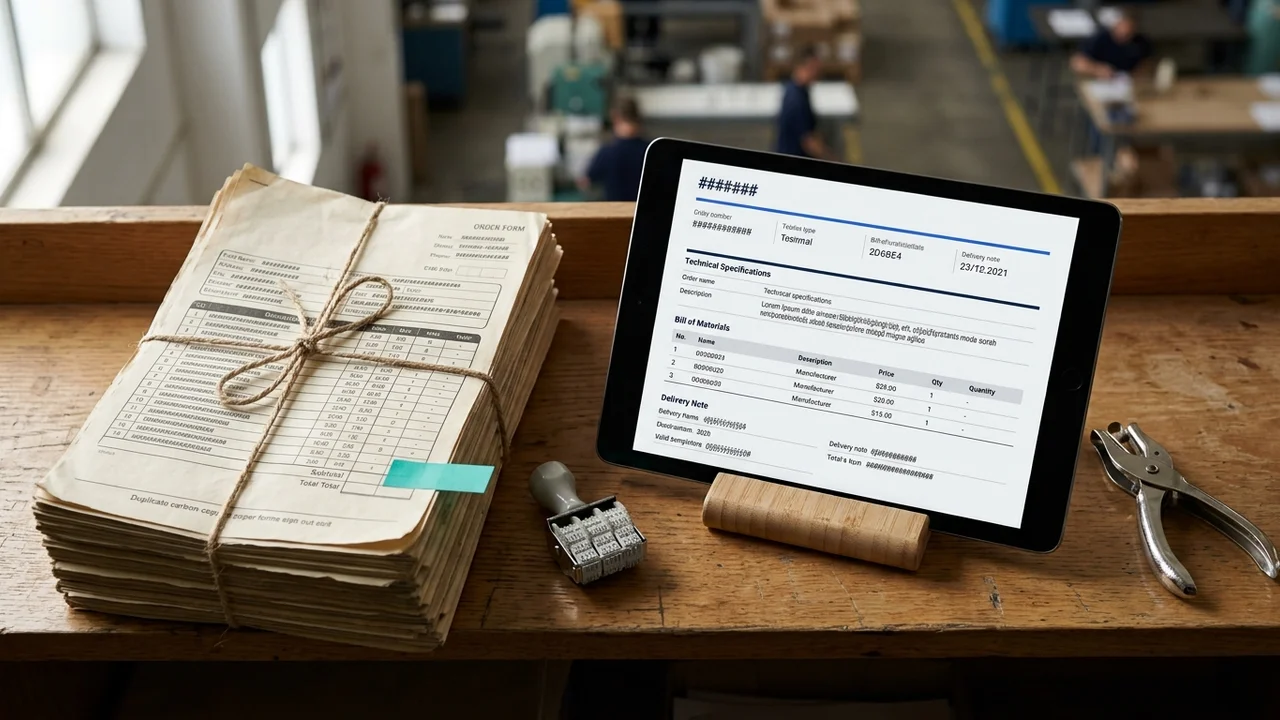
When every customer order requires the manual completion of a technical data sheet, bill of materials and delivery note, the time multiplies with every job order. Digitalising this workflow frees up time to reinvest, for example in quality control.
A real case study: from 8 hours to 5 clicks for quote preparation
In the ERP Costruzioni case study, in the construction sector, preparing a quote went from 8 hours to 5 clicks in 30 days.
The figure from the case study is this: from 8 hours to 5 clicks for quote preparation, in 30 days. This is the result of that specific project, not a forecast valid for every company; elsewhere it must be measured against your own process.
How to get started without disrupting existing processes
Introducing AI automation in a manufacturing SME does not require replacing existing systems, but rather mapping current processes and intervening incrementally at the points where the greatest invisible costs are concentrated.
The first step is not to buy new software, but to understand where time is really being lost. Even a brief process mapping exercise makes it possible to identify the most costly repetitive activities and to address those first, without disrupting the existing organisation. This gradual approach reduces the perceived risk for the business owner and allows results to be measured in the field before extending the intervention.
- Map the administrative processes related to quotes, orders and documentation
- Identify the activities that require the most repetitive person-hours
- Intervene with custom automation on the highest-impact processes
- Measure results in terms of hours recovered and error reduction
- Gradually extend automation to other departments
Frequently asked questions from manufacturing business owners
Many business owners wonder whether automation requires a structured in-house IT team. In most cases it does not: a reliable external partner can manage the entire process of analysis, development and maintenance, without requiring any technical expertise inside the company.
How Leomat helps manufacturing SMEs recover margin
Leomat works on exactly this problem: custom AI automations for Italian SMEs that want to optimise operational processes without proportionally increasing costs. The approach is based on pure code, developed around the company's real processes, without adapting the client's reality to a standard template. Leomat designs and builds custom ERP systems conceived specifically for the company's needs, not for a generic market.
A concrete example is the ERP Costruzioni case study, in the construction sector, where preparing a quote went from 8 hours to 5 clicks in 30 days. If your manufacturing company is suffering from declining margins despite stable revenue, the first step is to understand where the invisible cost is hiding: discover how Leomat can help you automate operational processes without disrupting what already works.
How much does it cost to implement AI automation in a manufacturing SME
The cost varies depending on the complexity of the processes to be automated and the number of departments involved. A serious partner always starts with a mapping phase to estimate realistic timelines and investment, avoiding over-engineered solutions relative to the company's actual needs.
Is an in-house IT team needed to manage automation
No, having a structured internal IT team is not necessary. An external technology partner can handle the entire process, from the initial analysis to software development, through to monitoring and maintenance after launch.
How long does it take to see the first results
It depends on the process: you start with a small, useful slice that goes into production quickly and can be evaluated in the field. In Leomat's case studies, ERP Costruzioni went from 8 hours to 5 clicks for a quote in 30 days, and About medically achieved a +85% increase in document generation speed in 90 days. The reduction in person-hours dedicated to repetitive activities is generally the first visible indicator.
Does automation risk replacing existing staff
The goal is not to replace people, but to free them from repetitive activities so their time can be reinvested in higher-value work, such as quality control, business development or customer management.
This post was created with AI
Content (text, processing, quotations and images) generated or artificially manipulated by artificial-intelligence systems. Notice provided under the transparency obligations of Article 50 of Regulation (EU) 2024/1689 (AI Act), applicable from 2 August 2026.