5 Mistakes in Sales and Production Alignment at SMEs
When the sales team promises dates that the shop floor cannot meet, both margins and reputation pay the price. Here is how to realign the two worlds.
Alignment between sales and production in SMEs starts with the delivery date
Alignment between sales and production in an SME is the way in which the sales team and the shop floor share the same capacity, the same dates and the same constraints before committing to a delivery. Without this exchange, an order goes out with an optimistic date and production only discovers it when the workload is already full. The result is a delay, an apologetic phone call and a margin that shrinks. Aligning the two worlds means letting the sales team see, in real time, what can actually be produced and when.
In many Italian manufacturing companies, an order lives in three different places: the salesperson's message, the management system and the sheet on the shop floor. What is often missing is the realistic date, the remaining machine time and the materials already committed. Whoever confirms to the customer cannot see those fields; whoever produces cannot see the promise. The misalignment is not a personality conflict: it is an information gap that repeats itself with every job.
Sales and production speak two different languages
Sales sells a date; production sells machine hours, materials and queues, and the two languages only meet once the delay is already visible.
The salesperson thinks in terms of customers, margins and closing deals. Production thinks in terms of sequences, setups and bottlenecks. Both are right about their own piece, but there is only one order. When a delivery date is agreed verbally, in a car or during a site visit, nobody has the real workload in front of them. The promise becomes a social commitment, not a capacity figure.
The opposite also happens: the shop floor protects its timelines by inflating them, while the salesperson cuts them to avoid losing the job. Without a shared view, each side optimises its own risk. The shop floor that chases orders instead of anticipating them is the same mechanism, seen from the other end of the corridor.
Why visibility into production capacity is lacking
Visibility is lacking because capacity, stock and commitments are not in the same place where the salesperson writes the delivery date.
Real-time production capacity is not a cosmetic dashboard. It is the sum of three things: how much machine time is still free, which materials are already reserved and which orders have priority. If these three pieces of information live in notebooks, chats and spreadsheets, the confirmed date is a personal estimate. The management system records the order afterwards, when it is too late to say no.
The most frequent errors, in the shop floor and in the office, repeat themselves with the same pattern:
- the delivery date is written without any constraint on workload or materials;
- warehouse commitments do not update the availability visible to the salesperson;
- the owner's urgent jobs jump the queue without recalculating the other dates;
- returns and rework do not reduce the remaining capacity;
- the quote and the confirmed order do not share the same lead times.
Who confirms delivery dates verbally on behalf of the sales team
Someone who visits customers and closes deals on the same day needs an answer in a few seconds, not a meeting. If the only option is to call the shop floor, either the call does not get through or it gets a gut-feel estimate. Alignment between sales and production, in this case, does not call for more meetings: it calls for the feasible date to be visible before the handshake.
Who manages orders on scattered spreadsheets and messages
Whoever keeps the queue on a spreadsheet and commitments in a chat accumulates different versions of the same order. The salesperson reads the latest email; the shop floor reads yesterday's sheet. Automated order management in SMEs reduces precisely this gap: a single confirmation, the same fields, fewer copies to chase.
A delivery date with no capacity behind it is not commercial optimism: it is an order that is already late, just not yet declared.
What happens to customers, margins and reputation
Missed deliveries burn trust, force work into emergency mode and turn the job's margin into overtime, couriers and goodwill discounts.
The customer does not argue about machine workload: they argue about the date they were given. When that date slips, reminders, rescheduling and, in the worst cases, the loss of repeat business follow. At the same time, the shop floor accelerates, splits batches and changes sequences. Every change has a cost: extra setups, scrap and unplanned hours. A delay is not just a calendar problem; it is a unit-cost problem.
The reputational damage is silent. Someone who has suffered a delay does not always complain: they simply choose their next supplier more carefully. Inside the company, sales and production stop trusting each other. The former hides its promises; the latter hides the real timelines. That climate makes every new order slower to confirm.
- the customer receives an apology instead of the part, and remembers the supplier as unreliable;
- the job's margin erodes into couriers, overtime and rework;
- urgent jobs contaminate the plan and delay even those who had a solid date;
- the salesperson stops asking the shop floor and goes back to promising on instinct;
- production stops believing the dates in the order master data.
Who has little time to chase orders every day
Whoever holds together the owner, the sales team and the shop floor does not have a full day to spend on alignment calls. Every reminder is time taken away from producing or selling. If the daily routine is chasing dates, the problem is not the people's willingness: it is the absence of visible capacity at the moment the order is accepted. Reducing those rounds is the first way to recover hours, even before talking about new machinery.
How automation with artificial intelligence aligns the two worlds
Automation with artificial intelligence aligns sales and production when it reads orders, workload and stock together and proposes a feasible date before confirmation.
No oracle is needed. What is needed is a flow that, at the point an order arrives, compares quantities, bills of materials, lead times and existing commitments. Artificial intelligence helps to classify the order, estimate the remaining time and flag the conflict: this date does not work, this one does, this one slips if you accept the urgent job. The decision remains human; what changes is that the decision arrives with the constraints already clear.
In practice, three steps help to close the information gap:
- a single entry point for the order, with a proposed date rather than one typed in manually;
- a workload recalculation whenever an urgent job jumps the queue, visible to the salesperson as well;
- an alert when materials or hours are insufficient, before the customer is confirmed.
Generic software, designed for everyone, often stops at order registration. In manufacturing SMEs the constraints are specific: setups, minimum batch sizes, subcontractors, shifts. This is why bespoke software for manufacturing SMEs keeps those constraints together, while a one-size-fits-all tool leaves them out of the calculation.
A successful alignment without disrupting existing processes
You start at the point where the wrong date is born, usually the quote or the order confirmation, without replacing the entire shop floor overnight.
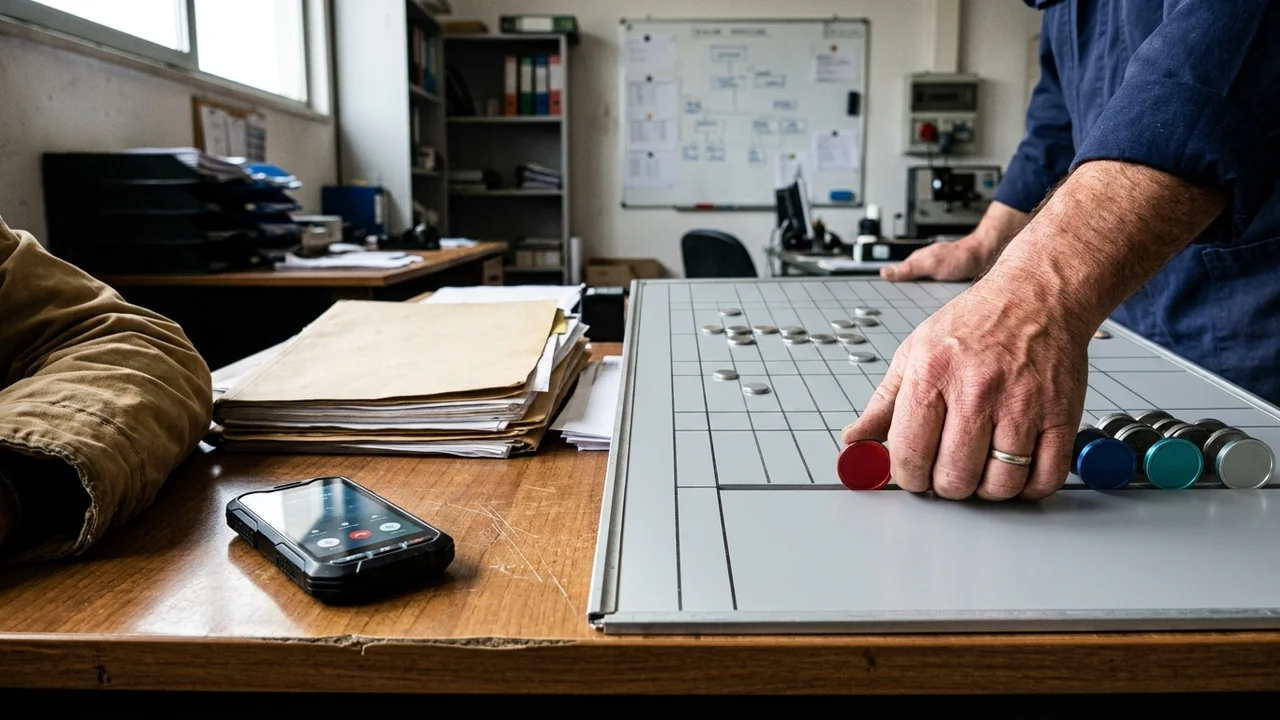
Anyone who wants to align sales and production can map three things in a week of observation: who states the date, where they write it and who can contradict it. Then that step is connected to the data that already exists, even if imperfect. A date calculated on an incomplete but shared workload is better than three different dates all described as "certain".
A straightforward path, suited to companies without an internal IT department, could look like this. Phase 1 (Mapping): list the fields missing from the order confirmation. Phase 2 (Single view): sales and production see the same queue. Phase 3 (Guided promise): the system proposes the date, and the person accepts or rejects it. Phase 4 (Urgent jobs): every queue jump recalculates the other deliveries. No phase requires changing the way production works; it requires stopping the practice of promising in the dark.
Aligning sales and production does not mean selling less: it means selling only the dates the shop floor can actually meet.
How Leomat brings sales and the shop floor closer together without complicating the work
Leomat simplifies SME processes with artificial intelligence automations and software built around the company, so that the delivery date comes from real data rather than from instinct.
The work is done as a partner, not from a catalogue: it starts from the flows you already use, avoids over-engineering and makes measurable what previously existed only in the heads of two departments. Among the services on offer is the development of bespoke management systems, built around the company's process and domain.
A concrete example is ERP Costruzioni, in the construction sector: drawing up a quote went from 8 hours to 5 clicks in 30 days. When a quote stops being a lengthy script and becomes a piece of data connected to the real work, sales and operations have fewer reasons to argue over dates. On Leomat and automations for businesses you can see how this logic applies to those who want to grow without adding chaos.
How do you align sales and production in an SME?
You start with the delivery date: who decides it, where they write it and what data is missing. Then you put sales and the shop floor on the same queue of workload, materials and priorities. Artificial intelligence helps to propose a feasible date and flag conflicts; confirmation remains with the people. There is no need to replace machinery: what is needed is to stop making promises based on old or incomplete information.
Why does the salesperson promise dates that production cannot meet?
Because whoever sells cannot see remaining capacity, committed stock or urgent jobs already in the queue. The date is set to close the job, not as a result of a workload calculation. At the same time, the shop floor either protects its timelines or discovers them too late. This is not bad faith: it is a gap between the order as spoken and the order as produced. As long as those fields are not in the same place, missed deliveries remain the norm, not the exception.
What is needed to see production capacity in real time?
Three ingredients are needed in the same place: machine time still available, materials already reserved and orders with their priorities. If any one of the three lives on a spreadsheet or in a chat, the view is not real time. An automated flow updates the queue whenever an order or an urgent job arrives. The salesperson reads a proposed date; the shop floor reads the same figure. The Monday meeting becomes a check, not a discovery.
Does artificial intelligence take work away from the production manager?
No. It takes away the work of chasing dates, copying orders and putting out fires caused by blind promises. The manager remains the one who decides sequences, exceptions and quality. Automation classifies, calculates and alerts; it does not replace the craft. In an SME without an IT department, this is the key point: less time on the phone, more time producing and selling with dates that can actually be kept.
This post was created with AI
Content (text, processing, quotations and images) generated or artificially manipulated by artificial-intelligence systems. Notice provided under the transparency obligations of Article 50 of Regulation (EU) 2024/1689 (AI Act), applicable from 2 August 2026.