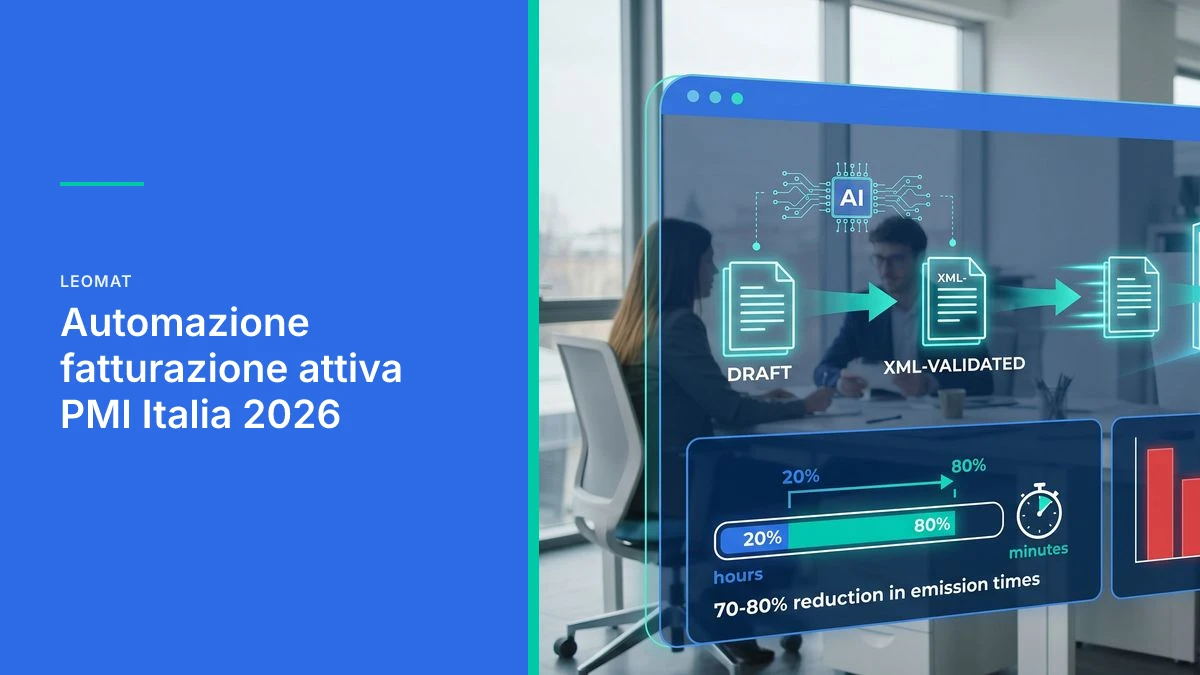
Active Invoicing Automation for Italian SMEs in 2026
A practical guide to automating active invoicing for Italian SMEs in 2026: SDI, AI, tailored ERP solutions, and integrated workflows to reduce errors and processing times.
Active invoicing automation for Italian SMEs: AI tools compatible with the Italian system in 2026
Active invoicing automation for Italian SMEs involves using software and artificial intelligence to generate, validate, transmit and archive electronic invoices through the Exchange System (SDI) without manual intervention. In 2026, this process can reduce issuance times and compilation errors and accelerate collection times, freeing up people for higher-value activities.
The electronic invoicing market in Italy is now mature from a regulatory standpoint, but many SMEs continue to manage the active cycle in a semi-manual way: they compile the XML file by hand, upload it to external portals and reconcile payments on spreadsheets. In Italy, where the obligation for electronic invoicing between private parties has been in force since 2019 and since 2024 applies to all flat-rate taxpayers, the margin for optimisation is still considerable.
Why automate active invoicing in 2026: concrete benefits for Italian SMEs
Automating active invoicing means reducing issuance time, catching XML compilation errors before submission and accelerating the collection cycle through automatic notifications and reminders.
For an SME processing hundreds of outgoing invoices per month, manual management absorbs a significant portion of administrative work every day. Every formal error in the XML file that fails the SDI checks generates a rejection, which requires correction and resubmission, a process that can extend collection times. Automation greatly reduces this variable, because data is pulled directly from the sales order or contract and converted into validated XML before it is even sent.
The benefits are not limited to speed. An automated system tracks the status of every invoice (sent, delivered, accepted, rejected, overdue) and can trigger personalised payment reminders based on the customer profile. This impact on Days Sales Outstanding (DSO) is measurable by comparing historical collection data from before and after automation.
How electronic invoicing works in Italy: SDI, XML and updated regulatory obligations
In Italy, every B2B and B2G invoice must be transmitted in FatturaPA XML format through the Exchange System of the Revenue Agency, which checks the document and delivers it to the recipient or communicates its rejection.
The FatturaPA XML format is defined by the technical specifications of the Revenue Agency and includes precise mandatory fields: supplier and customer data, VAT type and rate, recipient code or PEC address, and purchase order references in the case of public administration supplies. From 1 January 2024, the obligation applies to all flat-rate taxpayers, regardless of revenue.
The SDI responds with standardised notifications: rejection notice, delivery receipt, non-delivery notice and, only for invoices addressed to the public administration, the contracting authority outcome notification (acceptance or rejection). An automated system must be able to interpret these notifications and update the invoice status in the management system without human intervention, and where applicable open a correction ticket in the event of rejection.
Updates to SDI specifications
The Revenue Agency periodically updates the technical specifications of the FatturaPA XML schema, introducing new codes and new validation checks: the version currently in force and its effective date should be verified on the Agency's website. An automated system must update itself to these specifications without requiring manual intervention from the company. For this reason, whether the solution is built in pure code or delivered as a SaaS portal, it is worth knowing who maintains the system and within what timeframes.
AI applied to invoicing: what artificial intelligence can actually do in the active cycle
Artificial intelligence applied to active invoicing can automatically classify order lines, suggest the correct VAT type, detect price anomalies against contracts and predict the risk of late payment for each customer.
Many SMEs associate AI with invoicing and think of a simple OCR that reads PDFs. In reality, in 2026 language models and machine learning systems applied to the active cycle do much more. A model trained on the company's historical data can recognise when a unit price deviates from the framework contract, flag a customer VAT number that does not match the updated registry, or calculate the probability of late payment based on the debtor's historical behaviour.
AI can also automate the generation of credit notes in the event of a return or dispute, linking the tax document to the commercial case without the operator having to open multiple applications. The result is an active cycle that closes faster and with fewer exceptions to manage manually.
- Automatic classification of order lines: the AI associates each line with the correct product/service code and the appropriate VAT type.
- Price consistency check: automatic comparison between the invoiced price and the contractual terms stored in the CRM or management system.
- Customer registry validation: verification of the VAT number and tax code through available official verification services.
- Bad debt risk prediction: automatic scoring based on payment history, sector and customer size.
- Personalised reminders: automatic generation and sending of reminders calibrated to the customer profile and overdue amounts.
- Automatic bank reconciliation: matching between current account movements and open invoices without manual intervention.
Tools and approaches compatible with the Italian system: from management software to custom pure-code solutions
For Italian SMEs, there are three main approaches to active invoicing automation: generalist SaaS portals, add-on modules for traditional management systems and solutions developed in pure code tailored to the company.
SaaS portals such as those offered by the main Italian electronic invoicing providers cover the basic functions (XML generation, SDI submission, substitute archiving) but rarely integrate deeply with the company's specific processes. They work well for businesses with a simple and uniform sales cycle, but show their limitations as soon as variables such as multiple price lists, framework contracts, open orders or foreign currency invoicing are introduced.
Add-on modules for traditional management systems (legacy ERP) offer greater integration with company data, but often require manual updates to SDI specifications and do not include native AI functionality. Customisation costs can be high and implementation timelines long.
Solutions developed in pure code by a specialised technology partner represent the most flexible and durable approach. The code is written precisely to the company's requirements, integrates with existing systems via API where available, and can incorporate AI models trained on proprietary data. Leomat, for example, developed a system for ERP Costruzioni that transformed the drafting of a quote from 8 hours of work to 5 clicks in 30 days: the same principle applies to active invoicing, where every manual step becomes a measurable automation.
Comparison of the three main approaches
A generalist SaaS portal has a low upfront cost but accumulates subscription costs over time and does not scale with the business. A legacy ERP module is already in place but requires costly customisations. A pure-code solution has a higher initial investment, but generates a proprietary technology asset that the company controls completely, with no dependency on third-party licences or no-code platforms that can change their pricing or features without notice.
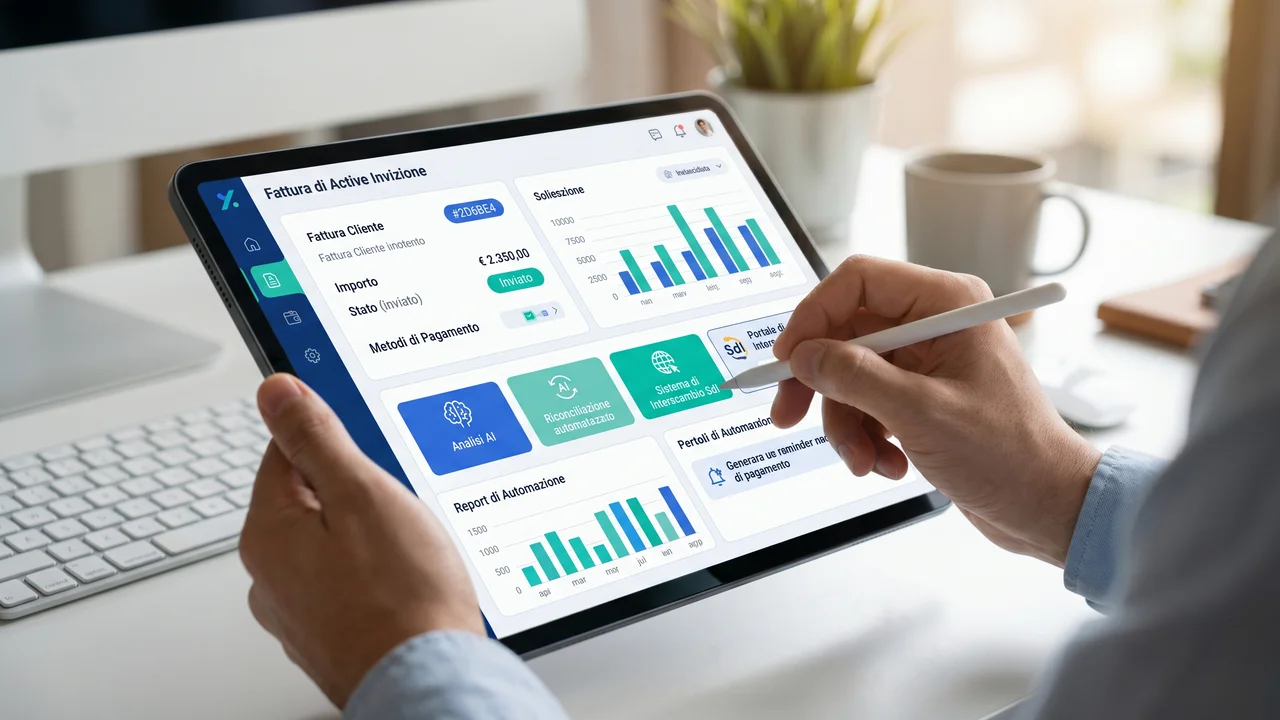
Integration with ERP and business workflows: how to connect invoicing, CRM and accounting
Active invoicing automation reaches its full potential only when it is integrated with the CRM, warehouse, accounting system and banking systems, creating a continuous data flow from quote to collection.
In most Italian SMEs, invoicing is an island: order data is manually re-entered into the invoicing software, the invoice is then uploaded to a separate SDI portal, and finally the payment is reconciled by hand against the bank account. Every step is a point of error and a hidden cost. A well-designed integration eliminates these manual bridges: when the order is confirmed in the CRM, the system automatically generates the invoice draft; when the goods are shipped or the service delivered, the invoice is issued and transmitted to the SDI; when the payment arrives in the account, it is automatically matched to the open invoice.
Achieving this integration reliably requires robust APIs between the systems involved and an orchestration layer that handles exceptions (partial orders, returns, credit notes, split payments). This logic is precisely the kind of complexity that no-code platforms struggle to handle without fragile workarounds, whereas pure code allows individual use cases to be modelled explicitly.
Common mistakes in invoicing automation and how to avoid them
The most frequent mistakes in active invoicing automation relate to the quality of registry data, the handling of unforeseen exceptions and the absence of a human validation step before submission to the SDI.
The first mistake is starting automation without first cleaning up the customer registry. If the database contains incorrect VAT numbers, outdated recipient codes or PEC addresses that are no longer current, automation multiplies errors instead of eliminating them. Before automating, a registry audit with verification via official APIs is essential.
The second mistake is failing to plan an exception-handling path. Every invoicing cycle has special cases: invoices with mixed VAT, exempt transactions, split payment for the public administration, intra-community reverse charge. An automated system must be able to recognise these cases and, if it cannot handle them autonomously, flag them to an operator rather than stalling or, worse, sending an incorrect document.
- Customer registry audit before activating any automation: verify VAT numbers, SDI recipient codes and PEC addresses.
- Mapping of exceptional cases (split payment, reverse charge, VAT exemptions) and definition of the system's behaviour for each one.
- Testing on a subset of invoices before full go-live: a parallel run period with manual verification.
- Monitoring of SDI notifications with automatic alerts in the event of rejection or non-delivery.
- Periodic updates to the technical specifications of the Revenue Agency: rely on a partner who keeps the code up to date.
How to get started: a practical path for SMEs that want to automate active invoicing
An active invoicing automation journey for an Italian SME typically unfolds in three phases: analysis of current processes and existing systems, design of the automated workflow with exception handling, and implementation and testing before the definitive go-live.
The analysis phase, even if brief, is the most important. It serves to understand how many invoices are issued per month, at what frequency, to which types of customers (private individuals, companies, public administration), under which VAT regimes and with which payment methods. This mapping determines the complexity of the solution and allows a realistic estimate of the return on investment.
The design phase defines the ideal workflow: where the data comes from (CRM, management system, orders), how it is transformed into FatturaPA XML, how it is transmitted to the SDI, how return notifications are handled and how payments are reconciled. This phase also identifies exceptional cases and determines whether to handle them automatically or with a manual alert.
The duration of the implementation phase, with a partner that develops in pure code, depends on the complexity and the systems involved, and cannot be estimated before they have been reviewed. A parallel go-live (where the automated system runs alongside the manual one for a period) is strongly recommended to catch any unforeseen cases before relying entirely on automation.
- Analysis: mapping of current processes, registry audit, identification of systems to integrate.
- Design: definition of the automated workflow, exception handling, technical specifications.
- Development: pure-code implementation, API integration with SDI and business systems.
- Testing and parallel go-live: verification on a sample of real invoices, correction of anomalous cases.
- Post go-live (Optimisation): monitoring of KPIs (SDI rejection rate, DSO, average issuance time) and system refinement.
Frequently asked questions about active invoicing automation for Italian SMEs
How much does it cost to automate active invoicing for an SME processing 200 to 500 invoices per month?
The cost depends on the complexity of the processes and the systems to be integrated. A pure-code solution for an SME processing 200 to 500 invoices per month requires an initial investment in design and development, which makes sense when the time saved and errors avoided consistently outweigh the cost of building and maintaining it. It is important to request an estimate based on a specific analysis of your own processes, not a packaged price.
Is active invoicing automation compatible with the flat-rate tax regime in 2026?
Yes. From 1 January 2024, the electronic invoicing obligation applies to all flat-rate taxpayers, regardless of revenue (from 1 July 2022 it applied to those above 25,000 euros). An automated system can handle this regime as well, with the appropriate XML specifications. For flat-rate taxpayers with low volumes, simplified solutions may be sufficient; for the tax aspects of your specific regime, it is advisable to consult your accountant.
Can I automate active invoicing without changing my current management system?
In many cases, yes. A pure-code solution can connect to the existing management system via API or through direct database access, without requiring the software to be replaced. This approach preserves the investment already made in the management system and adds a layer of automation and intelligence without disrupting established processes. Feasibility depends on the APIs available in the management system in use.
What happens if the SDI rejects an automatically issued invoice?
A well-designed system intercepts the SDI rejection notification in real time, identifies the reason for the error (missing data, incorrect format, invalid VAT number) and automatically opens an alert for the operator with correction instructions. In some cases, if the error is of a known and automatically correctable type (such as an updated recipient code), the system can resubmit the invoice without human intervention.
How long does it take to see the first concrete results from invoicing automation?
The first results to observe after go-live are the reduction in issuance time and the SDI rejection rate; when they appear depends on the process and the systems involved, which is why it is best to start with a well-defined process. The reduction in DSO takes longer to measure, because it depends on customer payment cycles.
This post was created with AI
Content (text, processing, quotations and images) generated or artificially manipulated by artificial-intelligence systems. Notice provided under the transparency obligations of Article 50 of Regulation (EU) 2024/1689 (AI Act), applicable from 2 August 2026.