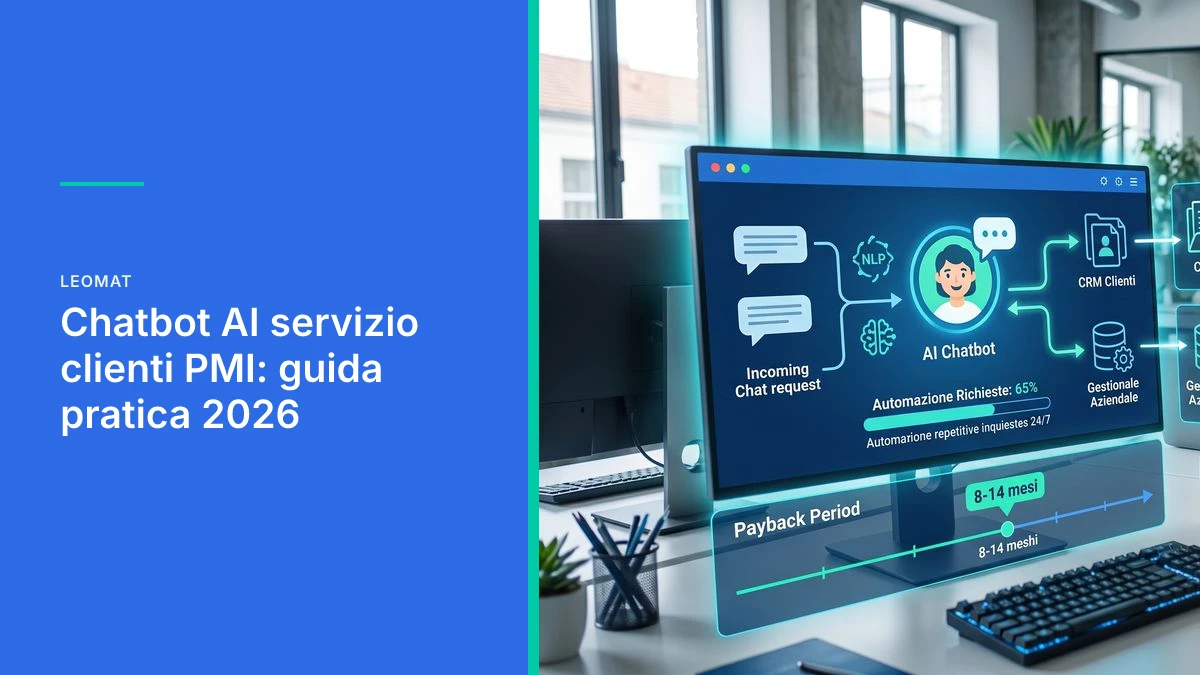
AI Chatbots for SMB Customer Service: A Practical 2026 Guide
How an AI chatbot can support customer service for a small or mid-sized business in 2026: real benefits, selection criteria, how to think through costs, and first steps to get started without the stress.
AI Chatbots for SME Customer Service: Everything You Need to Know in 2026
An AI chatbot for customer service is a software system that automatically responds to customer requests, in natural language, across channels such as websites, WhatsApp or email, without requiring human operator involvement for the most frequently asked questions. For an Italian SME, this means having an assistant available 24 hours a day, capable of handling multiple conversations in parallel, responding based on company data and integrating with systems already in use.
The use of business chatbots has grown in recent years, driven by the spread of next-generation language models and pressure on operating costs. For Italian SMEs, which often cannot afford large support teams, this technology is no longer a future option: it is a concrete lever for competitiveness today.
What an AI Chatbot for Customer Service Is and Why SMEs Need One in 2026
A modern AI chatbot is not a simple tree of predefined responses: it is a system that understands the context of a conversation, accesses company information in real time and responds relevantly even to questions phrased imprecisely or informally.
The difference compared to first-generation chatbots, those based on rigid rules and multiple-choice menus, is substantial. Current language models (LLMs) make it possible to build virtual assistants that understand customer intent, retrieve data from management software or the CRM, and provide personalised responses. An SME that sells industrial components, for example, can configure the chatbot to answer questions about order status, delivery times or the technical specifications of a product, drawing directly from the internal database.
In 2026, three factors make this technology particularly relevant for Italian SMEs. The first is the availability of AI models accessible even without costly cloud infrastructure. The second is the growing expectation among customers to receive immediate responses, even outside office hours. The third is margin pressure: hiring staff dedicated to customer service carries high fixed costs, whereas a well-configured chatbot handles greater volume with costs that grow far more slowly than headcount.
Who Really Benefits from an AI Chatbot: Three Concrete Profiles
Consider, as an example, a distribution company that receives many requests every day via email and WhatsApp, largely about stock availability, prices and delivery times. With a chatbot integrated into the management system, recurring requests can be handled automatically, and the team can focus on more complex commercial negotiations.
Or consider a small artisan workshop that sells online internationally, with customers writing at night to ask about product customisation. If the response only arrives the following morning, some orders are lost. A chatbot can respond in multiple languages, collect the details of the request and pass them to the owner already organised.
Or consider a professional practice whose clients frequently call to find out whether a document has arrived or what the status of a matter is. A chatbot connected to the document management system can answer these operational questions, reducing interruptions and freeing consultants for high-value work.
Concrete, Measurable Benefits: What Really Changes in the Business
The benefits of an AI chatbot in an SME's customer service can be measured across three main dimensions: reducing the operational load on the team, improving response speed for customers and increasing the perceived quality of service.
On the operational side, the most immediate benefit is the automatic handling of frequently asked questions. In many SMEs, a significant portion of support requests concerns a limited set of topics: order status, return policies, product information, opening hours, prices. A chatbot that responds based on this real content can resolve many of these cases autonomously, passing to a person those that fall outside its scope.
On the speed side, for questions the chatbot can handle, a response can arrive within seconds rather than hours. This can affect customer satisfaction and, in the case of commercial enquiries, the conversion rate. A customer who receives an immediate answer to the question "do you have this product available in size XL?" is far more likely to complete a purchase than one who has to wait.
- Continuous availability: the chatbot responds 24 hours a day, 7 days a week, including public holidays and overnight hours.
- Immediate scalability: it handles peaks in requests (sales, product launches, tax deadlines) better than a fixed-size team.
- Consistency of responses: if the chatbot responds only based on up-to-date company documentation, customers receive the same information, with fewer variations caused by internal misalignment.
- Structured data collection: every conversation generates useful data about what customers ask, which problems recur and where they get stuck in the purchasing process.
- Reduced load on the team: human operators focus on complex cases, sensitive complaints and commercial opportunities, not repetitive questions.
- Multichannel integration: the same chatbot can operate across the company website, WhatsApp Business, email and mobile apps with a single knowledge base.
How to Choose the Right Chatbot for Your SME: Practical Criteria
Choosing the right chatbot for an SME depends on three fundamental variables: the complexity of the requests it needs to handle, the company systems it must integrate with, and the level of customisation required to reflect the company's specific tone and processes.
The first mistake to avoid is choosing a tool based on list price or ease of initial configuration, without evaluating integration capabilities. A chatbot that does not connect to the company management system can only answer generic questions, not the specific ones customers actually ask. And a chatbot that responds generically is often worse than no chatbot at all, because it frustrates the customer without solving the problem.
Technical Criteria to Evaluate Before Choosing
In the technical evaluation, at least the following aspects should be verified: the system's ability to access real-time data (not just a static knowledge base), the availability of APIs for integration with CRM and management systems, native support for Italian with sector-specific nuances, and the ability to define escalation flows to human operators when necessary.
Off-the-Shelf Solutions vs Custom Development
Pre-packaged SaaS platforms offer rapid configuration and low initial costs, but impose significant constraints on the customisation of flows and on integration with proprietary systems. For an SME with standard processes and low volumes, they can be a starting point. For those with specific processes, a custom management system or complex integration requirements, a solution developed in pure code offers greater flexibility and fewer constraints imposed by third-party architectures.
Leomat, for example, develops chatbots in pure code, without relying on third-party no-code or low-code platforms. This approach makes it possible to build conversational logic that aligns with the client's processes and to integrate with leading market applications via APIs and native connectors, with security designed from the outset.
Questions to Ask a Supplier Before Signing
Before choosing a chatbot partner, it is useful to ask some direct questions: can the system access my management system's data in real time? How is privacy handled and where are conversation data stored? Can I modify the flows independently or do I always have to go through the supplier? If the volume of requests doubles, do costs scale linearly? Is there a handoff mechanism to a human operator for complex cases? Does the chatbot inform the customer that they are speaking with an AI system, as required by the EU AI Act for systems that interact with people?
Integration with Existing Processes: From CRM to Management System
An AI chatbot becomes truly useful when it is connected to the systems you already use: the CRM, the management system, the ticketing system, the appointments calendar. Without these integrations, it can only answer generic questions and cannot access the specific information your customers are looking for.
Integration with the CRM allows the chatbot to recognise the customer during the conversation, access their purchase history, open tickets and recorded preferences. This transforms the interaction from generic to personalised: instead of responding "for information about your order status please contact our office", the chatbot responds "your order #4521 is being shipped and will arrive on Thursday 18 June".
Integration with the management system is equally critical for manufacturing or distribution SMEs. Stock availability, updated prices, production times: these are pieces of information that change every day and that customers ask about constantly. A chatbot that reads this data in real time reduces one of the main sources of frustration in customer service, namely receiving outdated or contradictory information.

How Much It Costs and How to Estimate the Return for an Italian SME
The cost of an AI chatbot for an Italian SME in 2026 varies significantly based on the complexity of the project, and the return on investment should be verified in the field, starting from a small scope; it is easier to achieve for companies with high volumes of repetitive requests.
To get a sense of the landscape, it is useful to distinguish three typical scenarios. The first is an SME with standard requirements: a chatbot that answers FAQs, collects contact requests and routes them to the correct team. In this case, development and configuration costs fall within an accessible range, with modest monthly maintenance. The second scenario involves integration with a CRM and management system: costs increase due to technical complexity, but the value generated can also grow. The third scenario is a multichannel chatbot with advanced conversational logic and multiple integrations: a more significant investment, whose impact on operational efficiency and customer satisfaction should be measured in the field.
To calculate ROI in concrete terms, the starting point is to measure the current cost of handling requests manually. By knowing the number of repetitive requests, the average time to handle them and the hourly cost of the staff involved, you can estimate what that work costs today and how much of it the chatbot can absorb. To this you can add, if they are verified in the field, conversions recovered outside business hours and the improvement in perceived service quality.
- Calculate current volume: how many customer service requests you receive each month, across which channels and with what distribution by question type.
- Identify automatable questions: which requests fall into recurring categories that the chatbot can handle.
- Estimate the cost of human time: hours per month spent answering repetitive questions, multiplied by the hourly cost of the staff involved.
- Add the value of missed opportunities: commercial requests that arrived outside business hours and were not converted, customers lost due to excessively long response times.
- Compare with the cost of the chatbot: development, configuration, annual maintenance.
How to Get Started: First Steps for Adopting an AI Chatbot Without Stress
Adopting an AI chatbot does not require overhauling business processes all at once: the most effective path starts from a specific use case, validates it with real data, and then gradually extends the functionality.
The first step is to map customer service requests from the past three months. How many are there? What type are they? Which channels do they come through? Which require access to management system data and which can be resolved with static information? This analysis, even if brief, makes it possible to identify the use case with the greatest immediate impact and to define the technical specifications of the chatbot precisely.
The second step is to choose the starting channel. For many Italian SMEs, the company website and WhatsApp Business are the main points of contact. Starting with just one, validating how it works, and then extending to other channels is more effective than trying to cover everything at once.
The third step is to define the chatbot's boundaries: what it should be able to do, what it should escalate to a human operator, and how it should behave in ambiguous cases. A chatbot that knows when it cannot answer, and that transfers the conversation to a human smoothly, generates far more trust than one that attempts to answer everything and gets it wrong.
The fourth step is post-launch monitoring. The first few weeks are crucial for identifying questions the chatbot does not handle well, phrases that generate incorrect responses, and points where customers abandon the conversation. This data makes it possible to refine the system quickly and to increase the automatic resolution rate over time.
This post was created with AI
Frequently Asked Questions About AI Chatbots for SME Customer Service
Can an AI chatbot really understand my customers' questions in Italian, even with typos or colloquialisms?
Current language models handle colloquial Italian, typos and imprecise phrasing well. The quality of comprehension depends, however, on the configuration and the content it responds from: a chatbot built well around the specific vocabulary of your sector and your customers will perform significantly better than one configured generically. This is one of the aspects worth investing in during the initial phase of the project.
Can the chatbot completely replace my customer service team?
No, and that should not be the objective. The chatbot handles repetitive and structured requests autonomously, which in many SMEs make up a significant portion of total volume. Complex situations, sensitive complaints, commercial negotiations and cases requiring empathy or contextual judgement remain the responsibility of human operators. The goal is to free the team from routine questions so they can focus on high-value ones, not to eliminate human contact.
How long does it take to implement an AI chatbot in an SME?
For a chatbot with basic functionality (FAQs, contact collection, request routing) the timelines depend on what the chatbot needs to do. For solutions with CRM and management system integration, they grow based on the complexity of the APIs and the quality of the documentation for existing systems. A gradual approach, starting from a simple use case and then extending the functionality, reduces risks and allows real feedback to be gathered before investing further.
Is my customers' conversation data safe?
Data security depends on the chosen architecture. A chatbot developed in pure code allows you to decide where data stays; if it uses an AI model from an external supplier, it should be made openly clear what leaves the company perimeter and what does not. It is important to verify with the supplier where conversation logs are stored, for how long, and how they are handled in compliance with the GDPR. These aspects must be defined contractually before the project begins.
How do I know whether the chatbot is working well after launch?
The main metrics to monitor are: automatic resolution rate (percentage of conversations closed without human escalation), abandonment rate (customers who leave the conversation without receiving a response), average conversation duration, and post-interaction satisfaction (measurable with a rating question at the end of the chat). A good reporting system integrated into the chatbot makes these metrics visible in real time and allows rapid intervention when something is not working as expected.
Content (text, processing, quotations and images) generated or artificially manipulated by artificial-intelligence systems. Notice provided under the transparency obligations of Article 50 of Regulation (EU) 2024/1689 (AI Act), applicable from 2 August 2026.