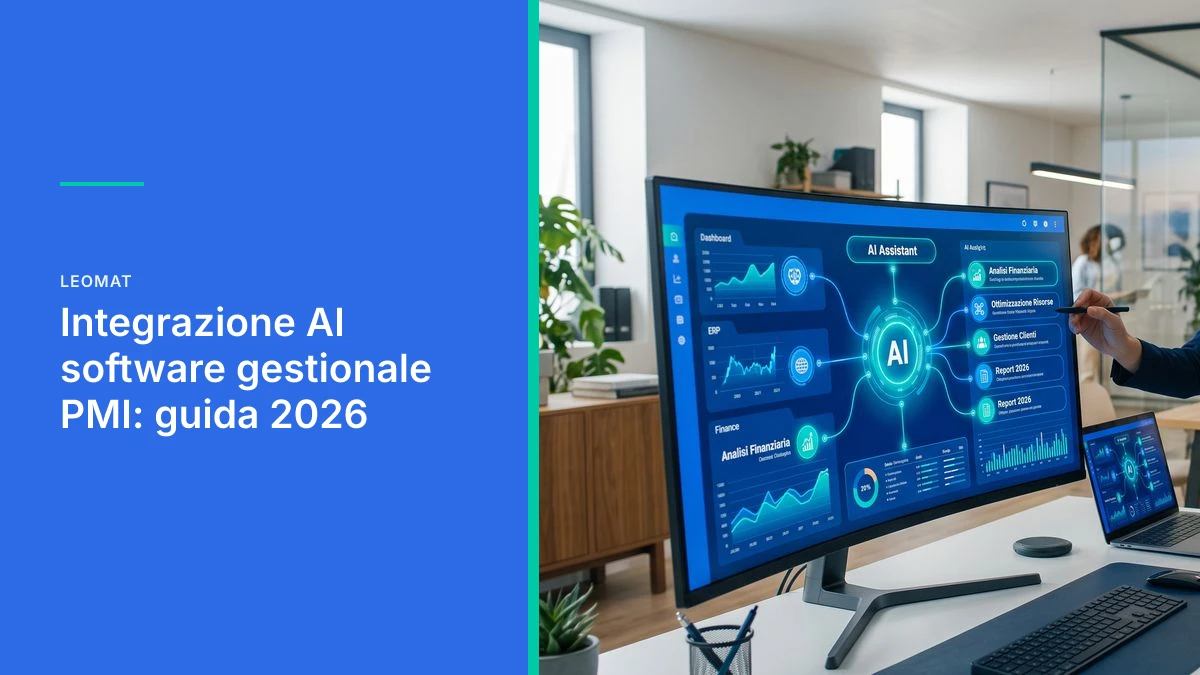
AI Integration for SME Management Software: 2026 Guide
How to enhance the management software you already use with artificial intelligence, without switching systems and without an in-house IT team. A practical guide for small and medium-sized businesses.
AI Integration for SME Management Software: How to Enhance What You Already Have
Integrating AI into management software already in use means adding artificial intelligence capabilities, such as predictive analytics, document automation and intelligent assistants, directly on top of the ERP or management system your company uses every day, without replacing it. The result is more capable software, built on the same data and the same starting processes, but with an extra edge that reduces manual work and speeds up decision-making.
In Italy, many manufacturing and service SMEs have been using the same management system for years, often customised over time with logic and data that would be difficult to replicate elsewhere. Abandoning it in favour of a new platform can mean months of work, considerable budget and the risk of losing the company's institutional memory.
The Real Problem: Replacing Everything Is Not the Solution
The temptation to replace the management system with a new, "AI-ready" platform is understandable, but in most cases it is the most costly and risky choice for an Italian SME.
Consider a distribution company whose ERP has been managing orders, inventory and invoicing for years. That system holds the discount logic for each customer, product seasonality patterns and exceptions built up over time. Migrating to a new platform "with AI included" means rebuilding all of this. Often, many of the features being sought can be added to the existing system, and it is worth verifying that before making a decision.
The problem is not the legacy management system. The problem is that an intermediate layer is often missing: the applied AI layer that connects to what already exists and enhances it. This layer does not require discarding anything. It requires building on top, methodically.
Why Italian SMEs Resist Changing Systems
The reasons are concrete and rational. A management system that has been in use for years contains historical data, customisations, integrations with other tools (accounting, CRM, e-commerce) and, above all, the tacit knowledge of business processes encoded in its rules. Migrating all of this carries a real cost, often underestimated in initial quotes, that surfaces during implementation in the form of consulting hours, staff training and temporary operational disruptions.
The Hidden Cost of Full Migration
For a company without an in-house IT manager, a full migration means complete dependence on the vendor for the entire duration of the project, with the resulting operational risk.
How AI Integration Works on an Existing Management System
AI integration on an existing management system is achieved by building a dedicated software layer that reads data from the current system, processes it with artificial intelligence models and returns useful outputs directly within the workflows already familiar to users.
In practical terms, this layer can take different forms depending on the objective. It can be a module that analyses order history and suggests automatic stock replenishment. It can be an assistant that generates draft quotes based on parameters entered in the management system. It can be an automatic classification system for incoming documents, such as invoices or delivery notes, that associates them with the correct jobs and routes to a person any cases that do not pass the checks.
The technical key is data access: if the management system exposes APIs (application programming interfaces), the integration is direct and stable. If it does not, the work is done via database connections or structured exports. In both cases, a pure-code approach, written and maintained by developers, makes the connection more robust, updatable and less dependent on third-party platforms that could change their terms or stop working.
Data as the Starting Point
Every AI integration begins with a mapping of the data available in the management system: which tables exist, how complete they are, how up to date they are. This phase, even if brief, is essential because AI produces useful results only when the input data is reliable. A preliminary analysis makes it possible to identify the modules with the greatest potential and to avoid investing in areas where data is too fragmented. It is also necessary to decide, together with whoever handles privacy in the company, which personal data relating to customers and employees can be passed to an AI model and which cannot.
What AI Can Do with Your Software Today: Concrete Cases for SMEs
The most effective AI applications for SME management systems involve automatic document generation, demand forecasting, intelligent request classification and the automation of internal approval workflows.
One example is quote preparation: in the ERP Costruzioni case, in the construction sector, preparing a quote went from 8 hours to 5 clicks in 30 days.
Another example involves About Medically S.r.l., a company in the parapharmaceutical sector: an 85% increase in document generation speed in 90 days.
- Automatic document generation: draft quotes, proposals, technical data sheets and periodic reports produced from data in the management system.
- Demand forecasting: analysis of order history to suggest optimal stock levels and anticipate seasonal peaks.
- Intelligent classification of incoming documents: invoices, delivery notes and orders recognised and automatically associated with the correct jobs.
- AI assistant for internal support: automatic responses to employees' frequently asked questions about business processes, linked to management system data.
- Approval workflow automation: purchase requests, expense reports and orders automatically routed to the correct manager based on configurable rules.
- Predictive customer analytics: identification of customers at risk of churning or with upselling potential, based on transaction history.

Pure Code vs No-Code Connectors: Why the Technical Choice Matters
Integrating AI through custom-developed pure code provides greater stability and control and reduces dependence on third-party platforms that can change their pricing, alter features or discontinue their service, all critical factors for an SME that cannot afford operational disruptions.
In recent years, many companies have experimented with visual connectors and low-code automation platforms to connect their management systems to AI services. The appeal is immediate: configuration takes just a few days and no developers are required. The problems emerge later: every update to the management system or the AI service can break the workflow. Data volume limits become restrictive as the company grows. Monthly licence costs accumulate. And above all, the business logic remains trapped inside a platform that is not under the company's control.
The pure-code approach, which Leomat adopts as a distinctive technical choice, works differently. Custom-written code adapts precisely to the company's data and processes, not the other way around. There are no volume limits imposed by a pricing tier. Dependencies on external services, such as AI model providers, remain visible and replaceable rather than hidden inside a platform. And when the management system is updated, the integration code is updated accordingly, with full visibility into what changes and why.
What Happens When a No-Code Platform Changes the Rules
Visual automation platforms can modify their pricing plans or discontinue features, leaving the companies that rely on them with integrations to rebuild. For an SME without an IT manager, this means operational disruptions and unexpected costs. Pure code, maintained by a technical partner, reduces this dependency.
The Signs That Your Management System Is Ready for AI
A management system is ready for AI integration when it contains a sufficient history of structured data for the intended use case, when the main processes are already digitalised and when repetitive activities exist that consume time without adding decision-making value.
Not all management systems are at the same level of maturity. Some have been updated recently and have documented APIs. Others are legacy systems with proprietary databases. In both cases, AI integration is possible, but the technical path is different. Here are the concrete signals that indicate the right moment to begin.
- Sufficient historical data: a history of transactions, orders or interactions adequate for the use case, with a consistent structure.
- Documented repetitive processes: activities that employees carry out in the same way every time, such as compiling weekly reports or managing replenishment orders.
- Measurable frustration: if your team spends hours every week copying data from one system to another or formatting documents, there is room for AI.
- Technically accessible data: even without native APIs, an accessible database or a structured export system is sufficient to get started.
- Willingness to follow a gradual path: the most effective AI integrations start with a pilot module, measure the results and then expand. Those who want everything at once rarely get the most out of it.
Consider a logistics company with an older management system, no native APIs, but an accessible database and years of shipping data. Starting from that database, it is possible to build a weekly volume forecasting module that helps the team know in advance when peaks will arrive.
How to Get Started Without Getting Stuck: The Practical Path
The most effective path to integrating AI into an SME management system starts with a brief analysis of available processes and data, identifies a small and measurable pilot use case and only then expands to other modules.
The most common obstacle is not technical: it is the difficulty of deciding where to begin. With a management system that touches dozens of business processes, the temptation is to want to automate everything at once, or to wait for the perfect moment when all data is clean and all processes are documented. That moment never arrives.
The approach that works is different. It starts with a mapping conversation, even a brief one, in which three or four activities that consume the most time and have sufficient data to be automated are identified. The one with the most immediate return on investment is chosen and a pilot module is built. The result is measured in concrete terms: hours saved, errors reduced, process speed. Only then is a decision made about whether and how to expand.
This gradual path has another advantage: it allows the team to adapt to the new tool without disruption. When AI is inserted into workflows that employees already know, it adds functionality rather than changing everything, and the learning curve tends to be lower, making adoption more straightforward.
Frequently Asked Questions About AI Integration in SME Management Systems
How much does it cost to integrate AI into my existing management system?
The cost depends on the complexity of the use case and the accessibility of data in the management system. A pilot module for a specific process, such as automatic quote generation or document classification, is generally a smaller investment than a full system migration, and its return can be verified in the field.
Do I need to change my management system to integrate AI?
No. AI integration is designed to work on top of the system you already use, not to replace it. Whether you have a proprietary ERP, a sector-specific management system or a custom solution developed years ago, it is possible to build an AI layer that connects to your existing data. The only prerequisite is that the data is accessible, via APIs, a database or structured exports, and that the available history is sufficient for the chosen use case.
How long does it take to see the first concrete results?
With a pilot approach focused on a single process, you start with a small, useful slice that goes into production quickly and can be evaluated in the field. The ERP Costruzioni case developed by Leomat brought quote preparation from 8 hours to 5 clicks in 30 days. The About Medically project recorded an 85% increase in document generation speed in 90 days. These are the results of those specific projects, not an estimate valid for every process: starting from a well-defined use case makes it possible to verify results in the field before scaling up.
Is an in-house IT manager needed to manage the integration?
No. The technical partner handles all development, integration and code maintenance. Your team only needs to know how to use the new features, which are designed to be intuitive and consistent with the workflows they already know.
How is the ROI of an AI integration on a management system measured?
The most direct metrics are: manual working hours saved per automated process, reduction in errors on repetitive tasks (with an impact on returns, rework or disputes), customer response speed and, where applicable, reduction in the cost per document produced. Before starting a project, it is useful to measure the time currently dedicated to the target process: that measurement becomes the benchmark against which to calculate the return on investment.
This post was created with AI
Content (text, processing, quotations and images) generated or artificially manipulated by artificial-intelligence systems. Notice provided under the transparency obligations of Article 50 of Regulation (EU) 2024/1689 (AI Act), applicable from 2 August 2026.