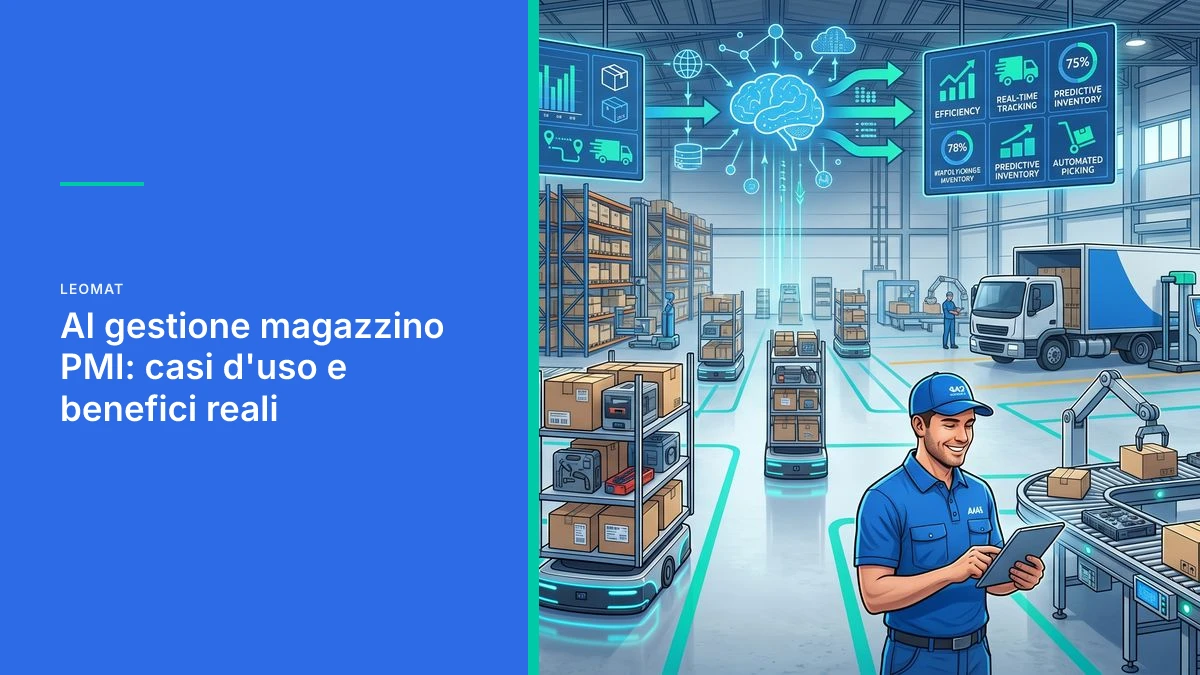
AI for Warehouse Management in SMEs: Real Use Cases and Benefits
How artificial intelligence is transforming warehouse management in Italian manufacturing SMEs: concrete use cases, measurable benefits, and how to get started without an in-house IT team.
AI for SME warehouse management: how artificial intelligence solves the hidden bottleneck
AI applied to warehouse management in manufacturing SMEs refers to a set of artificial intelligence technologies, such as machine learning and computer vision, that automate inventory control, demand forecasting and internal logistics. It can help small and medium-sized businesses reduce inventory errors, contain storage costs and improve delivery punctuality, without requiring a dedicated IT department.
The warehouse is often the point where manufacturing SMEs lose the most margin without realising it: excess stock ties up liquidity, while stockouts halt production and damage customer relationships.
Why the warehouse is the hidden bottleneck of manufacturing SMEs
The warehouse of a manufacturing SME is often managed with tools that are inadequate for the real complexity of its flows: Excel spreadsheets, outdated management systems and manual procedures that generate costly errors and slow down the entire production chain.
Many business owners only discover the problem when it is too late: a supplier delivers late, the stock of a critical component runs out mid-week and production comes to a standstill. The cost is not just the machine downtime, but also the waiting customer, the contractual penalty and the time wasted chasing emergency solutions. These events are not random: they are a symptom of inventory management that cannot keep pace with the variability of demand and suppliers.
How AI applied to warehouse management works: a simple explanation
AI for the warehouse analyses historical sales data, supplier lead times and external variables to automatically calculate when and how much to reorder, where to position products and how to optimise the internal routes of warehouse operators.
There is no need to understand how the algorithm works under the hood, just as there is no need to understand how a car engine works in order to drive one. What matters is the result: the system receives data from the management software, the point-of-sale system or warehouse scanners, processes it in real time and returns clear operational instructions. Integration is handled through the management system's APIs where they exist, otherwise through scheduled exports or, as a last resort, through interface automation.
The key advantage of AI over a simple traditional management software is its ability to learn from data over time. If demand for a certain product increases every September, the system learns this and begins to anticipate the reorder as early as August, without anyone having to remember it or manually set a rule. This kind of adaptive automation is what distinguishes artificial intelligence from a simple spreadsheet with fixed formulas.
5 concrete AI use cases in the warehouse for manufacturing SMEs
The most effective AI use cases in the warehouse for a manufacturing SME involve demand forecasting, automatic reordering, visual quality control, internal route optimisation and returns management.
Not all use cases have the same impact for every company: it depends on the size of the warehouse, the variety of item codes and the complexity of the supply chain. However, there are five applications that frequently emerge as a starting point.
- Demand forecasting: the system analyses historical sales, seasonality, current orders and market signals to predict how many units will be needed in the coming weeks. This reduces both stockouts and excess inventory.
- Automatic reordering with dynamic thresholds: instead of a fixed reorder point set once and forgotten, AI continuously updates thresholds based on demand variability and actual supplier lead times. The operator receives an alert or, in fully automatic mode, the order is sent directly to the supplier.
- Visual quality control with computer vision: cameras connected to AI systems analyse incoming or outgoing products to detect defects, labelling errors or discrepancies against the bill of materials. Particularly suited to companies with high volumes of goods movement.
- Picking route optimisation: AI calculates the most efficient route for operators collecting products in the warehouse, reducing picking times compared to a non-optimised layout.
- Intelligent returns management: the system automatically classifies returns by cause (defect, shipping error, commercial return) and directs each item to the correct process, reducing processing times and re-inventorying errors.
Which use case to choose first
The answer depends on the most costly problem the company faces today. If stockouts are frequent, demand forecasting is the starting point. If picking is slow and picking errors are high, route optimisation is the natural candidate. A good technology partner helps identify the use case with the highest short-term ROI, before gradually extending automation to other areas.
Real, measurable benefits: time, costs and margins
The benefits of AI in the warehouse for a manufacturing SME are measured in terms of reduced average stock levels, fewer inventory errors, savings in operational hours and improved service rates for customers.
The figures vary depending on the starting situation, and any number given before examining a company's data would be invented. SMEs starting from manual or semi-manual management generally see the most marked improvements, precisely because the margin for optimisation is wider. Those already using a structured management system may achieve more gradual benefits, particularly in forecasting accuracy.
- Reduction in average stock levels: with a direct release of liquidity.
- Reduction in inventory errors: compared to manual management, provided the master data is correct.
- Savings in operational hours: for warehouse staff, who can be redirected to higher-value activities.
- Improvement in service rate (fill rate): with a direct impact on customer satisfaction.
- Reduction in urgent transport costs: fewer stockouts mean fewer emergency express shipments, with savings that grow with supply chain complexity.
- Verifiable return: by starting from a small, measurable scope, the return is verified in the field before scaling up.
How to get started: a practical path for an SME without an internal IT team
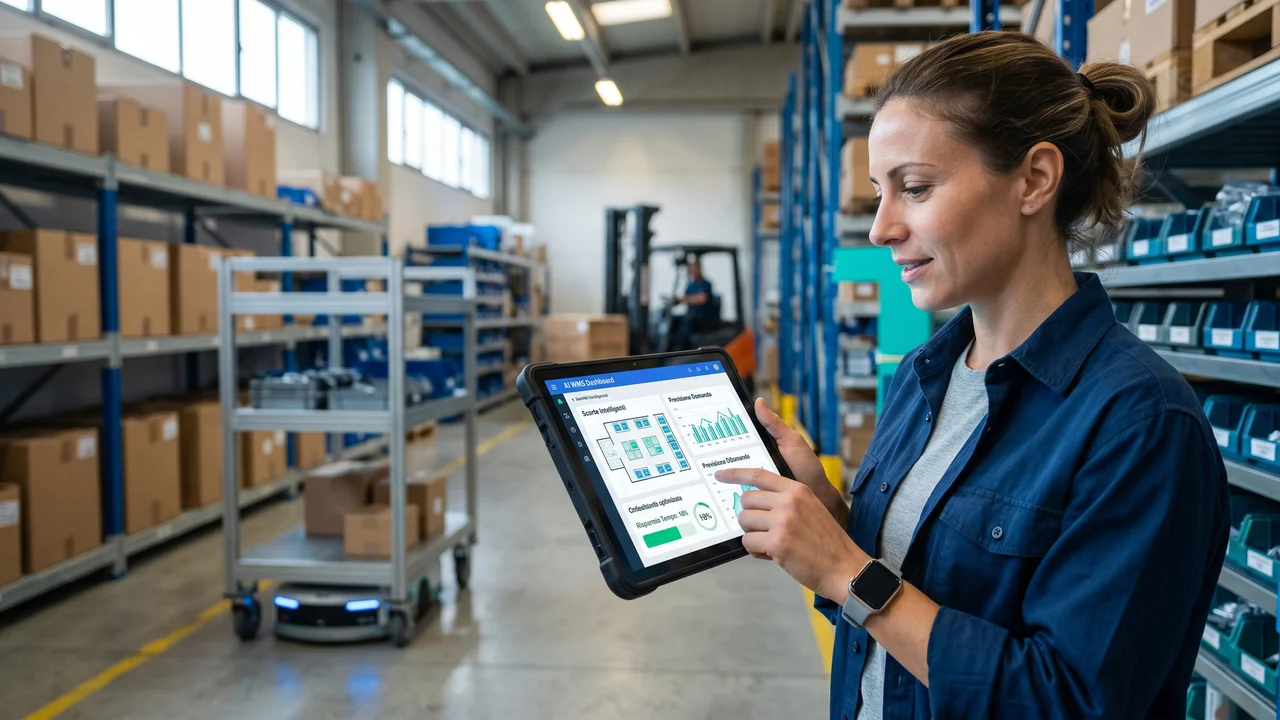
A manufacturing SME without an internal IT team can adopt AI for the warehouse by following a gradual three-phase path: analysis of existing data, selection of the priority use case and integration with systems already in use, with the support of a dedicated technology partner.
The most common concern among business owners is that an AI project requires months of consultancy, a large-company budget and an internal IT department. In reality, in most cases the solution integrates with existing systems without replacing them, and it is possible to start from a small, useful slice of the problem that goes live quickly and can be assessed in the field. The key is to start from the most urgent problem, not from the ambition to automate everything at once.
Phase 1 (Analysis): mapping available data
The first step is to understand what data the company already produces: sales history, warehouse movements, supplier orders, returns. Even an outdated management system or a set of well-maintained Excel spreadsheets contains valuable information. The initial analysis serves to identify the quality of available data and the use case with the greatest potential.
Phase 2 (Pilot): launching a small-scale project
Before automating the entire warehouse, it is worth launching a pilot project on a product category or a single process, such as automatic reordering for the top twenty item codes by turnover. This makes it possible to measure real results, train staff without disrupting routines and collect data to optimise the system before scaling it up.
Phase 3 (Scaling): extending automation gradually
Once the pilot results have been validated, extending to other processes and product categories generally happens more quickly, because the system has already learned the company's patterns and staff are familiar with the interface. At this stage, new modules can be added, such as computer vision for quality control or picking route optimisation, based on the priorities that have emerged from field experience.
Choosing the right partner: what to evaluate
For an Italian manufacturing SME, the ideal partner for an AI warehouse project must combine technical expertise, knowledge of the manufacturing sector and the ability to work without requiring an internal IT contact at the client company.
Not all AI software providers are suited to SMEs. Large software houses tend to propose standardised solutions that require lengthy customisation and high costs. Freelancers, on the other hand, may lack the structure needed to guarantee continuity and ongoing support. The right balance is a specialised partner with documented experience working with companies of a similar size and an approach focused on measurable results rather than technology for its own sake.
- Experience in the manufacturing sector: the partner must understand the typical processes of a manufacturing SME, not just AI technology in the abstract.
- Integration with existing systems: they must be able to connect to the management system already in use without requiring a full migration.
- Gradual and measurable approach: they propose a pilot project with clear KPIs before asking for a long-term commitment.
- Ongoing support: they guarantee assistance even after go-live, with updates to the AI model as the company's data grows.
- Transparency on costs: no surprises regarding hidden licence, maintenance or update costs.
Frequently asked questions about AI for warehouse management in SMEs
The questions below gather the most common doubts that manufacturing business owners raise when evaluating an AI warehouse project for the first time. The answers are designed for those without a technical background who want to understand what to expect in concrete terms.
How much does it cost to implement an AI warehouse system in an SME?
The cost depends on the complexity of the warehouse, the number of item codes and the level of integration required with existing systems. For a manufacturing SME, the cost of a pilot project depends on the number of systems to be connected and the state of the data: a serious estimate can only be made after examining the process. The return must be verified in the field, starting from a small, measurable scope.
Is my current management system compatible with an AI warehouse solution?
Often yes, but it depends on how the management system is built. If it exposes APIs, that route is used; otherwise scheduled exports are used, or as a last resort, interface automation, almost always without replacing the existing software. A good technical partner carries out a compatibility check in the initial phase of the project, before any financial commitment is made.
How long does it take to see the first concrete results?
With a pilot approach focused on a specific use case, the project starts from a small, useful slice that goes live quickly and can be assessed in the field; timelines depend on the data and systems involved. The benefits in terms of stock levels and service rate consolidate over time, as the AI system accumulates data and refines its forecasts based on the company's specific patterns.
Is AI for the warehouse suitable for a small business with few employees?
Yes, modern solutions are scalable and suited to small companies with compact warehouses. The important thing is to start from the most urgent problem, such as automatic reordering or demand forecasting, and to choose a partner who proposes a project proportionate to the size and real needs of the company.
Will AI replace my warehouse staff?
That is not the purpose: in well-designed projects, AI automates repetitive, low-value-added activities, such as stock counting, compiling reorder requests and planning picking routes. Warehouse staff are freed from these activities and can focus on tasks that require human judgement, such as managing exceptions, handling supplier relationships and quality control on complex products.
This post was created with AI
Content (text, processing, quotations and images) generated or artificially manipulated by artificial-intelligence systems. Notice provided under the transparency obligations of Article 50 of Regulation (EU) 2024/1689 (AI Act), applicable from 2 August 2026.