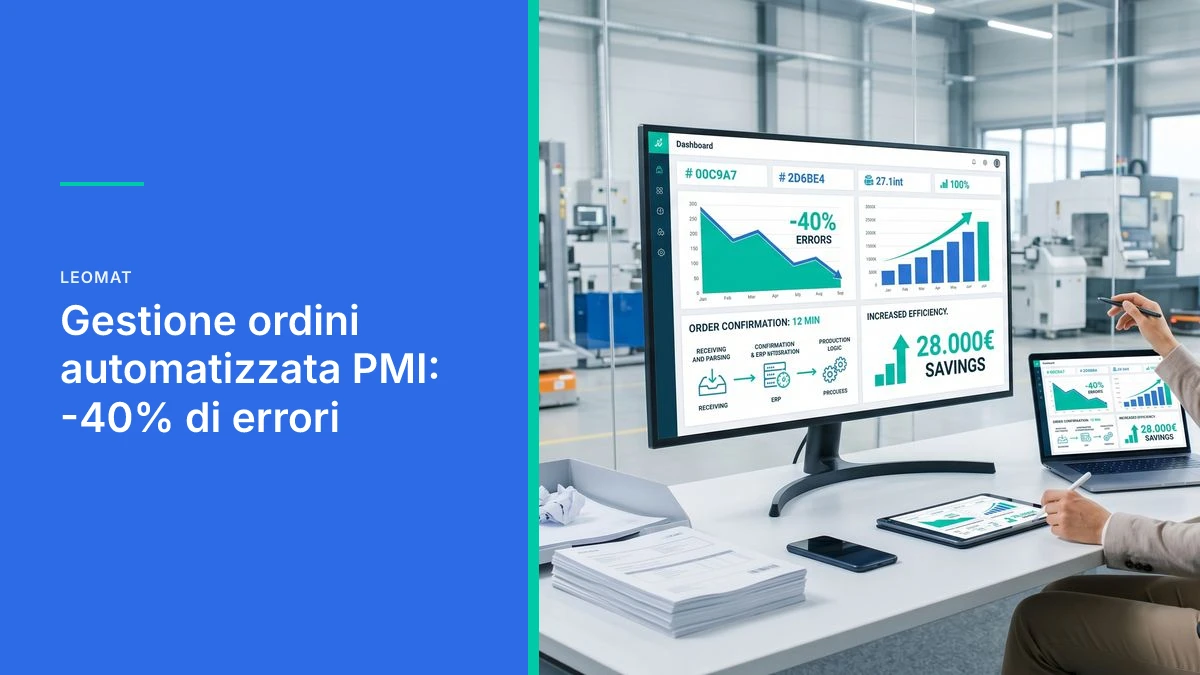
Automated Order Management for SMEs: Fewer Transcription Errors
How a manufacturing SME can reduce order management errors with pure-code AI automation: an illustrative scenario, key metrics to track, and a practical roadmap.
Automated order management for SMEs: how to reduce transcription errors
Automated order management for SMEs is an approach that replaces the manual steps of the order-production-shipping cycle with intelligent digital workflows, capable of receiving, validating, routing and tracking every order without repetitive human intervention. The expected result is a reduction in data entry errors, processing delays and hidden operational costs that erode the margins of small and medium-sized manufacturing companies.
In many manufacturing SMEs, order management is still largely manual: Excel spreadsheets, emails copied to multiple departments, confirmation phone calls and re-keying of data between disconnected systems. Every error has a direct cost (rework, corrective shipment, complaint handling) and an indirect one (customer trust, reputation, staff time).
The problem: order management errors and the hidden cost for manufacturing SMEs
Order management errors are not just an operational nuisance: for a manufacturing SME they represent a hidden cost that erodes margins, through rework, incorrect shipments and staff hours spent on corrections rather than production.
The problem almost always stems from the fragmentation of order intake channels. A medium-sized manufacturing company receives orders by email, web portal, phone, customer EDI and, in some cases, still by fax or attached PDF. Each channel has a different format, each format requires human interpretation, and each interpretation is a potential source of error. Manual re-keying into the ERP system is the most critical bottleneck: a wrong digit in the item code, a misread quantity, a delivery date entered in the wrong field. Small errors with large consequences.
The back office that re-keys orders by hand
When every customer sends their purchase order in their own format, the back office spends part of the day re-keying it into the management system, and data entry errors (wrong quantities or item codes) often only surface when production flags an inconsistency, triggering corrective work across production, warehousing and shipping.
The real cost of an order error
Calculating the cost of a single order management error requires adding up components that are often invisible in standard accounting. There are direct costs: material processed in excess or in deficit, urgent shipment to remedy the situation, a possible credit note to the customer. Then there are indirect costs: the time of the sales manager handling the complaint, the time of the production manager rescheduling, the time of the warehouse worker managing the return. And finally the reputational cost, which appears in no balance sheet but is measured in the contract renewal rate.
- Manual re-keying: every order entered by hand is an opportunity for errors on codes, quantities and dates.
- Channel fragmentation: email, portal, EDI, phone and PDF generate incompatible formats that multiply manual steps.
- Confirmation latency: without automation, the order confirmation to the customer waits until someone has manually entered and verified the order.
- Zero real-time visibility: without a digital workflow, the progress status of an order is known only to whoever is following it manually, making proactive customer communication impossible.
- Blocked scalability: increasing order volume means hiring administrative staff proportionally, if the process remains manual.
A typical scenario: how a manufacturing SME can reduce errors with AI automation
An AI automation system developed in pure code reads orders from the company's channels, validates them automatically, enters them into the management system and sends only those that fail the checks to a person: this is how a manufacturing SME eliminates the manual steps where order management errors originate.
The process is easier to understand by starting from a recurring situation: a company where the order cycle absorbs several back-office staff across receipt, verification and entry, with errors that recur on order lines.
The business owner without an IT manager
In SMEs without an IT manager, technology decisions are often made by the owner. It can happen that they have already evaluated no-code platforms for automating order management and rejected them: fragile integrations with the existing management system, insufficient customisation for the EDI formats of larger customers. The priority is a solution that actually works, not a demo that appears to work.
A project of this kind begins with a mapping phase, in which all received order formats are analysed (structured emails, PDFs, CSV files and EDI messages), along with the critical fields to validate and the company's specific business rules: internal item codes, quantity tolerances for customers with framework contracts, production priorities by customer. The system developed in pure code then integrates directly with the existing management system's APIs, without intermediate layers of third-party tools, which gives greater control over customisation.
How the implementation is typically structured
A project of this kind is usually structured in three operational phases. The first covers the automation of receipt and parsing of email and PDF orders only, with automatic validation of mandatory fields and alerts in case of anomalies: it is already at this stage that a reduction in data entry errors can be measured. The second extends automation to EDI integration and automatic order confirmation to the customer, with customised templates. The third introduces the logic of automatic order prioritisation in production, based on delivery dates, material availability and customer history.
How automated order management works in pure code
An automated order management system developed in pure code is a custom software application that integrates directly with existing company systems (management system, email, EDI, web portal) via native APIs, without depending on third-party automation platforms that introduce limitations, variable costs and points of failure.
The choice of pure code over no-code or low-code tools is not a matter of technical snobbery: it is a pragmatic decision with concrete consequences for stability, customisation and total cost of ownership over the medium term. A third-party visual automation tool may seem faster to configure in the first few weeks, but every update to the management system, every format change from a customer, every new business rule requires returning to the external platform, often with limitations imposed by the vendor. A system developed in pure code, on the other hand, is entirely under the control of the company and its technology partner.
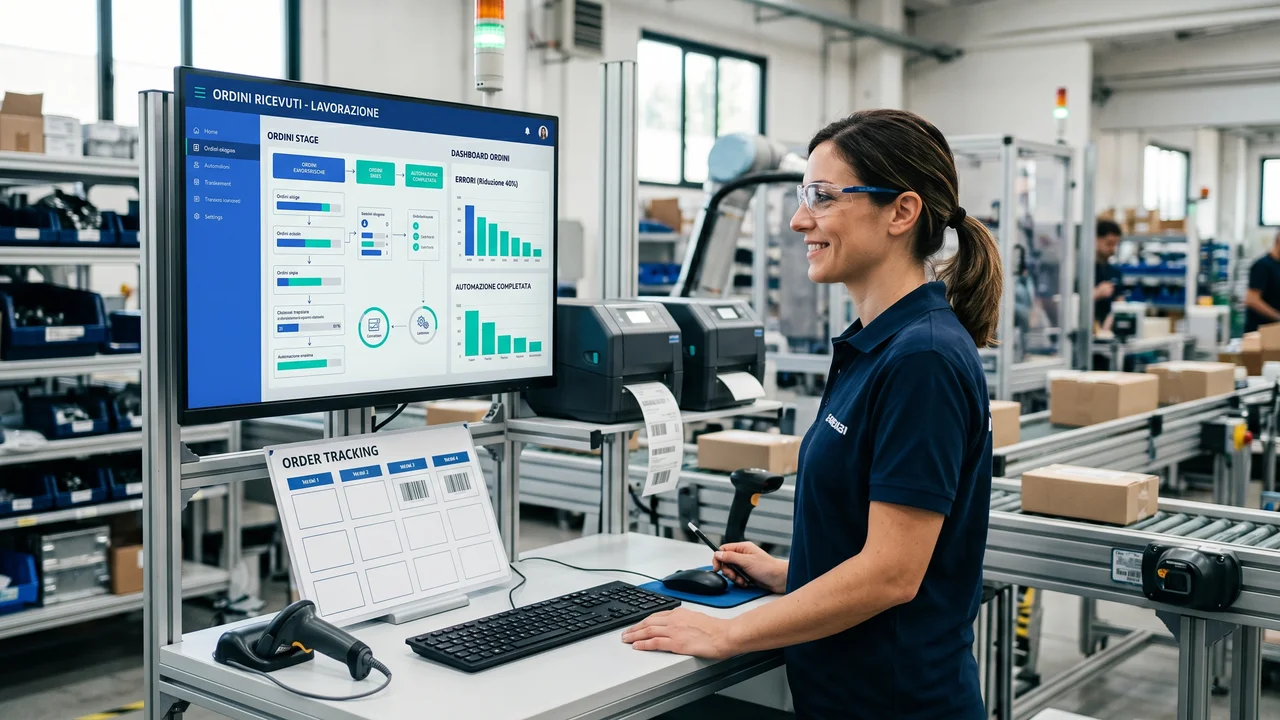
- Phase 1 (Acquisition): the system reads orders from all configured channels (email with NLP parser, web portal via REST API, EDI via native connector, PDF via intelligent OCR) and normalises them into a unified data format.
- Phase 2 (Validation): each order is automatically checked against the company's business rules: existing item codes, minimum and maximum quantities, active customers, feasible delivery dates relative to the production calendar.
- Phase 3 (ERP Integration): validated orders are automatically entered into the management system via direct APIs, with custom field mapping specific to the company.
- Phase 4 (Confirmation and tracking): the customer receives an automatic order confirmation as soon as the order passes the checks, with the internal order number and confirmed delivery date. The system updates the status in real time.
- Phase 5 (Alerts and escalation): exceptions (orders with missing data, customers with blocked credit, items not on the price list) are automatically flagged to the right person, with full context for a quick decision.
Measurable results: where to look to evaluate before and after
The benefits of automated order management are measured across four axes: error rate on order lines, average confirmation time to the customer, back-office hours dedicated to manual entry and the ability to absorb higher volumes without additional staff.
The honest way to evaluate a project like this is to establish the baseline before starting (how many erroneous order lines per month, how many hours of corrective work, how long between receipt and confirmation) and then remeasure the same indicators after several months. In projects of this kind, the reduction in errors and confirmation times can be significant, because the very manual steps where errors originate are eliminated; the point is to measure this against your own numbers, not to rely on industry-wide percentages.
The production manager, downstream of incorrect orders
There is also the perspective of the production manager, who in this scenario is not troubled by production itself but by the quality of the information arriving from the sales department: orders with wrong codes, quantities differing from those agreed, impossible delivery dates, and every morning a lengthy verification of the day's orders with the back office. When orders arrive already validated and complete, that verification is shortened and the department recovers time for production.
- Order error rate: this is the primary indicator, to be measured against your own baseline, line by line, before and after.
- Average order confirmation time: this shortens when validation is automatic, to be measured against your own baseline.
- Back-office hours dedicated to entry: these are freed up for sales and customer care activities.
- Scalability: order volume can grow without adding administrative staff proportionally.
Which processes to automate first: a practical roadmap for an SME
For a manufacturing SME starting from scratch with order automation, priority should go to the processes with the highest volume of repetitive transactions and the highest measured error rate: typically order receipt and entry, followed by automatic confirmation to the customer and integration with the production planning system.
The common temptation is to want to automate everything at once, but the most effective approach for an SME without an internal IT team is incremental: start with a single high-impact process, measure the results, consolidate and then expand. This approach reduces implementation risk, allows staff to adapt gradually and provides real data to justify subsequent investments to the board or shareholders.
A roadmap in three horizons
The first horizon covers the automation of order receipt and parsing from the main channels, with automatic validation and alerts on exceptions. This is the starting point that usually shows results earliest and builds confidence in the project. The second horizon extends automation to order confirmation, ERP integration and real-time status tracking. The third horizon introduces more sophisticated logic: automatic prioritisation in production, delivery time forecasting based on historical data, proactive alerts to the customer in the event of anticipated delays.
One element often underestimated in the roadmap is the quality of the starting data. Before automating, it is necessary to verify that the management system contains clean and up-to-date data: correct item codes, complete customer records, updated price lists. An automation system amplifies both the quality and the problems of the data it operates on. A data cleaning phase, even a brief one, in which the most obvious inconsistencies are resolved, is worth the time invested and prevents many false positives in the first weeks of operation.
How to choose the right technology partner
For an SME without an internal IT manager, choosing the technology partner is the most critical decision in the entire project. The criteria to evaluate concern not only technical competence, but also the ability to understand the specific processes of the manufacturing sector, the willingness to work iteratively and transparency about development methods. A partner who proposes solutions based on pure code and direct integration with existing systems offers greater scope for customisation, but must also be able to say when an off-the-shelf product is the right answer. It is useful to ask for specific references in manufacturing and, if possible, to speak directly with other business owners who have already implemented similar solutions.
Frequently asked questions about automated order management for SMEs
How long does it take to implement an automated order management system in a manufacturing SME?
Timelines depend on the complexity of the processes and the number of channels to integrate, and cannot be estimated before seeing the process and the systems involved: it is better to start with a small, useful scope that goes into production quickly and can be assessed in the field. The most critical phase is not the technical development, but the initial process mapping and data cleaning in the existing management system.
How much does it cost to automate order management for an Italian SME?
The cost varies depending on the complexity of the integration and the number of channels to manage. Two automations that look identical can cost very differently depending on the underlying systems, and maintenance costs must also be factored in. The return is calculated on time saved and errors avoided, starting from a small, measurable scope. For any applicable tax incentives, verification should be carried out with an accountant based on the measures currently in force.
Is it possible to automate order management without replacing the current management system?
Almost always yes. If the management system exposes APIs or connectors, integration is done there; otherwise, scheduled exports are used or, as a last resort, interface automation, without replacing the existing software. The automation system is positioned as an intermediate layer that reads orders from the intake channels and enters them into the management system via its native interfaces. The company continues to use the management system it knows, with the advantage that data arrives already validated and structured.
How is the success of an order automation project measured?
The main KPIs to monitor are: error rate on order lines (before and after), average order confirmation time to the customer, back-office hours dedicated to manual entry, number of complaints for incorrect orders and average cost of handling an exception. It is important to define these indicators and measure them rigorously in the weeks before implementation, in order to have a reliable baseline against which to compare results. Without a rigorous measurement of the starting point, it is difficult to demonstrate the value of the project internally.
Does automating order management require internal technical expertise within the company?
No, it is not necessary to have an IT manager or an internal technical team. The system, once developed and put into production, is designed to be managed by existing administrative staff through a simple interface. Day-to-day activities are limited to handling automatically flagged exceptions and monitoring KPIs via a dashboard. More substantial changes (new channels, new business rules, management system updates) are handled by the technology partner who developed the system.
Content (text, processing, quotations and images) generated or artificially manipulated by artificial-intelligence systems. Notice provided under the transparency obligations of Article 50 of Regulation (EU) 2024/1689 (AI Act), applicable from 2 August 2026.