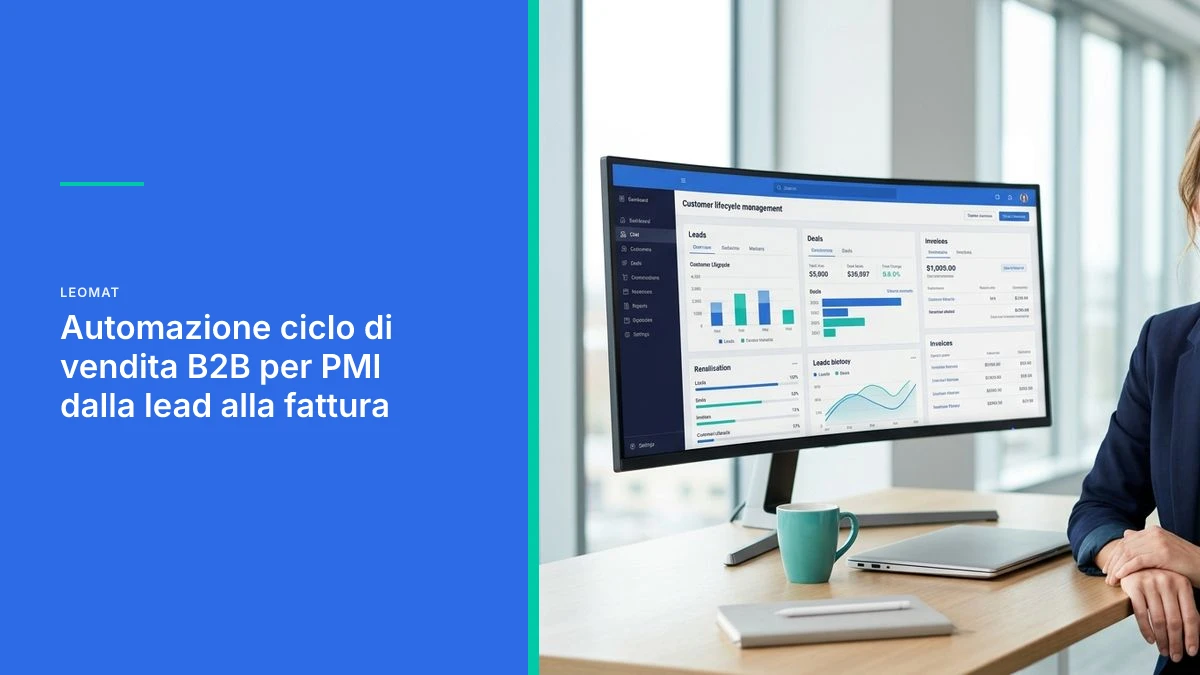
B2B Sales Cycle Automation for SMEs from Lead to Invoice
Discover how small and medium businesses can automate every stage of the B2B cycle, from lead qualification to invoicing, reducing repetitive manual work.
B2B Sales Cycle Automation for SMEs: From Lead to Invoice Without Bottlenecks
Automating the B2B sales cycle for SMEs means eliminating the repetitive manual tasks that slow down every stage of the commercial process: from the initial lead qualification, through the quote and contract, all the way to order confirmation and invoicing. Thanks to intelligent workflows and an automated CRM, a small or medium-sized business can reduce closing times and errors while freeing the sales team to focus on high-value activities.
The B2B sales cycle has historically been one of the most fragmented processes in Italian SMEs: scattered emails, Excel spreadsheets, forgotten follow-up calls and quotes rewritten by hand every time. Automating repetitive steps gives salespeople back the time that currently goes into administrative tasks. In a market where response times to customers make the difference between winning or losing a deal, automation is no longer an option reserved for large enterprises.
The Hidden Bottleneck Holding Back SME Growth in B2B
Often the brake on commercial growth for a B2B SME is not a lack of leads, but the time wasted manually managing every step between an opportunity and a paid invoice.
Think about a typical day at a small manufacturing company. The salesperson receives a request by email, copies it into an Excel spreadsheet, calls the potential customer to understand their needs, prepares a quote in Word, sends it, waits, calls again, rewrites the quote with the requested changes, and waits again. When the yes finally arrives, they have to create the order in the management system, send the confirmation, coordinate with production, and then, once delivery is complete, generate the invoice. Every step is manual, and every step is a source of error and delay.
In a small company with a single salesperson, it can happen that part of their time goes into sales-related administrative tasks, including data entry, follow-up emails and standard quotes rewritten by hand. These are hours taken away from client relationships and the search for new opportunities.
Why Traditional Systems Are No Longer Enough
Many SMEs still use a management system purchased years ago, perhaps alongside a basic CRM or simple shared spreadsheets. The problem is not the tool itself, but the lack of connection between the various pieces. The CRM does not talk to the management system, the management system does not automatically generate the invoice, and follow-up emails are written by hand every time. The result is a sales cycle that depends entirely on people's memory and availability, not on a structured process.
The Real Cost of a Manual Sales Cycle
Calculating the cost of a manual sales cycle is simpler than it seems. You just need to multiply the total employment cost of a salesperson by the share of their time spent on repetitive administrative tasks: that is what you are paying for operations that an automated workflow could largely handle. Multiplied across two or three salespeople, the figure becomes significant, especially for an SME operating on tight margins.
The Five Stages of the B2B Cycle That Can Be Automated Today
A complete B2B sales cycle consists of five distinct stages, each of which can be automated with tailored workflows: lead qualification, quote submission, contract management, order confirmation and invoicing.
Not all stages carry the same weight in terms of wasted time, but all of them contribute to the overall slowdown of the process. The most effective approach is not to automate everything at once, but to identify the most costly bottlenecks and start there, building a system that grows with the business.
- Stage 1 (Lead Qualification): automatic collection of requests from all channels (website, email, trade shows), scoring based on predefined criteria and assignment to the right salesperson without manual intervention.
- Stage 2 (Quote and Proposal): automatic generation of the commercial document from CRM data, with updated pricing and templates personalised by customer segment.
- Stage 3 (Contract and Signature): automatic dispatch of the standard contract with integrated digital signature, archiving of the signed document and status update in the CRM.
- Stage 4 (Order Confirmation): automatic creation of the order in the management system upon receipt of the signature, notification to production or the warehouse, confirmation email to the customer.
- Stage 5 (Invoicing): automatic generation and dispatch of the electronic invoice upon completion of delivery or when the contractual deadline is reached, with reconciliation in the accounting systems.
Automated CRM for SMEs: Qualifying Leads Without Picking Up the Phone Every Time
An automated CRM for an Italian SME does not mean purchasing an expensive and complex enterprise platform, but building a system that captures every lead, qualifies it based on real criteria and assigns it to the right salesperson at the right moment, without anyone having to do it by hand.
Consider a company that receives requests from different channels (website, general email, LinkedIn and phone) and handles them in an unstructured way: some requests get lost, others receive a reply days later. A pure-code workflow that centralises all sources into a single system, automatically assigns priority based on potential volume and sends a personalised first response shortens the time to first contact, because no request sits idle in an inbox that nobody monitors.
The key point is automatic qualification: not all leads deserve the same amount of a salesperson's time. A well-configured system can distinguish, from the very first request, between a high-value potential customer and a generic enquiry, directing the team's energy where it truly matters. This does not eliminate human contact, but makes it more targeted and effective.
When lead qualification is automated, salespeople's time returns to direct selling activities instead of manually sorting through contacts.
Quote, Order and Contract: Reducing Closing Times With Pure-Code Workflows
The phase between sending a quote and signing the contract is often the slowest in the B2B cycle for SMEs: automating it with workflows developed in pure code means eliminating the manual steps that unnecessarily extend closing times.
The classic problem is this: the salesperson prepares a quote, sends it, and waits. A few days later they follow up. The customer requests a change. The salesperson rewrites the document and sends it again. This cycle can repeat three or four times, with each iteration adding days to the process. An automated workflow can handle follow-ups independently, send personalised reminders at the right moment and generate updated versions of the quote from parameters already entered in the system, without the salesperson having to rewrite anything from scratch.
The choice to develop these workflows in pure code, without depending on third-party no-code platforms, allows a level of customisation that generic tools can rarely offer. Every business rule, every exception, every pricing logic specific to the company can be translated into a precise automated process, free from the constraints imposed by standardised visual interfaces.
The Quote as a Strategic Tool, Not an Administrative Chore
When quote generation becomes automatic, the salesperson can focus on the strategic content of the proposal: personalising the message, choosing the right moment to send it, preparing for the negotiation. The document stops being a task to get through and becomes a competitive positioning tool.

From Order Confirmation to Automatic Invoice With Fewer Manual Errors
Closing the B2B cycle automatically from order confirmation to electronic invoice means reducing transcription errors, keeping payment deadlines under control and freeing the accounting team from hours of repetitive work every month.
This is the part of the cycle most often overlooked in the early stages of automation, yet it is the one with the greatest direct impact on company cash flow. A confirmed order that takes three days to become an invoice represents a delay in payments, a risk of oversight and a potential error in the amount or billing details. Multiplied across dozens or hundreds of orders per month, the problem becomes structural.
An integrated system that connects the CRM to the management system and the electronic invoicing module can generate the invoice at the exact moment the predefined conditions are met: confirmed delivery, passed inspection, contractual deadline reached. The invoice is sent to the SDI, archived in the accounting system and recorded as an expected payment, all without anyone needing to intervene manually. The rules on when to issue the invoice (immediate or deferred), on its legally compliant archiving and on the checks to perform before sending should, however, be defined together with the company's accountant.
- Receipt of confirmed order: the system detects the digital signature or approval in the CRM and automatically creates the order in the management system.
- Operational notification: production, the warehouse or the service delivery team automatically receive a notification with the order details.
- Progress tracking: the workflow monitors the progress status and updates the CRM in real time, visible to the salesperson as well.
- Invoicing trigger: when the predefined condition occurs (delivery, end of month, contractual milestone), the system generates the electronic invoice.
- Dispatch and archiving: the invoice is sent to the SDI and to the customer, archived in the document management system and recorded in the accounts.
From 8 Hours to 5 Clicks in Quote Preparation With ERP Costruzioni
The ERP Costruzioni case concretely demonstrates how much time can be recovered by automating the quoting phase in a complex B2B sector such as construction, where every proposal requires detailed calculations and data from multiple sources.
In the ERP Costruzioni case, preparing a quote went from 8 hours to 5 clicks, in 30 days. A quote of this kind typically requires data collection, calculations and document formatting: it is exactly the kind of repetitive work that a tailored system can take on.
A tailored system reflects the way the company works: cost items, margin logic, proposal templates. That is the difference between adapting to a tool and having a tool that adapts to you.
What Made This Result Possible
The leap from 8 hours to 5 clicks did not happen by magic. The method is always the same: understand the process, the data and the real objectives before writing a single line of code, then start with a small, useful slice that goes into production quickly and can be judged in the field. Every company has its own specifics, but the method is replicable.
How Leomat Helps Your SME Automate the B2B Sales Cycle
Leomat supports Italian SMEs in designing and building automated B2B sales workflows, developed in pure code and tailored to the specific needs of each company, without depending on third-party platforms.
The process always starts with a concrete analysis of the existing commercial cycle: where the most hours are lost, where the most errors occur, which steps still depend on manual emails or Excel spreadsheets. Starting from this mapping, the Leomat team designs an integrated system that connects CRM, quote management, order confirmation and invoicing in a single automated flow, built precisely around the way the company works.
Among the available services is the development of custom ERP systems, designed for SMEs that need a management system reflecting their actual processes, not the other way around. The method is to start with a small, useful slice of the problem, one that goes into production quickly and can be evaluated in the field.
If you want to understand where to start in automating your B2B sales cycle, you can explore Leomat's approach directly at leomat.it.
Who This Service Is For
The service is designed for SMEs that manage a B2B sales cycle with multiple manual steps, that want to grow without hiring proportionally and that are looking for a technical partner capable of translating operational needs into working solutions, without over-engineering their processes.
Frequently Asked Questions About B2B Sales Cycle Automation for SMEs
How long does it take to automate the B2B sales cycle in an SME?
Timelines depend on the complexity of the process and the number of systems to integrate, so any figure given before seeing them would be invented. The method is to start with a small, useful slice of the cycle, one that goes into production quickly and can be judged in the field, and then extend from there.
Is it necessary to replace the existing management system or CRM?
Not necessarily. A system developed in pure code can integrate with the software already in use at the company, whether management systems, CRMs or electronic invoicing platforms. The assessment always starts with an analysis of the existing tools: the goal is to connect what already works, not to replace it by default.
What does a pure-code workflow mean compared to no-code solutions?
A pure-code workflow is developed from scratch by a technical team, without depending on third-party platforms with predefined logic and structural limitations. This means greater flexibility and the ability to respect every business rule specific to the company. Instead of licences for an external tool, the remaining costs are those of infrastructure and maintenance.
How is the return on investment of a B2B cycle automation measured?
The most direct metrics are time saved per quote or order processed, reduction in transcription errors, average deal closing time and the number of leads lost due to missed follow-up. Before starting a project, it is useful to measure these indicators in the current situation in order to have a real comparison after implementation.
Is B2B sales cycle automation suitable for SMEs with only a few salespeople?
Yes. In an SME with one or two salespeople, every hour recovered from administrative tasks can return to client relationships and the search for new opportunities. The system works even when the salesperson is busy in a negotiation or away on a business trip.
This post was created with AI
Content (text, processing, quotations and images) generated or artificially manipulated by artificial-intelligence systems. Notice provided under the transparency obligations of Article 50 of Regulation (EU) 2024/1689 (AI Act), applicable from 2 August 2026.