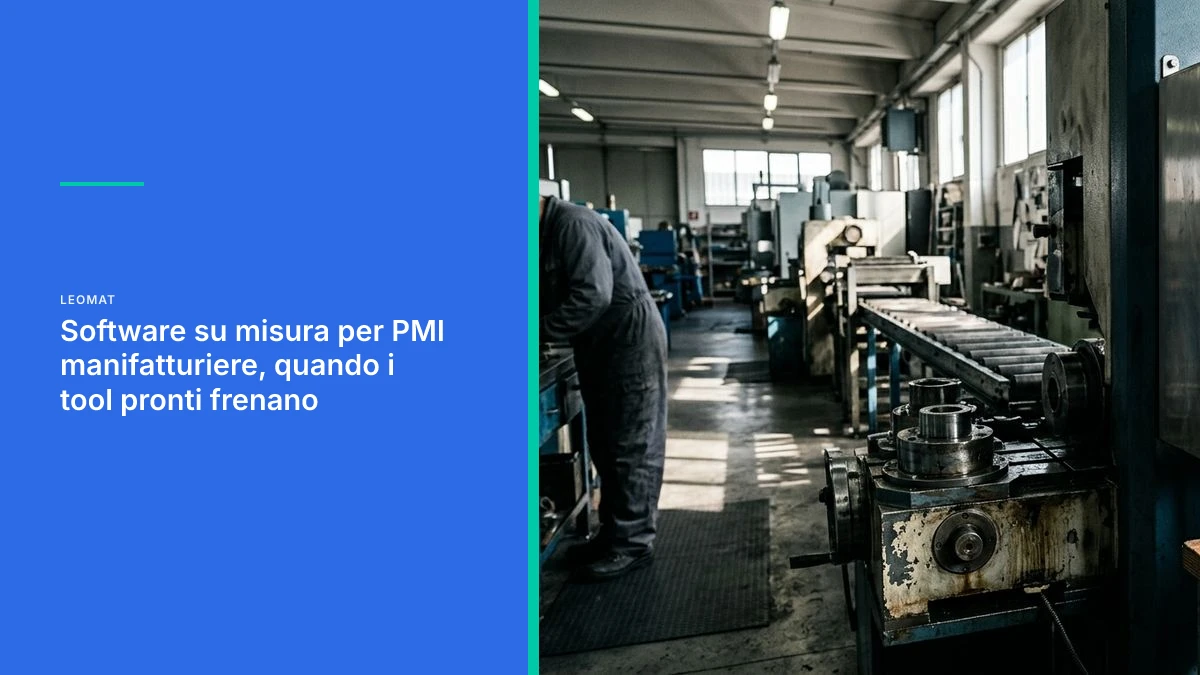
Custom software for manufacturing SMEs, when off-the-shelf tools hold you back
Standard management tools help as long as production stays simple. When it grows, they become a bottleneck: here is how to recognize the signs and what to do.
Custom Software for Manufacturing SMEs: When Off-the-Shelf Tools Hold Back Production
Custom software for manufacturing SMEs is a system built around a company's real processes, not the other way around. Unlike ready-to-use management tools, which impose standardised workflows, custom AI automation adapts to your warehouse, bills of materials, orders and specific departments, reducing the manual steps that generic software leaves uncovered and that, as production grows, become a genuine operational bottleneck.
Many management platforms are designed for a broad, generic market, so they handle common functions well (invoicing, master data, basic inventory) but leave specific production department processes uncovered: production planning, product variant management, quality control recording. The result is an ecosystem of Excel sheets, internal messaging and verbal handoffs that compensate for what the software does not do, and that nobody has ever properly mapped.
The Problem: When Standard Tools Become a Constraint
A standard tool becomes a constraint when the company has to bend its own processes to fit the software, rather than the software fitting the processes.
This almost always happens silently. At first the management system works, covers the basic needs and seems sufficient. Then a new product arrives with a complex bill of materials, or a customer requests lot traceability, or a department doubles its volumes, and the software shows its limits. It does not break, it simply is no longer enough, and those who use it start building manual workarounds that nobody designed.
3 Signs That Off-the-Shelf Software Is Holding Back Production
The three clearest signs are data duplicated across multiple files, waiting times between departments and reports that require manual effort every time.
- Production data is entered twice, once in the management system and once in a parallel spreadsheet that covers what is missing.
- One department waits for information from another because the system does not automatically communicate progress statuses.
- Every production or margin report requires someone to extract data manually and reassemble it.
- Exceptions (non-standard variants, customer urgencies) are always handled outside the system, never inside it.
Why Manufacturing SMEs Stay Locked Into Generic Tools
SMEs stay locked in because they do not have an internal IT team that can customise the software, and off-the-shelf tools offer only superficial configuration options.
Those who manage a manufacturing SME often know their production process very well, but lack the technical skills to intervene on the software that manages it. The management system vendor typically offers configuration parameters: changing the flow logic, when possible at all, requires dedicated development. So the company adapts to the tool rather than the other way around, accumulating inefficiencies that remain invisible until someone measures them.
A management system that does not speak the language of your production is not a technical limitation: it is a hidden cost you pay every day in hours of manual work.
The Difference Between Custom Software and Ready-to-Use Solutions
Custom software starts from the company's existing process, while a ready-to-use solution starts from a standard process that the company must adopt.
This difference changes everything downstream. A custom ERP can model batch scheduling logic, job-order tracking and sector-specific quality control rules. A ready-to-use solution, however configurable, remains tied to a structure designed for the generic case. This does not mean standard tools are wrong: for an SME in its early stages with still-simple processes, they are often the right choice. The breaking point comes when operational complexity exceeds what the tool can absorb.
Those Who Have "Tried Everything"
This happens to those who have changed management systems multiple times without solving the problem: the basic function is there, but the piece they really need (tracking production by job order, not by generic product) is always missing.
The Production Manager Without IT Support
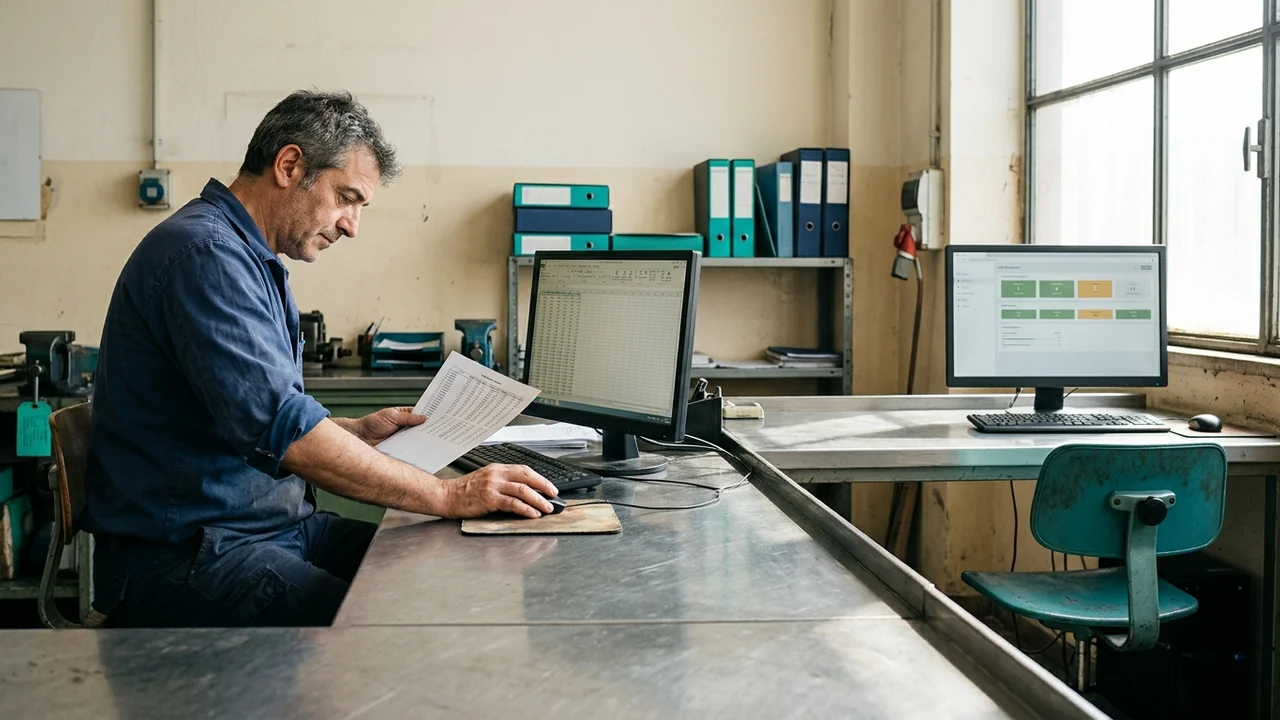
Another common pattern: the person responsible for production copies data from the management system into a spreadsheet every week to calculate line efficiency, because the software does not do it.
How Leomat Builds Custom AI Automation for Production
Leomat designs automation starting from the mapping of the company's real process, not from a predefined template.
Before writing a single line of code, the actual flow in the factory is analysed: where bottlenecks arise, what data is needed by whom and at what moment. From there, a custom ERP is built around the company, integrating the relevant departments without forcing the company into a standard structure. This is a different approach from those who work with pre-packaged products: the application and the environment in which it lives are built from scratch, with continuous monitoring and correction after launch.
A Transformation Example: From Manual to Automated Workflow
A concrete Leomat case involves a construction company that, before the intervention, took 8 hours to prepare a quote. After the custom automation, the same quote is generated in 5 clicks, in a project completed in 30 days. This is a concrete example of how a manual process can become an automated workflow when the software is built around the company's actual way of working, not imposed from outside.
Where to Start: First Steps Toward Custom Automation
The first step is to map the current process, identifying where the existing tool leaves manual tasks uncovered.
There is no need to throw away everything that already works. The key is to understand precisely where the current software stops and where manual workarounds begin. From there, you can decide whether a targeted integration is enough or whether it makes sense to rethink the entire flow with a custom system.
- List the recurring manual steps (parallel spreadsheets, copy-pasting between systems, verbal communications between departments).
- Estimate how much time, every week, is absorbed by these steps.
- Check whether the current management system has APIs or integration options, or whether it is a closed box.
- Compare the cost of custom automation with the often invisible cost of continuing to work this way.
The right question is not "how much does automation cost," but "how much does it cost to keep doing this manually every week."
To better understand the costs that often stay off the balance sheet, it may be useful to read about the invisible costs that erode manufacturing SME margins. Those wondering whether their current management system is still adequate can explore when to change management software by integrating it with AI.
How Leomat Can Help You Overcome the Limits of Off-the-Shelf Tools
Leomat builds custom ERPs and AI automation for manufacturing SMEs, starting from the company's real process rather than a standard template.
Leomat was created to bring frontier technology to businesses. The custom ERP offering is also designed for SMEs without an internal IT team that want smoother processes, without over-engineering anything. It is not about replacing everything that already works, but about intervening where the standard tool leaves an important part of production uncovered, with a partner who follows the project over time. Those who want to start with a contained project can also read how custom AI automation is structured starting from 500 euros. For a concrete assessment of your own situation, you can discover how Leomat works with Italian SMEs.
Frequently Asked Questions About Custom Software for Manufacturing SMEs
Does Custom Software Always Cost More Than an Off-the-Shelf Management System?
Not necessarily in a proportional way. The initial cost may be higher, but it should be weighed against the time spent every week on manual work and the errors that improvised workarounds generate over time. A well-scoped custom project makes sense when the time saved and errors avoided consistently outweigh the cost of building and maintaining it.
Do You Need an Internal IT Team to Manage a Custom ERP?
No, it is designed precisely for those who do not have one. A partner like Leomat builds the system and handles monitoring and maintenance after launch, without requiring internal technical expertise.
How Long Does It Take to Move From a Standard Tool to a Custom System?
It depends on the complexity of the process to be automated, and timelines can only be estimated after seeing it firsthand. The approach is to start with a small, useful slice that goes into production quickly, while broader transformations across multiple departments require phased planning.
Is It Always Necessary to Replace the Existing Management System?
It is almost never necessary to replace it entirely. It is often better to integrate the existing management system with targeted automation for the uncovered processes, keeping what already works well and intervening only where bottlenecks arise.
How Do You Recognise When It Is Time to Act?
When manual steps become established routine rather than the exception: parallel spreadsheets, informal communications between departments, reports built by hand every time. If these signs have been repeating for months, it is time to map the process and evaluate a custom intervention.
This post was created with AI.
Content (text, processing, quotations and images) generated or artificially manipulated by artificial-intelligence systems. Notice provided under the transparency obligations of Article 50 of Regulation (EU) 2024/1689 (AI Act), applicable from 2 August 2026.