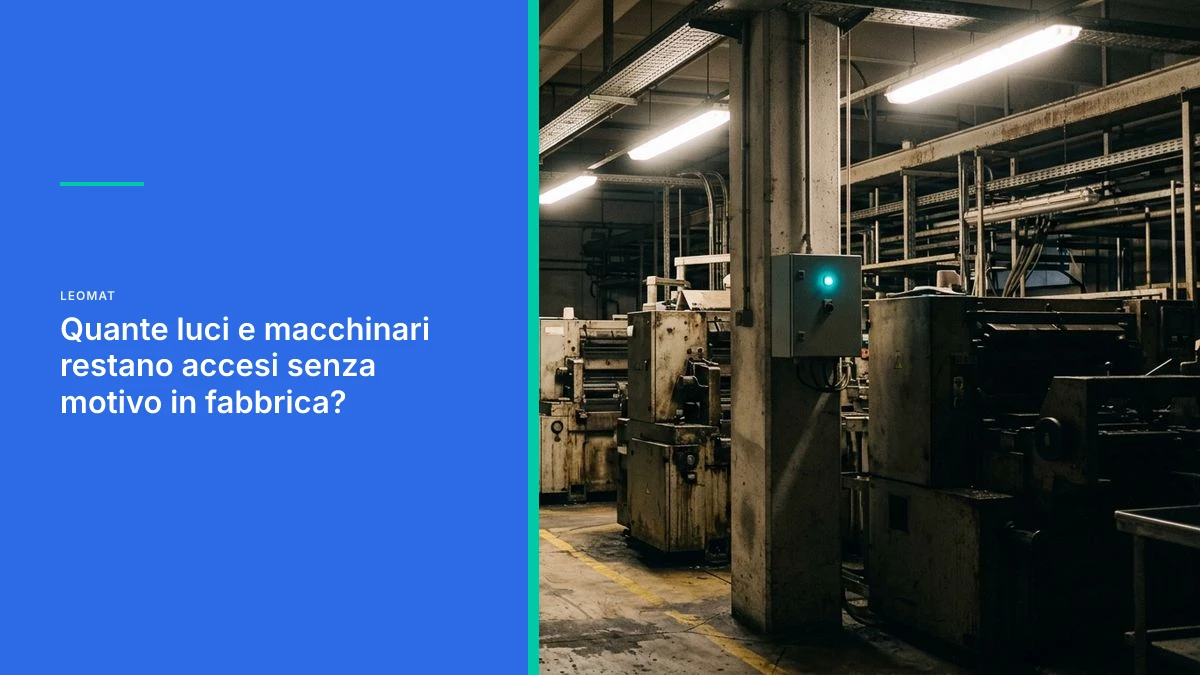
How Many Lights and Machines Stay On for No Reason in the Factory?
Lights and machinery left running during production downtime are a silent waste. Find out why it happens and how pure code automation eliminates it.
Machinery and lights left on in the factory for no reason: the cost nobody monitors
Machinery and lights left on in the factory for no reason point to a plant with no centralised control over energy consumption: departments that stay lit outside shift hours, lines on standby that keep drawing current, compressors running when nobody is using them. It is an invisible form of energy waste because it does not appear as a single line item on the bill, yet it accumulates month after month in the plant's fixed costs.
The mechanism is easy to understand once you look at it closely. A production facility has dozens of consumption points, including lighting, machinery and auxiliary systems, that are switched on manually at the start of a shift and turned off, when things go well, at the end of the day. Nobody automatically records when a machine stays operational with no active production: control relies on people's memory, and people's memory, under the pressure of deadlines and shift changes, fails. Without a system that reads the status of every line in real time, the waste remains invisible until the bill arrives at the end of the month.
What this silent waste actually costs in a manufacturing plant
The real cost depends on how many machines remain active outside production shifts and for how many hours a day, multiplied by the number of working days in the year.
There is no standard figure that applies to every factory, because the composition of the machinery fleet varies from sector to sector. What matters is the reasoning: a machine that draws energy even on standby, multiplied by the hours when nobody is using it, multiplied by the working days of the year, generates a cost item that silently adds itself to the cost of actual production. The same applies to the lighting in secondary departments, warehouses and transit areas, which is often left on out of habit rather than necessity.
A machine left on for no reason produces nothing, yet consumes exactly as if it were working: it is a fixed cost that nobody decided to incur.
- Lighting in departments not in use during the night shift
- Compressors and auxiliary lines left running during breaks
- Machinery on standby between one production order and the next
- Offices and common areas with systems left on outside working hours
Why it happens: shifts, departments and the lack of centralised control
It happens because switching off depends on different people across different shifts, with no single system that verifies the actual state of the plant.
In a manufacturing SME with multiple shifts and multiple departments, responsibility for switching off is distributed and fragmented. The person who closes the evening shift does not always overlap with the person who opened the morning one, and verbal procedures are easily lost in the daily routine. Without a dashboard showing in real time which machines are on and why, every check requires a physical walk through the plant, something that is hard to do consistently every day.
Those who manage multiple shifts without a single person responsible per department
In these cases responsibility for switching off changes several times a day, and every handover is an opportunity to leave something on unnecessarily.
Those who have a plant spread across multiple buildings or floors
The physical distance between areas makes continuous visual monitoring impossible: what you cannot see, you rarely switch off.
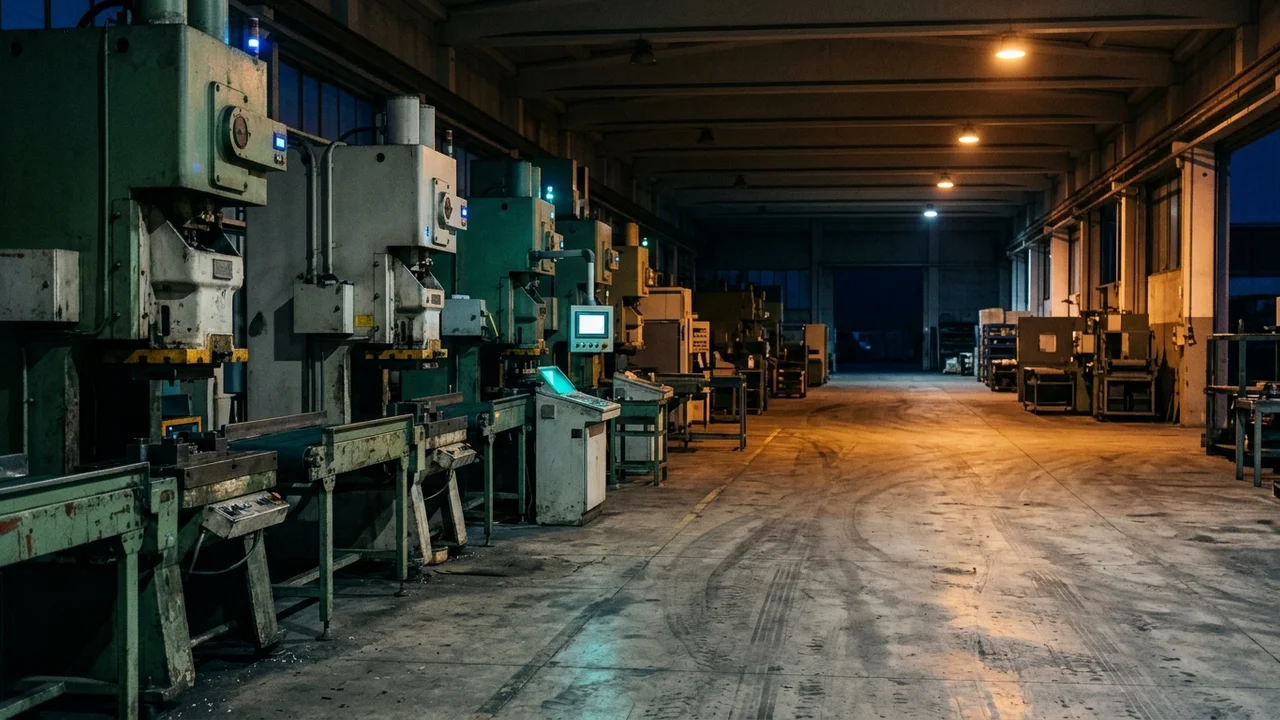
The solution: custom automation in pure code to monitor and switch off automatically
Automation in pure code connects sensors and machinery to a logic that detects inactivity and manages shutdown without manual intervention.
Leomat builds this type of automation starting from the real needs of the plant, without relying on generic no-code tools that cannot handle the complexity of a production facility. A pure-code system reads consumption and activity data, recognises when a machine has been idle for too long, and applies the shutdown logic agreed with the company: automatic, scheduled by time slot, or with a notification sent to the department manager. The difference compared to a ready-made tool is that every rule is written specifically for the actual machines and real shifts of that plant, not forced into a standard template.
Those who want to start with a single pilot department before rolling out the system
This is a prudent choice: results are observed in a contained area, the system's behaviour is verified, and only then is it extended to other departments.
Those who already have sensors installed but no automation logic connected to them
In this case the work starts with integration: the data already exists, what is missing are the rules that turn it into concrete actions such as automatic shutdown.
A concrete case: measurable results with AI automation
There is no specific verified case study on energy waste, but Leomat's approach to process automation has already produced measurable results in other industrial contexts.
In the construction sector, for example, custom automation by Leomat made it possible to go from eight hours to five clicks for drafting a quote, in just thirty days of work. The same principle applies to energy monitoring: identify a manual, repetitive process that causes waste, and replace it with an automatic logic written specifically for that company.
The strength of pure-code automation is not the technology itself, but the precision with which it is applied to the real process of the company using it.
How to get started even without an internal IT team
You start with an analysis of actual consumption and shifts, with no need for technical expertise inside the plant.
Many SMEs give up on this type of project thinking they need a structured IT department. That is not the case: the work of analysing, mapping machinery and defining shutdown rules can be guided by an external partner who handles the technical side, leaving the company only the operational decisions about how and when to intervene. To understand how this kind of collaboration works even without dedicated technical staff, it may be useful to read how process automation works in an SME without an internal IT manager.
- Mapping of machinery and areas with the highest consumption outside shift hours
- Installation or integration of sensors at critical points, as described in this in-depth article on IoT sensors in a factory even without an internal IT department
- Definition of custom automatic shutdown rules
- Testing in a pilot department and monitoring of results
- Progressive rollout to the other departments of the plant
Those who are also wondering which other hidden costs are weighing on their margins can explore further with the five invisible costs that erode the margins of a manufacturing SME.
How Leomat turns this waste into a controlled process
Leomat works on operational simplicity and concreteness: it does not propose oversized solutions, but custom automations designed for the individual plant. The pure-code approach, without generic no-code tools, makes it possible to write monitoring and shutdown rules that genuinely respect the real shifts and machinery of the company, not a standard template forced into place. Those who want a broader custom system that also includes consumption management as part of a single management platform can consider building a custom ERP designed for their own company, one of the verified services offered by Leomat.
Frequently asked questions about energy waste and factory automation
How long does it take to see the first results from a consumption monitoring system?
It depends on the complexity of the plant, but a pilot department usually allows the first useful data to be observed within a few weeks of installing the sensors and activating the first automatic shutdown rules.
Do all machines need to be replaced to activate automation?
No, in most cases the work is carried out on existing machinery, integrating sensors and control logic without having to replace the production equipment already in place.
Is it possible to start with just one department before extending the project?
Yes, and it is often the most prudent choice: automation is tested in a contained area, real results are verified, and only then is a decision made about whether to extend the system to the other departments of the plant.
Who handles the technical side if the company has no IT department?
The external technology partner takes care of it, managing the mapping, sensor integration and writing of automation rules, leaving the company only the operational decisions about how the system works.
What is the difference between a no-code tool and pure-code automation?
A no-code tool applies predefined logic that is forcibly adapted to the specific case, whereas pure-code automation is written specifically for the actual machines and real shifts of the plant, with greater precision and flexibility over time.
This post was created with AI.
Content (text, processing, quotations and images) generated or artificially manipulated by artificial-intelligence systems. Notice provided under the transparency obligations of Article 50 of Regulation (EU) 2024/1689 (AI Act), applicable from 2 August 2026.