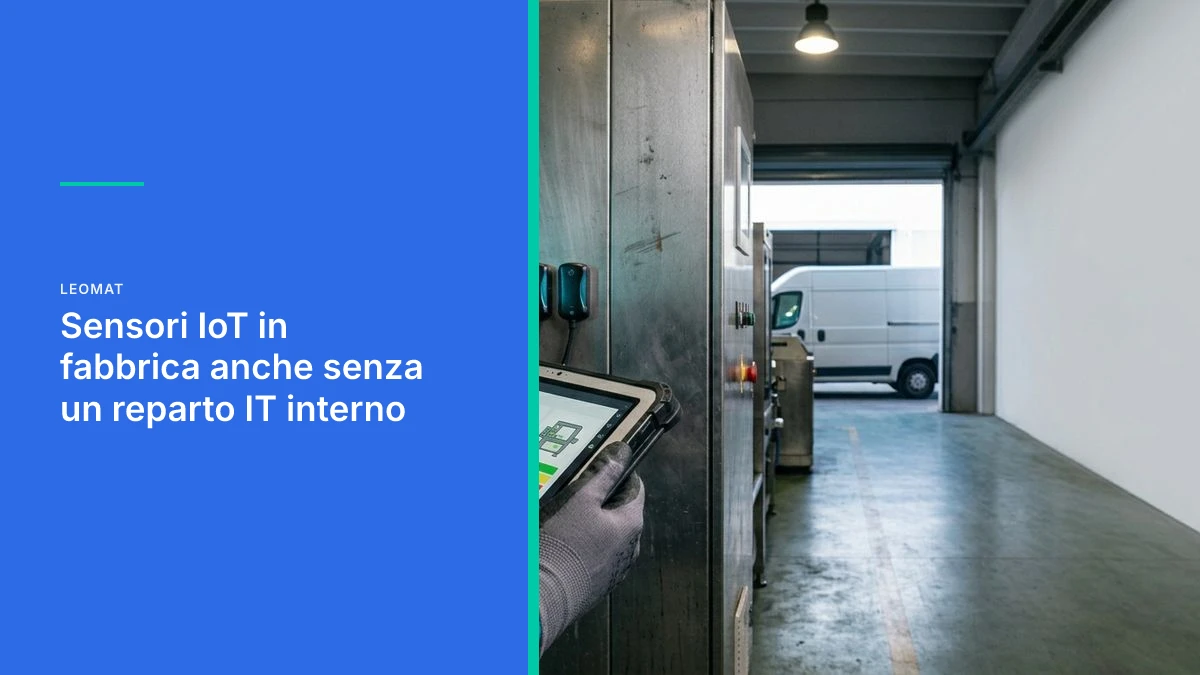
IoT Sensors in the Factory Even Without an In-House IT Department
Your factory generates data every minute, but no one is reading it. Discover how IoT sensors can deliver real value even without a dedicated IT department.
IoT Sensors in the Factory Without an IT Department: Where to Actually Start
IoT sensors in the factory are devices that collect data from machines, warehouses and energy consumption and send it to a system that interprets it. You do not need an IT department to activate them: the complex technical side is handled by whoever installs the solution, while the business owner receives only readable information, ready for immediate operational decisions.
In many Italian manufacturing SMEs, machines produce continuous signals: temperature, vibrations, work cycles, electrical consumption. These signals already exist, but they remain invisible because no one collects them in a structured way. A sensor does not invent new data: it makes readable what the machine has always been communicating, and transforms it into a number that appears on a dashboard instead of disappearing into nothing.
Why the Factory Generates Data That Nobody Reads
The factory produces data continuously, but without a system to collect and organise it, that data remains scattered across machines, spreadsheets and the memory of shop floor workers.
Every machine has a control panel, every shift produces information on downtime, waste and cycle times. The problem is not a lack of data: it is that the data lives in isolation, each piece in its own silo, never converging at a single point of reading. When a business owner asks what a machine stoppage really costs, the answer often comes from a rough estimate, not a verifiable number.
- Machine stoppages not tracked in a systematic way
- Energy consumption read only at the end of the billing period
- Production waste estimated rather than measured
- Maintenance carried out on a calendar schedule instead of based on actual need
What IoT Sensors Really Are, Explained Without Technical Jargon
An IoT sensor is a small device that measures a physical quantity, such as vibration or temperature, and transmits it over a network to software that transforms it into readable data.
There is no need to install servers or rewrite the existing management system. The sensor is applied to the machine or line, sends data to a small local gateway, and from there the numbers reach a platform that displays them as graphs or alerts. The complicated technical work stays behind the scenes: what the business owner sees is a simple panel, with thresholds and notifications.
For Those Who Have Little Time to Check Every Machine in Person
Someone who walks the shop floor every day to visually check whether a machine is running normally can receive an automatic alert when something goes out of range, without needing to be physically present.
A Company Managing Multiple Production Lines in Parallel
When there are more than two or three lines, comparing performance by eye becomes complicated: a single dashboard with normalised data makes it immediately clear which line is underperforming and why.
Data that is not collected is not missing data: it is a decision made without information, and that costs more than the collection itself.
Why You Do Not Need an IT Department to Get Started
Modern IoT sensors are installed with preset configurations and platforms that require no programming skills to read and manage.
The most common misconception is thinking that IoT requires an in-house technician who can write code or manage servers. In reality, whoever proposes a serious IoT solution takes care of installation, configuration and technical maintenance: what remains in the company is simply reading the data, often already available on a smartphone or tablet on the shop floor.
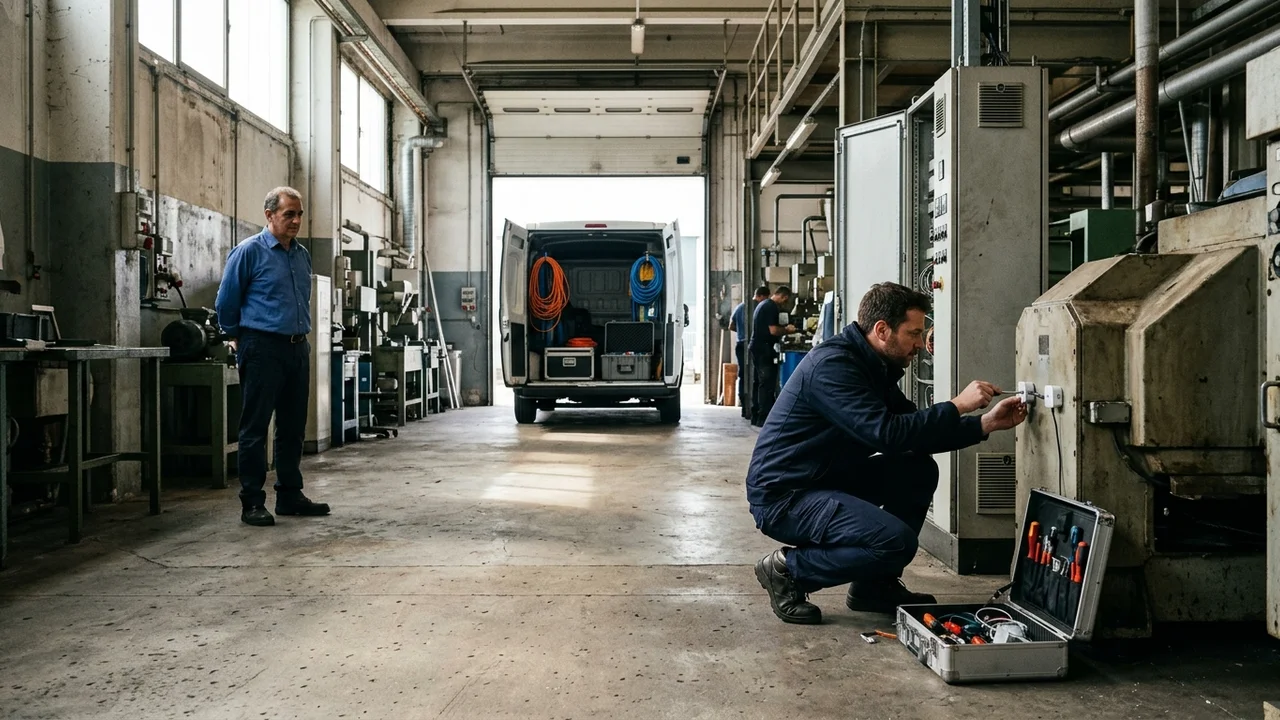
Concrete Use Cases: Machines, Warehouse, Energy Consumption
IoT sensors apply to three typical areas of the manufacturing SME: machine monitoring, warehouse tracking and energy consumption control.
On the machine side, a vibration or temperature sensor can signal an anomaly before it becomes a failure: this is the foundation of predictive maintenance, which shifts the intervention from "when it breaks" to "before it breaks." In the warehouse, level sensors or part counters reduce manual counting errors, a topic that directly concerns anyone managing a warehouse still counted by hand. On the energy side, a sensor on electrical panels or compressors shows where energy is being wasted, often in ways that are not visible from the monthly bill.
- Real-time machine monitoring to anticipate stoppages
- Predictive maintenance based on vibration and temperature thresholds
- Automatic tracking of stock levels and warehouse movements
- Energy consumption control by line or department
A Company That Wants to Reduce Unplanned Downtime
Anyone who experiences sudden stoppages that block the entire line can use vibration and temperature data to schedule the intervention before the failure occurs, rather than chasing it after the fact.
For Those Who Want to Understand Where Energy Is Actually Being Wasted
Anyone who only looks at the total bill without knowing which machine consumes the most can isolate consumption by individual department or compressor and act in a targeted way.
A sensor that produces no decision is simply an added cost: the value of IoT lies in the action that the data makes possible, not in the data itself.
How to Get Started Without Disrupting the Company
The most effective way to begin with IoT is to start with a single critical line or machine, measure the results, and then expand gradually.
There is no need to equip the entire factory from day one. You start with an area where the problem is already recognisable, for example the machine that stops most frequently, and build a small monitoring system that demonstrates value before scaling up. This approach avoids excessive investment and allows course corrections as the first data comes in.
From Shop Floor Data to Business Process
Data from a sensor produces value when it enters the processes already existing in the company, rather than remaining on an isolated dashboard.
Leomat's approach starts from the client's operational reality, not from a standard product to sell. Leomat works on software automation, not industrial automation: its services include custom management systems and integrations between systems that currently do not communicate, meaning the software side where data already collected becomes part of the daily decision-making process. A concrete example of how Leomat transforms data and processes into recovered time is the ERP Costruzioni case, where drafting a quote went from 8 hours to 5 clicks in 30 days. Anyone who wants to understand how process automation works without a dedicated IT manager can read this in-depth piece on automation and SME processes, while anyone who wants to assess when it is time to update their management system can consult this guide on AI integration in management software. To understand how to begin a similar journey, the starting point is a conversation with Leomat about which systems to connect first, on the software side.
Frequently Asked Questions About IoT Sensors in the Factory
How Much Does It Cost to Install IoT Sensors in a Small Factory?
The cost depends on the number of machines to be monitored and the type of sensor chosen. Starting with a single critical line keeps the initial investment manageable and allows results to be evaluated before extending the system to other areas of production.
Is In-House Technical Expertise Required to Manage the Sensors After Installation?
No, the data reading platform is designed to be consulted without programming skills. The complex technical side, such as device configuration and maintenance, remains handled by the partner who implemented the solution.
Do IoT Sensors Work on Older, Non-Digital Machines?
Yes, there are external sensors that can be applied to older machines without replacing the equipment. They measure quantities such as vibration, temperature or electrical consumption from the outside, without interfering with the machine's original electronics.
What Is the Difference Between Real-Time Monitoring and Predictive Maintenance?
Real-time monitoring shows the current state of the machine, while predictive maintenance uses that data over time to anticipate a failure before it occurs, based on thresholds and recurring patterns in the collected signals.
Where Is It Best to Start If I Have Multiple Production Lines?
It is best to start with the line that has the most unplanned stoppages or the highest maintenance costs: that is where monitoring can produce the most visible and measurable benefit.
This post was created with AI.
Content (text, processing, quotations and images) generated or artificially manipulated by artificial-intelligence systems. Notice provided under the transparency obligations of Article 50 of Regulation (EU) 2024/1689 (AI Act), applicable from 2 August 2026.