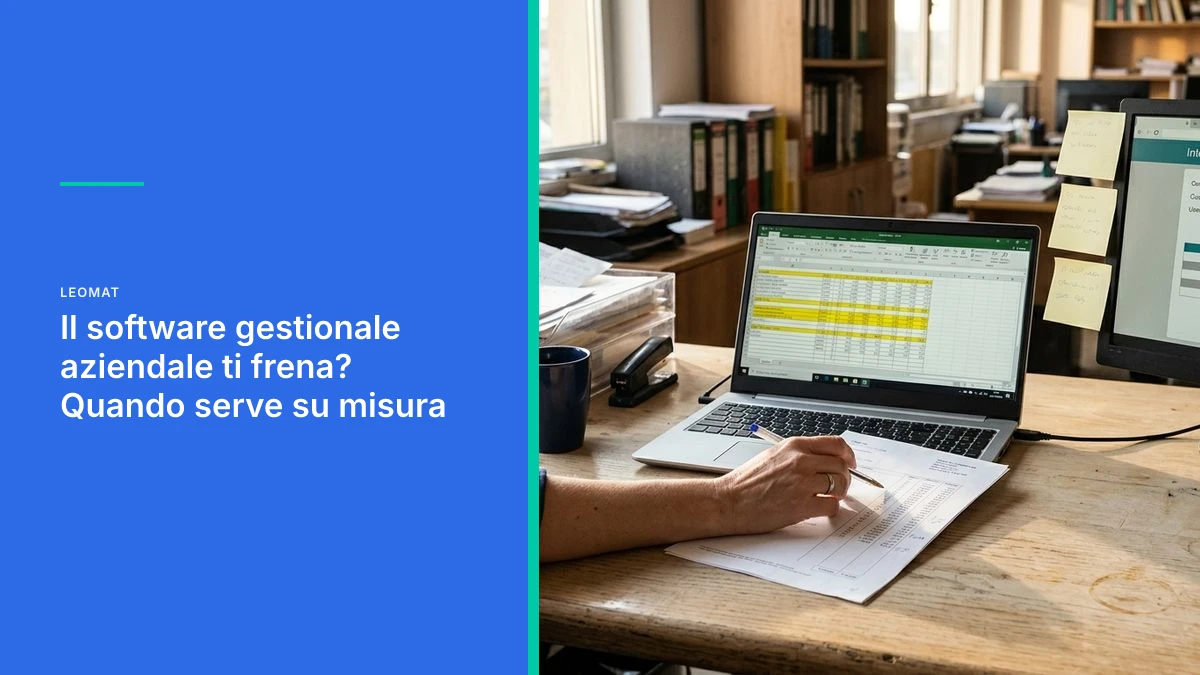
Is your business management software holding you back? When a custom solution is the answer
Does your management software fail to match the way you actually work? What a business management software should do, which signals show it may no longer be enough, and how to choose between an off-the-shelf product and a custom-built one.
What business management software must do in an SME
Business management software keeps customer records, quotes, orders, inventory, invoicing and job status all in one place, so every department works from the same data. For an SME it needs to do three things. Record what happens without duplicate data entry, enforce the rules of the company's own process (approvals, price lists, deadlines) and produce reliable reports. If an off-the-shelf product can do this, it makes sense to keep it; if it cannot, a custom management system is worth considering.
In practice, many SMEs start with a product designed for an average-sized company. Fixed fields, workflows decided by the vendor, identical screens for everyone. It works as long as the work fits the template. Then the exceptions arrive. A price that changes mid-job, an approval that must go through a specific person, a document that should be generated from data already held elsewhere. Whatever the software cannot handle migrates back into spreadsheets, emails and phone calls, and someone spends the day retyping.
The problem, the management system does not follow how your SME works
The problem arises when the software forces its own schema on people instead of following the company's real process.
The symptom is almost always the same. The management system exists, but the truth lives somewhere else. The correct version of a quote lives in a file, the status of a job is communicated verbally, the change agreed with the client exists only in an email. Nobody made a mistake. The official system had no place for that piece of information, and people found a workaround.
The cost does not appear on a single line in the accounts. It shows up in the hours spent checking that two sources say the same thing, in quotes that differ for identical requests, in reports reconstructed by hand before every meeting. And it shows up when a key person is absent and nobody else knows where the right data is.
Who recopies the same data across multiple tools
A very common situation is one where the same client is entered into the management system, the spreadsheet and the email programme. Every manual step is a point where data can diverge. Here the first step is often not to replace the management system, but to understand which systems are not talking to each other and why.
The functions that really matter in business management software
Good management software is judged by a handful of functions. Data entered once only, process rules enforced by the system, clear roles and permissions, reports that can be trusted.
Before comparing products it is worth writing down what the software needs to do in your specific work, not what the feature list promises. A long list of modules does not help if the step that wastes your time is not covered. These are the functions that make a difference in an SME.
- Single master records. A client or supplier exists once only, with the related history attached.
- Consistent quotes and orders. Prices, discounts and terms follow written rules, not the memory of whoever fills in the form.
- Job status inside the system. Anyone who needs to know where things stand reads it from the software rather than asking someone.
- Tracked approvals. Who authorised what, and when, remains on record.
- Documents generated from data. Quotes, order confirmations and delivery notes are produced from information already in the system, without retyping.
- Role-based permissions. Everyone sees and edits only what falls within their remit.
- Reports without manual reconstruction. The numbers for the meeting come out of the system, not from a spreadsheet rebuilt the night before.
Management software is only as good as the data it creates once. Every instance of retyping is a point where the correct version and the version in use stop matching.
AI also fits into this picture, but as a tool built on top of well-ordered data. An assistant that reads duplicate records and missing statuses returns equally confused answers. If you want to explore the topic further, there is a 2026 guide to integrating AI into SME management software.
Five signs that standard management software is no longer enough
Standard management software is no longer enough when people are working outside the system in a stable, repeated pattern, not just occasionally.
No formal analysis is needed to notice this. It is enough to observe where the information the software cannot receive ends up. If only one of these signs appears it may be an isolated case; if more than one appears, the process and the tool have gone in different directions.
- A parallel spreadsheet holds the correct version instead of the management system.
- The same client has two records in two systems, with slightly different data.
- Quotes vary for identical requests, depending on who writes them.
- Job status is communicated verbally and does not exist in the software.
- Emails are the only archive of an agreed change, and reports are reconstructed by hand before every meeting.
There is also a technical sign, less visible. Legacy components that nobody dares update because everything might break. We discuss this in the article on how obsolete software dependencies can bring a management system to a halt.
A craftsperson or small company with around forty product lines
An illustrative example. A company managing around forty product lines, with price lists that vary by client. If the management system does not support that variation, the correct price lives in a file and every quote depends on who remembers it. Here the sign is a quote that changes with whoever writes it.

Custom management system or ready-made solution, how to choose
A ready-made product makes sense if your workflow is standard and the software covers it without retyping; a custom solution makes sense when off-the-shelf tools force you to work outside the system.
Custom development is not the right choice for everyone. If a ready-made product does what you need, a personalised project only adds complexity to maintain. But if you repeat the same exceptions every week, adapting the work to the screens costs more than adapting the software to the work.
A custom system is not a larger management system. It is a management system that describes the process as it actually is and leaves out everything that is not needed.
Those with a standard workflow and few exceptions
If exceptions are rare and manageable with an internal rule, a ready-made product remains the simpler choice. Often it is enough to configure it better or connect it to the systems already in use, without replacing anything.
Those with exceptions that recur every week
Here a ready-made product forces permanent manual steps. A custom management system is built for exactly this situation. It encodes the approval, the variable price or the document to be generated directly in the software. If you are considering changing tools, also read when to change management software and move to a custom ERP.
The questions to bring to a first meeting with a vendor
Before signing, these questions reveal more than a demonstration. Bring them to any comparison, regardless of which firm you speak with.
- Does the written scope state what is automated and what remains with people?
- Is it clear which systems currently do not communicate with each other and who manages them?
- Do irreversible actions require human confirmation?
- Do you also receive the environment, including monitoring, backups and recovery?
- Does the system remain yours, built on standard technologies and without lock-in to a single vendor?
- Does the estimate come after the vendor has seen the process, and will they tell you in advance if part of it does not make sense?
Also prepare three concrete things. The process described step by step, a list of the tools you use today and a real example of an exception that wastes your time. With this material the comparison starts from facts, not from feature lists.
How Leomat works on custom management software
Leomat is a software engineering firm based in Naples that builds custom web applications, management systems included, together with the environment in which they run.
Leomat designs and builds complete web applications and the entire environment in which they live. The starting point is the process, not the technology. The firm maps what you do today step by step, who does it and where it breaks down, then proposes a clear scope. The software is built to measure in code, with AI as a force multiplier and every architectural, quality and security decision verified by a person. Security is designed from the outset against public references such as OWASP, and the system remains yours, on standard technologies and without lock-in.
On its website Leomat also describes a management system for tour operators, covering tour and vehicle planning, operational activities, quotes and an AI assistant that acts on data with human confirmation for sensitive actions, as well as a time-tracking system integrated with project management.
There is no standard price list, because two projects that look similar can cost very differently. The first conversation and the scope proposal are free, and if part of the project does not make sense they will tell you before you commit. To describe your process you can speak with Leomat.
Frequently asked questions about custom management software
How much does a custom management system cost for an SME?
It depends on how complex the process is and how many systems it needs to interact with. Two management systems that look similar can cost very differently, depending on how the underlying systems are built. This is why a figure given before the process has been examined is not very reliable. It is worth asking for an estimate after the analysis, with a written scope that states what is included and what is not.
What is the difference between a management system and an ERP?
A management system generally covers certain areas, such as invoicing, inventory or jobs. An ERP brings multiple areas into a single system with shared data. In practice the boundary is blurred. What matters more is understanding which processes need to sit together. It is possible to start with one module and grow, rather than building everything at once.
Can I keep my current management system and add only what is missing?
Often yes. When the bottleneck is not the management system itself but a piece of data that originates in a spreadsheet or an approval that has never been formalised, there is no need to replace anything. The solution is to make the systems you already have talk to each other. That choice is made after mapping the process, not before.
How do you avoid being tied to a single vendor?
By asking for standard technologies, access to the code and the environment, and a documented system that another team can take over. When speaking with a vendor, verify that the software remains yours and is portable. If a company ties you to proprietary tools that only they understand, the risk shifts from the software to the dependency.
This post was produced with AI
Content (text, processing, quotations and images) generated or artificially manipulated by artificial-intelligence systems. Notice provided under the transparency obligations of Article 50 of Regulation (EU) 2024/1689 (AI Act), applicable from 2 August 2026.