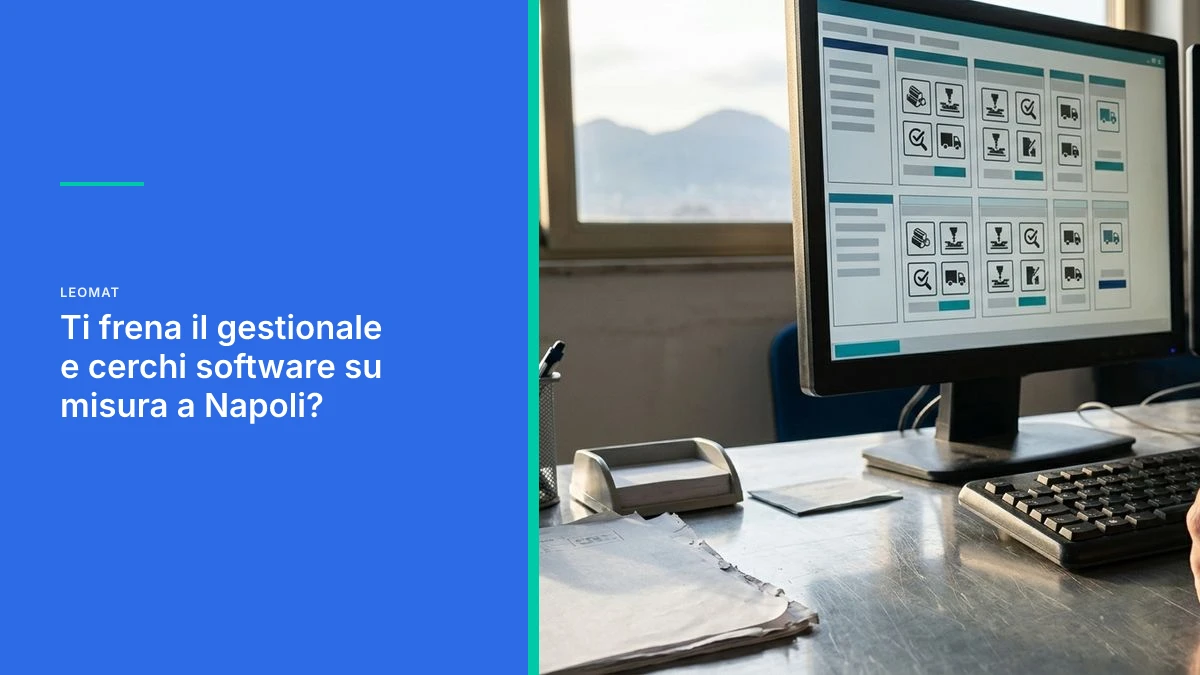
Is your management software holding you back? Custom software development in Naples
Your management system does not follow your process and your business ends up re-entering data by hand. Here is what tailored development in Naples really means and what to evaluate before signing a contract.
Custom software development in Naples starts with the process
Custom software development in Naples means designing a complete web application, and the environment that keeps it running, around a company's real process, not around a generic management system to be bent around exceptions. It starts from how an order, a quote or a data handoff actually works today, and arrives at a database, interface, security hardening, deployment and monitoring. Where agents are needed, they act on data first under human supervision, with confirmation required for sensitive actions. For a small or medium-sized business, the useful result is a system in production, not a presentation.
The mechanism shows up in the office, not in a percentage. A product designed for the average company covers the states, fields and exceptions its author anticipated. Real work has steps that product does not name: an approval that goes through a specific person, a price that changes on site, a document that needs to be generated from data already present elsewhere. What the software cannot handle flows back into spreadsheets, emails and phone calls. Someone re-enters data, checks by eye and keeps the correct version in their head. Two systems end up saying two different things about the same order.
When the management system does not follow the way you work
The management system slows you down when the real steps of the trade fall outside its screens and end up back in people's hands.
This is not a flaw in the off-the-shelf product. It is a misalignment. The software describes an average workflow. Your business has exceptions that repeat, which means they are the work, not the incident. If every order requires a field that does not exist, that field lives in a note. If every quote requires data sitting in another system, someone transcribes it. After a while the management system is no longer the source: it is one of the places data passes through, often with a delay.
The signs are recognisable without a formal audit. People keep a parallel spreadsheet for safety. The same customer has two records. A quote changes format depending on who writes it. A change agreed over the phone leaves no trace. The status of a job depends on who you ask. The issue is not about digitising more. It is about deciding which steps must live in the software and which remain human, with a visible confirmation.
Those who re-enter the same data across multiple systems
Anyone who sells, invoices or updates a catalogue while keeping a management system, an online shop, emails and spreadsheets separate knows the pointless step: opening a screen, reading, pasting into the other one, checking that no line was skipped. The error does not come from distraction. It comes from the fact that the systems do not communicate. A custom integration is not a generic bridge. It is the translation of a precise step: which data leaves, which arrives, who can correct it, what happens if the two values do not match. To recognise this before commissioning work, look at the signs that your software systems are not talking to each other.
Those who lose the day between quotes and documents
Those who prepare quotes, reports or repetitive documents often do not lose time writing well. They lose it searching for the right version, reassembling figures that are already known and repeating the same check. In these cases the software does not replace judgement. It prepares the document from already reliable data and leaves the person to verify it. This is the same principle as agents: repetitive work is shifted, sensitive decisions remain confirmed by a person.
- A parallel spreadsheet that holds the truth instead of the management system.
- Mandatory fields that nobody fills in, because they do not describe the real work.
- Job statuses communicated verbally and absent from the software.
- Different quotes for the same request, depending on who writes them.
- Emails that are the only record of an agreed change.
- Reports reconstructed by hand before every meeting.
A management system that does not follow the process is not a screen problem: it is a set of steps the software does not execute, which flow back into people's hands.
What custom software means for a small or medium-sized business
It means rewriting in software a process that someone currently does by hand, after understanding it step by step, not buying a tool and hoping it fits.
For a small or medium-sized business, custom software development has a defined scope, not a slogan. It states what is automated, what remains with people and which systems need to be touched. Often the problem is not where it appeared to be. A bottleneck attributed to the management system turns out to be an undocumented approval, or a piece of data that originates in a spreadsheet and has no official home. In most cases the real work lies in making systems talk to each other when today they remain separate.
If the work is built to go into production, you do not receive a demonstration. You receive the application and the environment that supports it: an isolated infrastructure, repeatable deployment, backups and recovery under control, monitoring and correction after launch. Without that environment, finished software stops at the first unexpected event. This is not the automatic choice for every business. If the workflow is standard and an off-the-shelf product covers it without continuous re-entry, a custom project adds complexity to maintain. It makes sense when ready-made tools force people to work outside the system, as we describe for manufacturing businesses in when off-the-shelf tools hold back a manufacturing business.
A local partner or a remote supplier
Distance does not change how software is written: it changes the phase in which the process is observed, which in the local area yields more when done in person.
A studio based in Naples can build for a company in the city and for one in Milan using the same method. Design and construction are almost entirely done remotely. Presence changes the beginning. Seeing the process among the people who carry it out surfaces in an afternoon things that take weeks over a video call. Many exceptions are never described: they become visible when someone skips a step that is always done a certain way.
Those in Naples or Campania who can show the work in person
If you are in the area, the first step is best done in person. It is not a courtesy visit. It is needed to understand who performs the action, which screen they open, where they note the exception and which check today exists only in one person's memory. From that comes a proposal with a clear scope. If a piece is not worth automating, that needs to be said at that stage, not once the project has started.
Those in the rest of Italy who work remotely
If you are not in Campania, the limitation is not technical. It requires more care in showing the process: screen sharing of the actual action, not of a presentation, real documents and a person from your office who can say where things are usually done differently. The written scope remains the same tool: what enters the software, what remains human, which systems need to be connected.
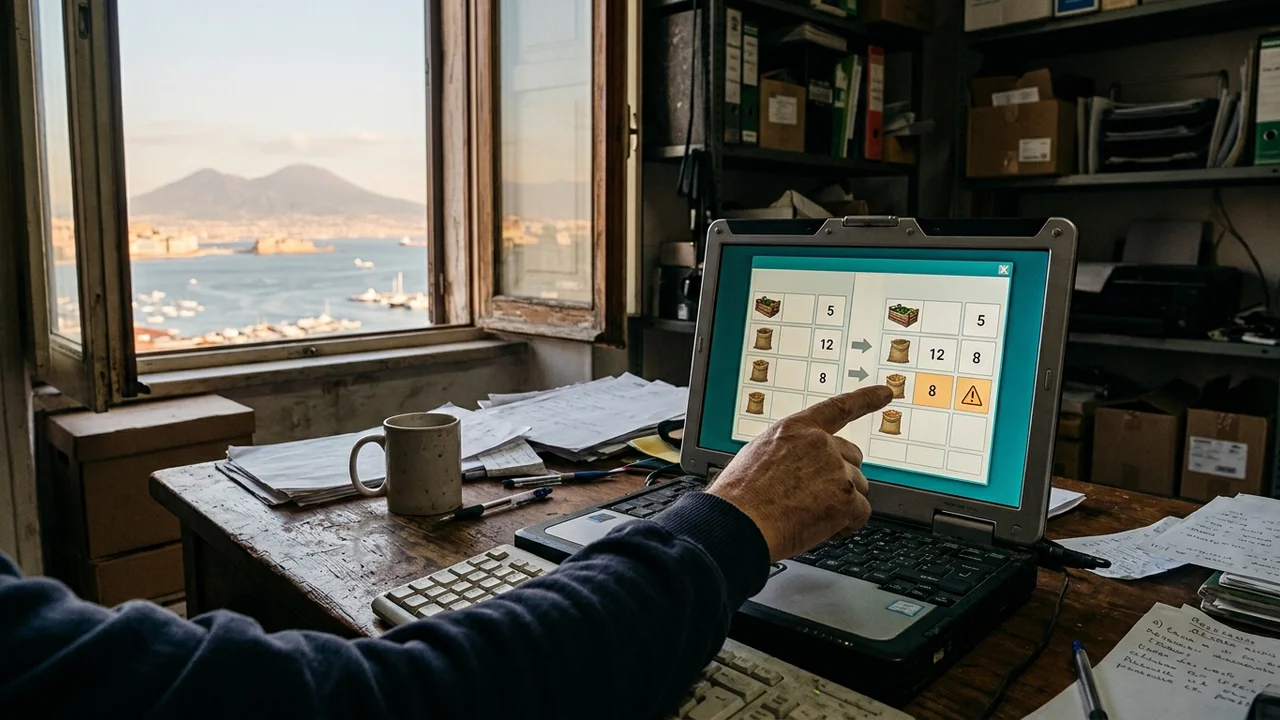
Security, agents and a system that stays in production
A useful system goes into production with security designed from the start, agents observed by a person and an environment that can be monitored and restored.
Artificial intelligence speeds up construction and can remove repetitive work, but architecture, quality and security remain choices verified by a person. This is not a throwaway prototype. Agents carry out work on data: initially under supervision, then with autonomy only where their behaviour has proven reliable. For sensitive actions, human confirmation is never removed. The right model is chosen for the task, the result is measured and an alternative plan is kept in place in case a supplier changes, degrades or raises prices. The system is not locked to a single supplier.
Security is not a final coat of paint. It is designed on public standards: OWASP for web application and API risks, MITRE ATLAS for threats to artificial intelligence systems, NIST AI RMF for risk management, and the EU AI Act for transparency obligations for those building with AI. In practice, one customer's data does not end up in another customer's context, irreversible actions require confirmation and what the system does remains traceable. Your company's obligations, from the GDPR to the AI Act, must be verified with your own adviser: an article does not replace that opinion.
Software automation is not industrial automation. The former concerns processes that people carry out on a computer: orders, documents, emails, catalogues, data moving from one system to another. The latter concerns machines, plant and factory robotics. A software studio does not replace those who design plant. Confusing the two leads to asking the wrong supplier.
- Discovery: process, data and objectives, before writing any code.
- Design: architecture, data model and security surface.
- Building the application and infrastructure, with repeatable and isolated deployment.
- Security hardening against recognised standards, including protection against malicious instructions directed at models.
- Agents under supervision, with correction of edge cases.
- Release with backups and recovery ready.
- Monitoring and autonomy only where behaviour is reliable.
An agent can prepare the work, but for sensitive actions confirmation remains with a person, and what the system does must stay traceable and readable.
On the question of when a management system should be replaced or supplemented, without chasing the latest trend, it helps to understand when to integrate artificial intelligence into a management system. The criterion is not the model of the moment. It is whether the repetitive step is clear and safe to delegate, with an alternative plan if a supplier's quality changes.
Measured cases and questions to ask before signing
The numbers you can use to judge are those from already measured projects, not a promise that is the same for every business.
The approved cases, to be read as they were recorded, are as follows. A marketing agency in Rome, AI voice agents: 80% more qualified leads. About medically s.r.l., parapharmaceutical sector: 85% faster document generation (90 days). ERP Costruzioni, construction sector: from 8 hours to 5 clicks to produce a quote (30 days). These are the outcomes of those specific projects, not a guarantee that your process will produce the same result. A construction quote and document generation in the parapharmaceutical sector cannot be copied across. They serve to show a tight, assessable scope that went into production, not to sell a percentage.
Before signing, questions matter more than the demonstration. Ask who verifies architecture and security, a person or only a model. Ask whether the system remains yours, with standard technologies and no lock-in to a single supplier. Ask where the data goes, what leaves the perimeter and what must not. Ask whether you start from a small, useful slice that can be assessed in production, rather than a long project that is only visible at the end. No serious estimate can be given before seeing the process: a number of days stated at a desk is an invented number.
- Does the scope state what is automated and what remains with people?
- Is it clear which systems currently do not communicate and who governs them?
- Do irreversible actions require human confirmation?
- Do you also deliver the environment, monitoring, backups and recovery?
- Does the estimate come after seeing the process, not from a generic price list?
- If a piece is not worth automating, will you say so before the contract is signed?
How Leomat builds with you software that goes into production
Leomat, a software engineering studio based in Naples, designs complete web applications and the environment in which they run, with agents under human supervision and security designed from the start.
The published method starts from the process, not from the technology. Architecture, application, infrastructure, security hardening, deployment and observability follow. Artificial intelligence is a multiplier: every architecture, quality and security decision is verified by a person. Agents gain autonomy only after working under supervision, and sensitive actions retain confirmation. There is no lock-in to a single model supplier: the right tool is chosen for the task, the result is evaluated and an alternative plan is kept ready. Services include custom management systems and portals, together with automations that remove repetitive work.
The initial conversation is a free call to analyse your specific case. The response includes an approach, an architecture and a real estimate, without inflated promises. The first conversation and the scope proposal are free of charge. If you are in Campania, that first step on the process is preferably done in person. For the rest of Italy the work continues remotely, in the same way. If you want to set up a project, start with the Leomat software engineering studio and describe the process that is costing you time, not the technology you would like to buy.
How much does custom software development in Naples cost?
We do not publish a price list. Two projects that look the same can cost very differently, because the cost depends on how complex the process is and how many systems it needs to touch. The first conversation and the scope proposal are free of charge: they serve to establish what to automate, what to leave with people and what is needed from the systems already in use. From that scope comes a real estimate, without inflated promises. If a piece is not worth automating, that is stated before the contract is signed. A price written before seeing the work would not be an estimate: it would be a made-up number.
Does a software company in Naples only work in the city?
No. A studio based in Naples works with companies across Italy, almost always remotely. Distance is not a technical limitation: software is built in the same way for a company in the city and for one in Milan. If you are in Campania, the initial phase is different. Seeing the process in person, among the people who carry it out, surfaces in an afternoon things that take weeks over a video call. For this reason, in Naples and Campania, that first step is better done in person. The work then continues remotely, on a written scope that can be assessed in the field.
What is the difference between custom software and an off-the-shelf product?
An off-the-shelf product asks you to adapt your trade to its screens and to the fields designed for the average company. Custom software development starts from the process as it is: it defines what the software must do, what remains with people and which systems need to be connected. It is not the right choice for every business. If the workflow is standard and the off-the-shelf product covers it without continuous re-entry, a custom project adds complexity to maintain. It makes sense when the real steps fall outside the management system and flow back into spreadsheets, emails and phone calls, with two versions of the same piece of data.
Can AI agents for small and medium-sized businesses decide on their own?
They can act on company data, but they do not start free. They first operate under supervision: a person observes the behaviour, corrects edge cases and measures it. Autonomy grows only where it has proven reliable. Sensitive actions retain human confirmation. In practice, one customer's data does not end up in another customer's context, irreversible actions require confirmation and what the system does remains traceable. If part of the process cannot leave the perimeter, it is designed so that it does not. It must be stated clearly what goes out to a model supplier and what does not. The opinion on your company's obligations remains with your own adviser.
This post was produced with AI
Content (text, processing, quotations and images) generated or artificially manipulated by artificial-intelligence systems. Notice provided under the transparency obligations of Article 50 of Regulation (EU) 2024/1689 (AI Act), applicable from 2 August 2026.