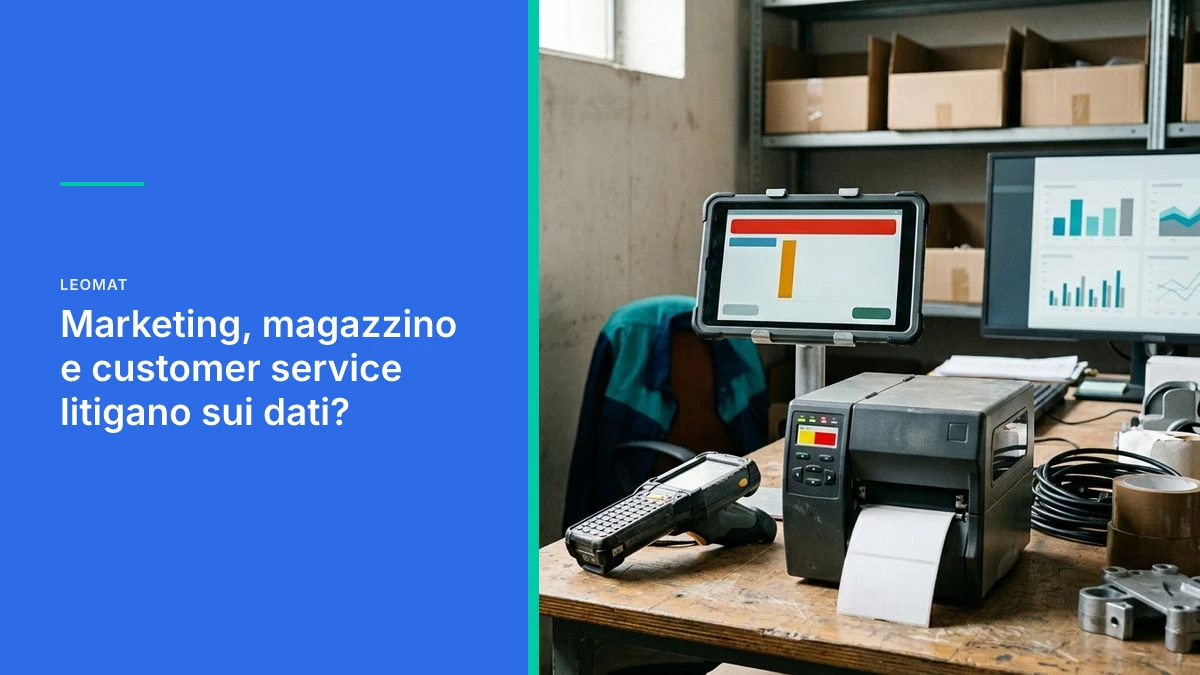
Are Marketing, Warehouse, and Customer Service Fighting Over Data?
When marketing, warehouse, and customer service look at different numbers, small and mid-sized ecommerce businesses lose sales and time. Here is how to unify data without disrupting existing processes.
Unified ecommerce data for SMBs: the end of meetings where everyone brings a different spreadsheet
In an SMB ecommerce operation, unified data means a single shared source of truth across marketing, warehouse, and customer service, reducing discrepancies between files, management systems, and different platforms. When all three departments read the same stock number, the same order status, and the same customer history, decisions become faster and operational errors decrease.
In many SMB ecommerce businesses, marketing works on a manually updated spreadsheet, the warehouse uses a separate management system, and customer service relies on a CRM that communicates with neither. An automation system trying to read all three would find fields with different names for the same concept (availability, stock, quantity), incompatible date formats, and no shared unique identifier linking orders, customers, and products. The result is that each department builds its own partial version of the truth, and the three versions rarely match.
Why fragmented data holds back SMB ecommerce growth
Fragmented data holds back growth because each department makes decisions based on incomplete information, generating promises the warehouse cannot keep and customer responses based on outdated order statuses.
Marketing launches a promotion on a product that the warehouse flags as nearly out of stock only the following day. Customer service receives a complaint about an order that, according to their system, is still being processed, while logistics has already shipped it. This is not a matter of inattentive people, it is an architectural problem: without a shared data source, every piece of software updates its own copy of reality on different timelines and according to different rules.
- The warehouse updates stock at the end of the day, while marketing publishes offers in real time.
- Customer service consults a CRM that receives order status updates hours late.
- Customer records live across three different systems, often out of sync.
Those managing a catalog with hundreds of items and little time for manual checks
In these cases fragmentation multiplies: every item has a different status on every system, and manually verifying discrepancies becomes a full-time job that no one in the company can afford to take on.
Those who have already invested in multiple software tools but keep seeing different numbers across departments
The problem here is not a lack of tools, but the absence of an integration layer that makes them speak the same language, with the same identifiers and the same update intervals.
An ecommerce business with three systems that do not communicate does not have three separate problems: it has one single problem, the absence of a shared data source, which manifests across three different departments.
What changes when all three departments look at the same number
When marketing, warehouse, and customer service share the same data source, decisions become consistent and customer communications reflect the real situation in real time.
A single source of truth means that when the warehouse records a drop in stock, marketing sees it at the same moment and can pause a promotion before it generates unfulfillable orders. It also means that customer service, opening a customer record, sees the order history, shipping status, and any warehouse notes in the same panel, without having to call another department for confirmation.
To explore the points where these flows most often get stuck, it can be useful to read about the typical bottlenecks in SMB ecommerce, which often originate precisely from this kind of fragmentation.
Those who want to scale without increasing the number of people dedicated to data control
With a single data source, growth in catalog size or order volume requires far fewer hours of manual cross-referencing between spreadsheets: recurring checks can become automated, with exceptions flagged to a single person.
The Leomat solution: custom AI automations to unify data
Leomat builds custom AI automations that connect the systems already in use within a company to a single data source, without forcing the SMB ecommerce business to replace all the tools it already knows.
Leomat's approach does not start by replacing existing software, but by understanding what data is missing between one system and another and how to make it flow through custom-built code, tailored to the company's real needs. This is not about generic no-code platforms, but about integrations designed for the specific workflow of that warehouse, that CRM, that ecommerce platform.

Case study: concrete results with a custom management system
A concrete example comes from the construction sector: with ERP Costruzioni, drafting a quote went from 8 hours to 5 clicks in 30 days.
A slow quote is often not the fault of the people writing it: it is slow because the data needed is scattered across systems that do not communicate.
How to get started without disrupting existing processes
Data can be unified by starting with a single critical flow, such as stock or order status, without immediately touching all the software already in use.
The most useful first step is to map where the three departments clash most often today: it is almost always stock levels, order status, or customer records. From there, a bridge between existing systems is built and tested on a limited flow before being extended. Those who have already faced similar decisions about their management system may find it useful to read about when it actually makes sense to change the management system before working on the data.
- Identify the piece of data that generates the most conflict between departments (often stock levels).
- Connect the systems involved with a custom integration, without replacing them.
- Verify over a trial period that the numbers match across departments.
- Extend the integration to other critical flows one at a time.
Those who fear that unifying data means starting from scratch
There is no need to replace existing software: a custom integration works on top of the systems already in use, connecting them to each other without requiring a full migration.
Leomat as a partner for unifying your ecommerce data
Leomat works with Italian SMBs to build custom AI automations that connect marketing, warehouse, and customer service on a single data source, without over-engineering the processes already in place. Among the available services is the development of a custom ERP tailored to the company, designed to bring together in one place the information currently scattered across different systems. Those who want to explore how to integrate artificial intelligence into their management tools can also read the guide on AI integration in SMB management software. To understand how to get started with your own ecommerce, the point of contact is Leomat.
Frequently asked questions about unified data and SMB ecommerce
How long does it take to unify data across different departments?
It depends on the number of systems involved and the complexity of the flows, but an initial intervention on a single critical piece of data, such as stock levels, can be put into production quickly and evaluated in the field, without touching the entire infrastructure.
Is it necessary to replace the current management system to unify data?
No, in most cases it is possible to build a custom integration that connects the existing systems, without requiring the company to migrate to a new platform.
Which departments benefit most from unified data in an ecommerce business?
Marketing, warehouse, and customer service are the three departments that most often work with the same data on different timelines, so they are the first to notice the benefit when that data is aligned.
How can you tell whether your company actually has a data silo problem?
A clear signal is when two departments report different numbers for the same order or the same stock availability, or when customer service has to call another office to confirm information that should already be visible to them.
Is this an accessible investment for an SMB without an internal IT team?
The custom approach makes it possible to start with a single critical flow, keeping the initial investment contained and evaluating results before extending the integration to other business processes.
This post was created with AI
Content (text, processing, quotations and images) generated or artificially manipulated by artificial-intelligence systems. Notice provided under the transparency obligations of Article 50 of Regulation (EU) 2024/1689 (AI Act), applicable from 2 August 2026.