Misaligned post-sale support: how to unify it with AI
When sales, warehouse, and support each tell a different story about the same order, customers get lost. Here is how to align the facts without adding headcount.
When after-sales support gives different information across departments
After-sales support gives different information across departments when sales, warehouse and support teams work from lists that do not match. The customer hears one version on the phone, another in a message and a third on the invoice. The mechanism is straightforward: each team updates its own tool, nobody confirms the same order status, warranty or return. Unifying the source of facts, in operational text and in shared data, reduces contradictory responses without adding staff.
In many small and medium-sized businesses, after-sales support often lives in inboxes, shared spreadsheets and internal chats. Anyone looking for the status of a case finds no single field for warranty, part availability or service date. The link between order, shipment and ticket is missing. In practice the customer receives three different truths and the company spends the day fixing the situation instead of closing the request at first contact.
What happens when departments give different answers
The customer receives three versions of the same fact, loses trust and reopens the request until someone manually reconstructs the truth.
The sales rep promised a spare part "within two days" in a message. The warehouse, looking at the same item code, sees an arrival scheduled for the following week. Support opens an old ticket where the item shows as "already shipped." Nobody is lying: they are reading three separate records. From the customer's perspective, the only thing that comes through is inconsistency, and the tone of the conversation rises accordingly.
The same pattern repeats itself with returns, service calls and warranty expiry dates. What is missing is a shared fact, not goodwill. Someone who has just joined the company spends weeks figuring out which list is the "real" one. Someone who has been there for years keeps the truth in their head, and when they go on holiday the service breaks down.
Those who have little time for the daily support routine
Anyone handling calls, messages and returns in the same shift cannot open three tools for every case. If order status lives in the management system, availability in a spreadsheet and warranty information in a folder, answers come from memory. Memory is fast, until it is wrong. Then you backtrack, ask the warehouse, rewrite to the customer. The time lost is not a meeting: it is every single request.
Those who sell parts and spare components
Consider a workshop or a small manufacturer with a limited catalogue, where every item has a different code, batch and reorder lead time. Support replies "it is in stock" because it was there yesterday. The warehouse has already allocated those parts to another order. Without an update that reaches everyone, the promise to the customer is false from the start. You do not need a huge catalogue for misalignment to cause damage: a few records kept in different places is enough.
Why support data remains fragmented
It remains fragmented because each department updates its own list and no tool acts as a single source of truth for orders, warehouse and warranty.
Sales lives in the sales cycle. The warehouse lives in quantities. Support lives in tickets. Three languages, three update schedules, three "official versions." When a field is missing (serial number, date of last service, who promised what), everyone fills it in verbally. The result is data consistency that exists only on paper.
Two operators acting in good faith who read two different lists will give two different answers. The problem is not the person, it is the source.
This happens even when software is in place. A management system for invoices, a spreadsheet for returns, a shared inbox for complaints: the tools do not talk to each other. The last person to write something "wins," until the customer shows a previous screenshot. The same knot, across marketing, stock and support, appears when departments argue over data instead of sharing it. Unifying data across company departments is not an aesthetic project: it is the only way to make the person on the phone and the person in the warehouse say the same thing.
How much this inconsistency costs a small business
It costs hours of internal clarification, avoidable returns and customers who do not renew because they do not know who to believe.
The visible cost is time: a second call, a message to the warehouse, waiting, a callback. The hidden cost is reputational. A customer who has heard three versions does not evaluate the product, they evaluate the company. In a small business without an internal IT department, nobody "fixes the data" over the weekend. Exceptions accumulate, and exceptions become the process.
Late deliveries make the situation worse, because support has to explain a delay that the sales team never saw coming. If the goods dispatch date is not the same fact for everyone, after-sales starts on the back foot. The same principle applies when you want to reduce delivery delays with automation: first you align the status, then you communicate.
- A second call about the same complaint, because the first answer was based on an outdated list.
- A return or spare part shipped twice, with stock showing as "available" only in one spreadsheet.
- A warranty applied or denied in opposite ways by two operators, on the same serial number.
- A sales rep who promises a date the warehouse cannot meet.
- A new hire who does not know which tool to consult and asks three people in the chat.
- A customer who writes directly to the owner because "nobody in your company talks to each other."
- Internal meetings to reconstruct who said what, instead of closing the case.
Those who have sales, warehouse and support on three different channels
Anyone taking orders by message, tracking stock in a spreadsheet and managing complaints by email lives three parallel truths. This is not personal disorganisation: it is the absence of a single mandatory step. As long as a fact (part dispatched, warranty opened, return accepted) is not written in one place, every channel remains a version. Aligning channels is more useful than adding a fourth tool.
How AI automation unifies after-sales support information
Automation reads the same facts from the order, warehouse and ticket and presents them to the operator as a single updated record.
This is not about having a machine speak to the customer instead of a person. It is about removing the detective work from the operator. An intelligent workflow can copy the order status into the support record, flag when availability has changed and recall the warranty date written on the invoice. The operator confirms, corrects if needed and responds. The customer hears a single voice because the facts are a single set.
AI automation in after-sales support works only if the fields exist and match. If the warranty lives in a free-text note, the system cannot confirm it. If the item code in support is not the same as in the warehouse, the record stays empty. The real work is naming the facts: status, quantity, serial number, expiry date, responsible person. Then you connect what you already use. For a small business without an IT manager, what matters is starting from a visible workflow, as described in what actually works when there is no internal IT team.
- List the three questions the customer always asks (where is the order, is the part available, does the warranty cover it).
- For each question, identify which tool currently holds the answer and who updates it.
- Choose a single field for each fact and prohibit parallel notes on the same topic.
- Connect the update: when the warehouse moves a part, support sees it without having to ask.
- Have the operator read a single record, with the date of the last update clearly visible.
- Log the exception (part replaced manually, commercial goodwill gesture) in the same place, not in a chat.
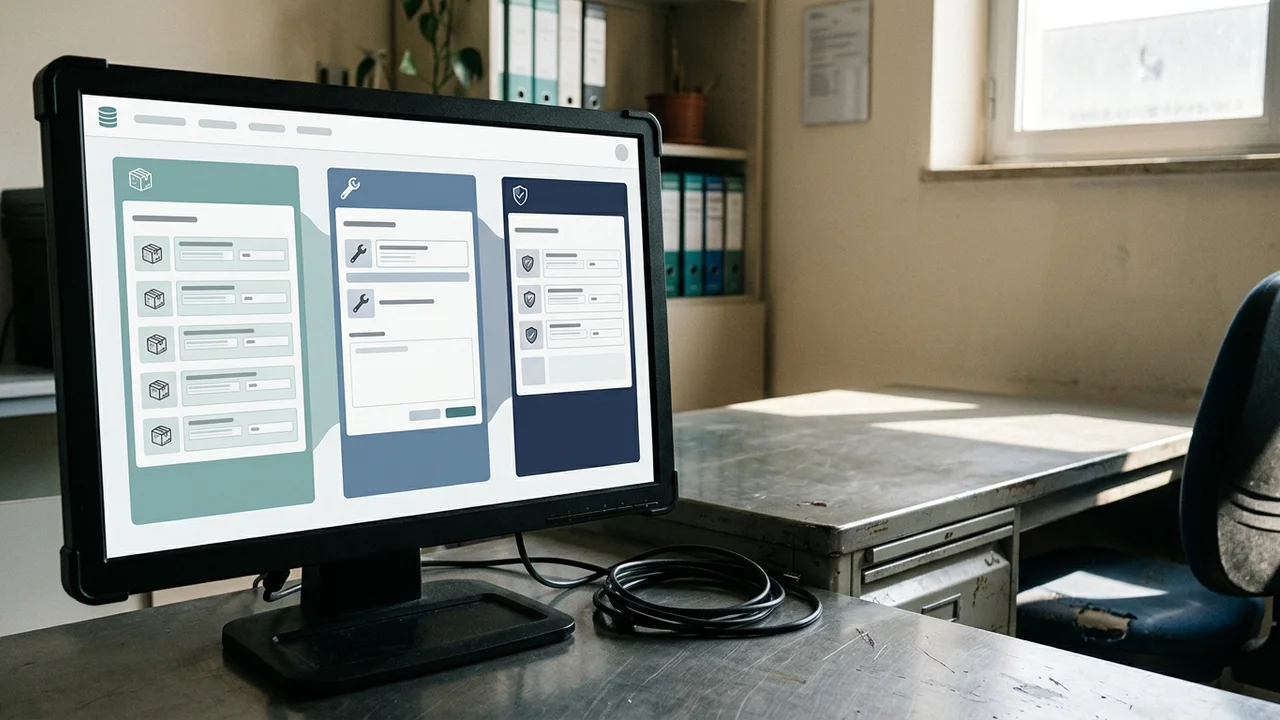
What holds support back is not a lack of channels, it is a lack of matching facts: if operational text and data do not say the same thing, the operator improvises.
Where to start to align customer support
Start with three shared fields (order status, availability, warranty) and one rule: whoever updates a fact updates it for everyone.
There is no need to redesign the entire company in a month. You need a small, respected perimeter. For one week, observe how many tickets arise from a wrong answer rather than a product defect. Name the three fields. Decide who owns each one. Remove the "convenience" spreadsheet that duplicates the management system. Then, and only then, automate the handoff.
Manual processes in small business customer service are not a bad habit: they are how the company grew. They remain useful for genuine exceptions (a long-standing customer, an out-of-catalogue part). They become a cost when the exception is the daily norm. The goal is not to take people off the phone. It is to ensure that when they pick up the receiver, they have the same truth in front of them as the warehouse does.
- Order status visible to both support and sales, with the date of the last movement.
- Spare part availability read from the same list as the warehouse, not from an evening summary.
- Warranty tied to the serial number or invoice, not to a note in the customer record.
- Return accepted or rejected with a single outcome, visible to whoever handles dispatch.
- Commercial promise written in the same place where support takes over the case.
How Leomat makes support consistent across departments
Leomat designs custom AI automations and management systems that connect existing workflows, so that sales, warehouse and support all read the same facts.
Leomat was created to bring frontier technology to businesses: the goal is not to add another programme to learn. We start from what you already do (orders, stock, tickets) and build an automatic handoff between departments. Where a single system is needed, we build a custom ERP tailored to the company, designed around your fields and your timelines, not around a generic template. Where connecting two tools is enough, we automate the workflow and leave everything else as it is.
We start from the process, not from the technology. Artificial intelligence comes in when it removes a repetitive step, for example copying an order status into the support record. If you want to find out whether your after-sales can speak with a single voice, the starting point is talking to Leomat about the facts that currently live in three different lists.
Frequently asked questions
Why do support and warehouse give different answers to the same customer?
Because they update different lists, at different times, with no single field for order status, part and warranty. The operator answers with what is in front of them at that moment. The warehouse answers with quantities. If the two facts do not match, the customer hears two truths. Aligning the source, rather than "better training" the people, is what closes the gap.
How do you unify data across departments in a small business without overhauling the software?
You name three shared facts and decide who updates them. Then you connect the update: when the warehouse moves a part, support sees it. There is no need to replace the entire management system in the first month. You need to remove the parallel spreadsheets covering the same topic. Automation comes later, to copy and confirm, not to invent fields that do not yet exist in the company.
Does artificial intelligence replace after-sales support operators?
No. It removes the work of manually reconstructing status across inboxes, spreadsheets and tickets. The operator remains the person who talks to the customer, handles the exception and decides on the goodwill gesture. Automation presents a single record, with the update date clearly visible. Without clear facts to begin with, artificial intelligence cannot confirm anything useful and the inconsistency remains.
Where do you start if the company has no IT manager?
From the list of questions the customer asks every day and from the tool that currently holds the answer. You choose an owner for each fact and prohibit duplicates. A partner who builds custom automations and management systems can connect the steps without requiring an internal team. The goal of the first step is a single voice on order, part and warranty, not an endless project.
This post was created with AI
Content (text, processing, quotations and images) generated or artificially manipulated by artificial-intelligence systems. Notice provided under the transparency obligations of Article 50 of Regulation (EU) 2024/1689 (AI Act), applicable from 2 August 2026.