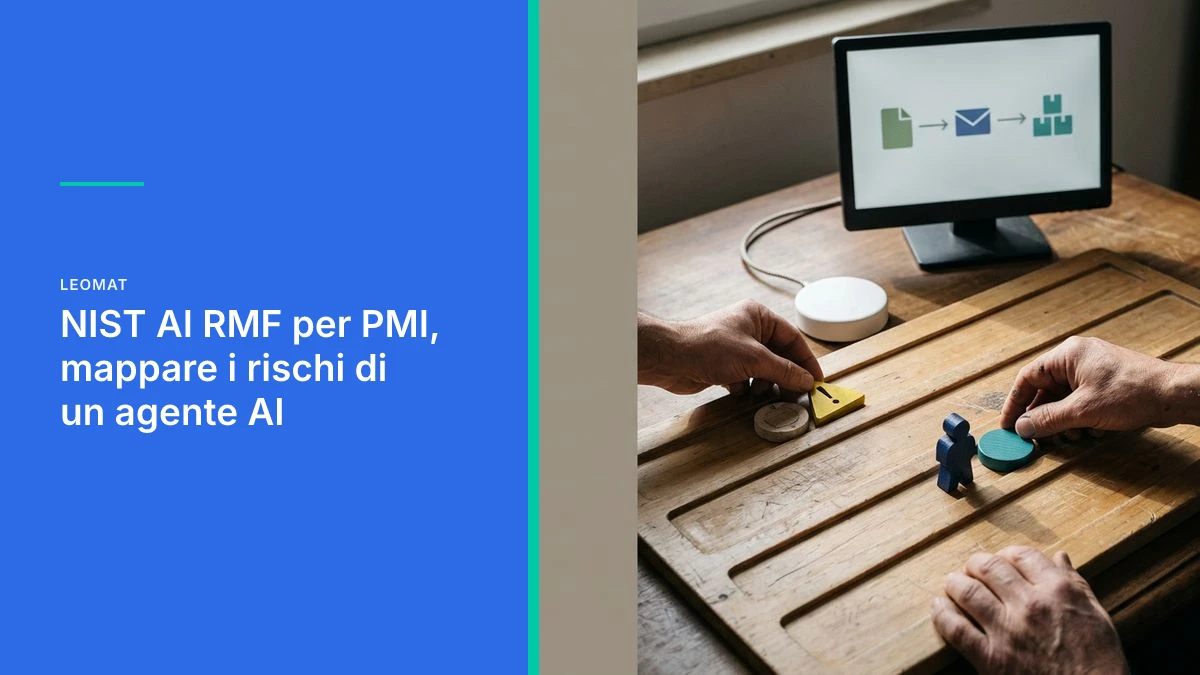
NIST AI RMF for SMBs, mapping the risks of an AI agent
A practical guide to mapping the risks of an AI agent using the NIST AI RMF, without a compliance team. Functions, steps, responsibilities, and a simple register.
The NIST AI RMF for SMEs is used as a list of questions, not as a certification
To map the risks of an AI agent with the NIST AI RMF, you first describe what the agent does, with what data and with what permissions; then you list the possible errors, decide who monitors them, and write everything down in a simple register. The framework is voluntary, it is not a certification and does not require a compliance team. All you need is one responsible person, a shared spreadsheet, and the habit of reviewing it whenever the agent changes.
In an SME, the AI agent almost always arrives from the ground up. Someone connects it to email, to the management system, or to the website, writes a prompt, and tries it out. What is usually missing is not the technology, but the document that states what the agent can touch, what it must never do, and who notices if it makes a mistake. Without that document, the risks remain in one person's head, and every subsequent change shifts them without anyone noticing.
Why map risks before putting an AI agent into production
An AI agent acts, it does not simply respond. It reads data, writes messages, and sometimes modifies records, so a confidently stated error can reach the customer before anyone sees it.
The difference compared to ordinary software is that the agent can be wrong in a plausible way. A traditional function breaks and you notice it; an agent produces a well-written but incorrect response, and no alarm sounds. This is why it is worth thinking through the risks before launch, when changing a permission takes a few minutes rather than a letter of apology to a customer.
Who responds to customers with an agent
An illustrative example. A company that entrusts an agent with the first responses on customer support. The main risk is fabricated information about warranties, timelines, or prices, delivered in a reassuring tone. Mapping means deciding which topics the agent can handle on its own and which it must pass to a person. For a broader overview of the topic, there is the practical guide to AI chatbots for SME customer service.
Who connects the agent to the management system
If the agent can write to the management system, an error does not stay in a chat. It enters the data and propagates to orders, quotes, and inventory. Here the risk map distinguishes read-only actions from those that modify records, and for the latter it requires human confirmation. The same reasoning applies to those who automate orders, as explained in the article on automated order management in SMEs.
The NIST AI RMF functions explained without jargon
The NIST AI RMF organises risk management into four functions, Govern, Map, Measure, and Manage, which in a small company translate into four simple questions.
The framework is published by NIST as a voluntary reference for those who build or use artificial intelligence systems. It does not prescribe forms to fill in. It offers a common language for reasoning about risk. For an SME, the value lies in turning a vague topic, "is AI risky?", into questions that can be answered in writing.
- Govern (who decides). Who is responsible for the agent, who can change it, and who can shut it down.
- Map (what can go wrong). What the agent does, with what data, toward whom, and which errors would be most damaging.
- Measure (how we monitor it). Which test cases and which spot checks indicate whether the agent is behaving correctly.
- Manage (what we do if something happens). How to limit the damage, who is notified, and how to correct it.
Mapping a risk does not mean removing it. It means writing down what can happen, who notices it, and what to do on the day it happens.
The four functions are not phases to be completed in sequence. You return to Map every time a permission is added to the agent, and to Measure every time the model or prompt changes. The framework is a guidance tool and does not replace any applicable legal obligations. For the EU AI Act, it is worth verifying with a legal consultant which category your use case falls into.
How to map your AI agent's risks step by step
You map an agent starting from its identity card. Purpose, data it reads, actions it performs, people it reaches; then for each action you write down the worst possible error.
The method that follows works even with a single spreadsheet and an hour of discussion between the people who use the agent and those who are accountable for it. The goal is not exhaustiveness, but a first version that can be corrected.
- Write in one sentence what the agent is for and what it must not be used for.
- List the data it can read and the data it must not see (personal data, contracts, confidential price lists).
- List the actions it can perform. Read, suggest, write, send, delete.
- For each action, note the worst possible error and who would bear the consequences.
- Assign each risk a simple level (low, medium, high) based on how serious it is and how difficult it is to reverse.
- Decide on the control measure. Human confirmation, scope limit, spot check, or simple monitoring.
- Choose a review date and a person who is responsible for it.
Writing what the agent can and cannot do
Permissions are the part that carries the most weight. An agent that only reads has a very different risk profile from one that sends emails on behalf of the company. It is worth starting with the narrowest scope and widening it only after observing real behaviour, which is exactly the opposite of what happens when full access is granted "for convenience".
Teaching the agent to say "I don't know"
The most underestimated risk is the confident but wrong response. It can be reduced by giving the agent an explicit rule. When the source is missing or the data is ambiguous, declare that you do not know and pass the matter to a person. In the map, this rule becomes a concrete control measure, and it should be tested with questions the agent cannot answer, to see whether it actually stops.
A reliable agent is not one that always responds, but one that knows when to stop and call a person.
Who decides what in a small company
In an SME, three roles written down with a name next to each are enough. Who is accountable for the agent, who monitors it every day, and who can shut it down without asking anyone's permission.
The person in charge decides the scope and accepts the residual risks; this is often the owner or an operations manager. The person who monitors is the one who actually uses the agent and sees errors first. The third role matters more than the others. An emergency switch, meaning the ability to stop the agent immediately, without going through a meeting. If no one has this authority, in a critical moment no one does.
Those who have little time and no dedicated role
Those who do not have a compliance officer can assign supervision to whoever already knows the process. Oversight must not become a separate job. Ten minutes a week to review a sample of the agent's actions is worth more than a perfect document that no one opens. What matters is that the person is written in the register and knows it.
Those who depend on a single person who "knows how it works"
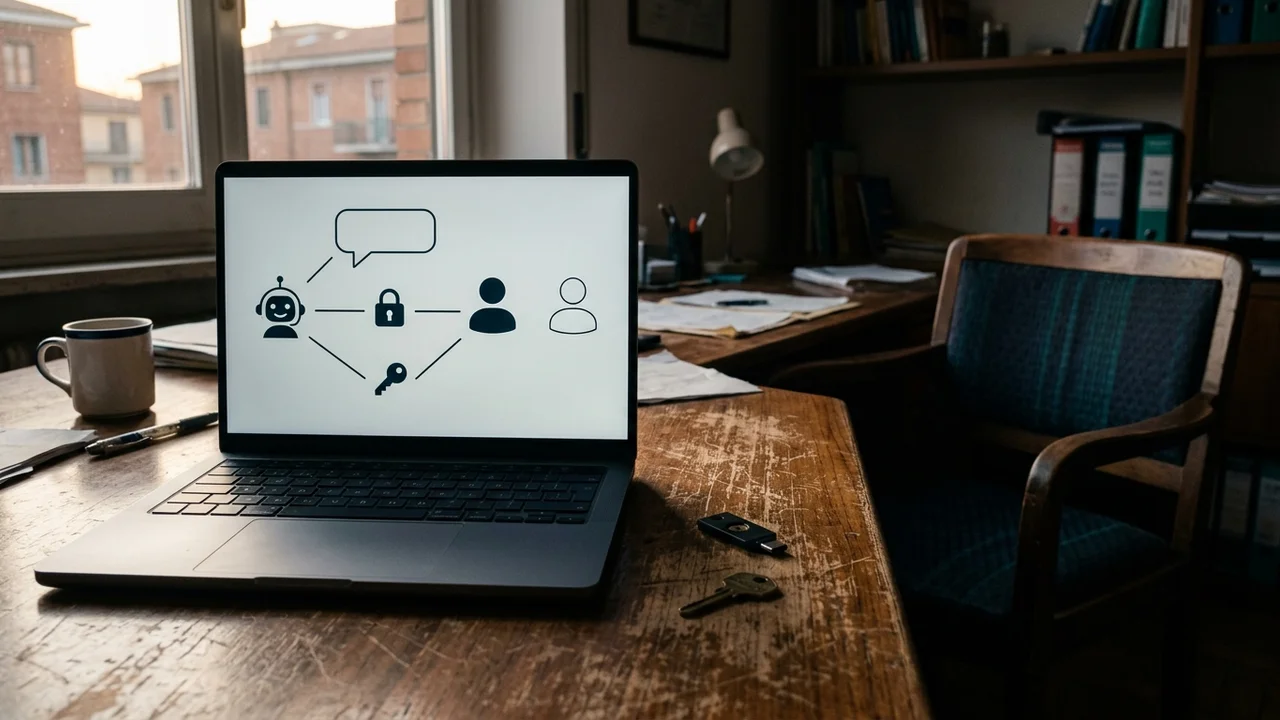
If only the person who configured the agent understands it, the risk is dependency on that individual. The map makes this visible. You only need to add a line stating where the prompts, permissions, and credentials are written down, and who else can read them. It is the same problem as management systems built by a single person, and it is addressed in the same way, with shared documentation.
A risk register that is simple to keep active
A useful AI risk register is a spreadsheet with few columns, one row per risk, updated every time the agent changes and on a fixed date even when nothing changes.
The register is where the map stops being a meeting and becomes a habit. Each row must be readable by someone who did not take part in the discussion, so no internal abbreviations and no references to past conversations. The essential columns are these:
- Description of the risk, in one concrete sentence ("the agent states an incorrect warranty expiry date").
- The agent action it is linked to.
- Severity and reversibility, with a simple level.
- The planned control measure and who carries it out.
- What to do if the risk occurs.
- Date of the last review and next deadline.
The register should be reviewed at three moments. When a permission or a data source is added, when the model or prompt changes, and after every real error. An error is the most valuable piece of information you can have. It should be recorded with what happened, why, and which control measure should have stopped it. The method for not missing the deadlines of a recurring activity, as described in the article on scheduled maintenance deadlines, also applies well to register reviews.
How Leomat works with AI agents
Leomat is a software engineering firm based in Naples that builds AI agents under human supervision and designs security on public frameworks, including the NIST AI RMF.
In its way of working, agents operate first under human-in-the-loop. Their behaviour is observed, edge cases are corrected, and autonomy grows only where it proves reliable; for sensitive actions, human confirmation always remains in place. OWASP, MITRE ATLAS, NIST AI RMF, and the EU AI Act are public references that the firm follows in its work, not certifications.
If you have an agent to build or one already in use and want to understand where the risks are, you can describe the process to Leomat. The initial conversation serves to understand what you do today, what stays with people, and what would be entrusted to the agent, and the proposed scope comes at no charge.
Is the NIST AI RMF mandatory for an SME?
No, the NIST AI RMF is a voluntary reference and not a certification, so it is not something you "obtain" and no one issues a certificate for it. It helps organise risk reasoning with a shared language. Legal obligations, such as those of the EU AI Act, are a separate matter. They depend on the type of system and how it is used, and should be verified with a legal consultant.
Do you need a compliance expert to map the risks of an AI agent?
For a first map, no. One person who knows the process, one who uses the agent, and a shared spreadsheet are enough. An expert becomes useful when the agent touches sensitive data, decisions that affect people, or regulated sectors. In the meantime, a written map also makes that conversation much more effective, because it brings concrete facts rather than impressions.
How often should the AI risk register be updated?
It should be updated every time something relevant changes. A new permission, a new data source, a different model, or a modified prompt. It should also be reviewed after every real error and on a fixed deadline, chosen based on how frequently the agent is used. What matters is that the review date is written down and that a specific person is accountable for it.
How do you prevent an AI agent from giving wrong but confident answers?
You can reduce the risk, not remove it entirely. You give the agent verified sources, limit the scope, write the rule "if you are not sure, say so and pass to a person," and test it with unanswerable questions. For actions that cannot be undone, human confirmation is needed, and a sample of responses should be reviewed regularly.
This post was created with AI
Content (text, processing, quotations and images) generated or artificially manipulated by artificial-intelligence systems. Notice provided under the transparency obligations of Article 50 of Regulation (EU) 2024/1689 (AI Act), applicable from 2 August 2026.