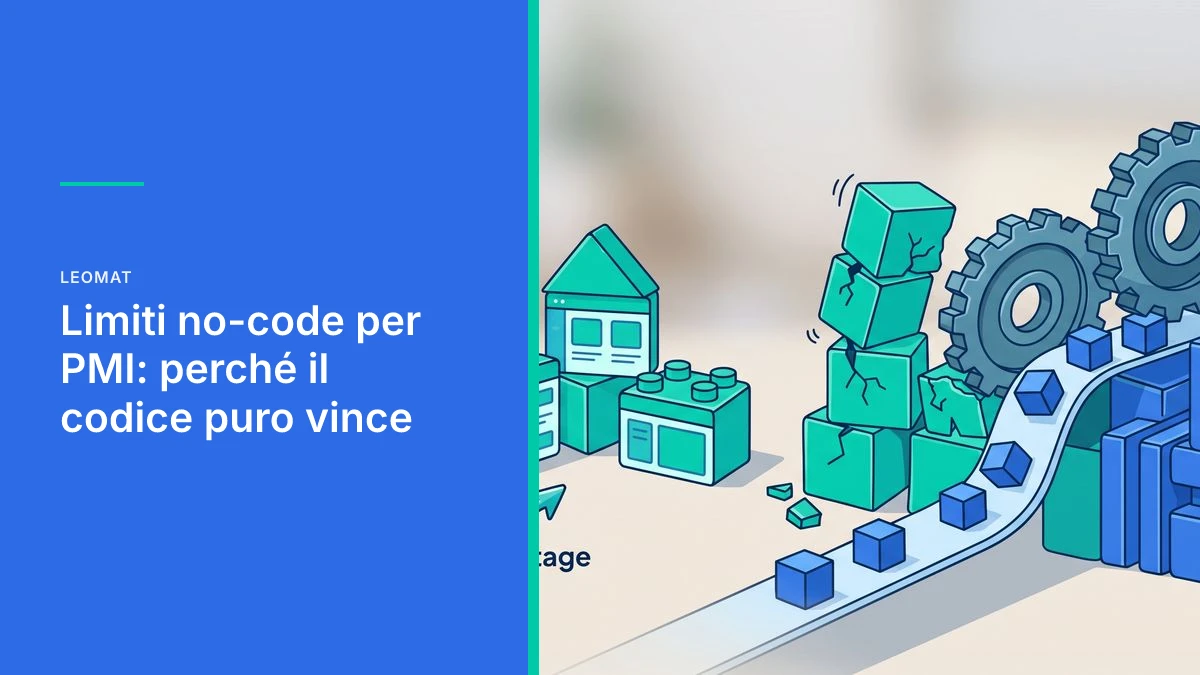
No-code limits for SMEs: why pure code wins
No-code can seem like the perfect solution for automating an SME, but as the business grows, its limits often become real bottlenecks. Here is why pure code wins.
No-code limits for SMBs: when pure code becomes the right choice
No-code limits for SMBs often emerge quietly: at first everything works, workflows run smoothly, the team is satisfied. Then the company grows, processes become more complex, and no-code platforms start to show cracks. Pure code is not a choice reserved for large companies with unlimited budgets, but a concrete answer to a scalability problem that every growing SMB will eventually face.
The no-code and low-code platform market has expanded rapidly in recent years, driven by the promise of democratizing automation. For many SMBs, when processes grow, this promise translates into wasted time, hidden costs, and operational frustration.
What no-code means and why SMBs fell for it
No-code is a software development approach that allows applications and automations to be built through visual interfaces, without writing a single line of code. For an SMB without an internal IT team, the promise is irresistible: autonomy, speed, and apparently low costs.
The appeal of no-code is understandable. A business owner managing an SMB does not want to hear about APIs, development environments, or deployment cycles. They want their CRM to talk to their management system, follow-up emails to go out automatically, and sales data to end up in a report without anyone having to do it by hand every Monday morning. No-code platforms respond to exactly this need, at least in the initial phase.
The problem is not the tool itself, but the gap between what is promised and what is actually needed when processes become complex. SMBs fall for it because the starting point is always simple: one workflow, one connection, one automation. The end point, however, is almost always more intricate than it appears at the beginning.
The 4 concrete no-code limits when an SMB grows
No-code limits do not all appear at once: they arrive in sequence, one after another, as the company scales. Knowing them in advance allows for more informed decisions before they become emergencies.
Every no-code platform is built around a set of predefined connectors and standard logic. This is its strength in the initial phase, but it becomes a structural limitation as soon as business processes move outside the use cases anticipated by the platform's developers. And the processes of a real SMB almost always move outside those use cases.
- Scalability limited by consumption-based plans: most no-code platforms bill based on the number of operations performed or rows processed. When volumes grow, costs grow with them and can exceed those of a custom solution, maintenance included.
- Dependency on third-party connectors: if the SMB's management software does not have a native connector in the no-code platform, the integration becomes a fragile workaround. Every update to the source software can break the workflow without warning.
- Inability to handle complex logic: nested conditions, exceptions, calculations on historical data, and sector-specific business logic are difficult or impossible to implement visually. The result is a workflow that works in the standard case but fails in real-world scenarios.
- Opaque and non-transferable maintenance: a no-code workflow built by one person is often incomprehensible to anyone else. There is no automatic documentation, no automated testing, and no straightforward way to understand why something has stopped working.
Pure code: what actually changes in day-to-day practice
Developing an automation in pure code means building a solution designed precisely around the company's processes, without the constraints imposed by a third-party platform. The result is a system that does exactly what is needed, nothing more and nothing less.
When pure code is mentioned, the common image evokes months of development, out-of-control costs, and eternal dependency on a technical vendor. The reality, for an SMB with well-defined processes, is very different. An automation developed in pure code for a specific use case starts from a small, useful slice of the process and does not pay a platform based on the number of operations.
The most important operational difference is maintainability. A system written in code has readable logs, can be tested automatically, can be documented, and can be handed over to another developer without loss of knowledge. When something stops working, you know exactly where to look. This is not a technical detail: it is the difference between an automation that becomes a business asset and one that becomes technical debt.
What "pure code" means for non-technical people
For a business owner without an IT background, "pure code" can seem like an abstract concept. In practice it means this: instead of using third-party software that connects your tools through a visual interface, a development team writes a custom program that does exactly what you need. That program runs where you decide, does not depend on a platform subscription, and when a vendor updates their API, you know where to intervene.
Real cases: automations built in custom code
Concrete cases are the most direct way to understand what changes when a process is automated on a custom basis. These are not extreme scenarios, but ordinary situations for a growing SMB.
In the construction sector, drafting a quote is traditionally a lengthy and error-prone process: collecting data from multiple sources, complex calculations, document formatting, internal approval, sending to the client. A company in the sector reduced this process from 8 hours of work to 5 clicks in 30 days, thanks to a system developed in pure code.
In the parapharmaceutical sector, a company increased document generation speed by 85% in 90 days.
In the marketing sector, a Rome-based agency implemented AI voice agents for lead qualification, achieving 80% more qualified leads.

How to assess whether your SMB has already outgrown no-code
There are precise signals that indicate when an SMB has crossed the threshold beyond which no-code becomes a brake rather than an accelerator. Recognizing them in time allows for planning the transition without waiting for an emergency.
The assessment does not require technical expertise: it requires operational honesty. You need to look at real processes, not theoretical ones, and ask how much time is spent each week correcting errors generated by existing automations, how many exceptions are handled manually because the automated workflow does not cover them, and what it would cost if the system went down for 24 hours.
- Automated workflows break more than once a month due to external updates.
- The monthly cost of the no-code platform grows quarter after quarter.
- There are critical processes that cannot be automated because they are too specific for the available connectors.
- Only one person in the company understands how the automations work and knows how to fix them.
- Data processed by the workflows regularly exceeds the limits of the current plan.
- There are integrations with proprietary management software or ERPs that no-code cannot handle in a stable way.
- The team complains about frequent exceptions that require manual intervention.
If several of these signals are present, it is likely that the SMB has crossed the threshold of no-code usefulness. This is not a failure: it is the signal that the company has grown enough to deserve more robust tools.
The move to pure code: how complicated it is and how it is not
The transition from no-code to pure code does not require throwing away everything that exists: it requires mapping critical processes and prioritizing interventions.
The main fear of a business owner facing this transition is time: how long will it take before the new system works? The answer depends on the complexity of the processes and the systems involved, and cannot be given before seeing them: you start from a small, useful slice, which goes into production quickly and is evaluated in the field, with a progressive go-live that limits the impact on current operations.
The starting point is never "let's rewrite everything": it is always "what is the process causing the most problems today that, if it worked well, would have the greatest impact on the business?" You start there, build a solid solution, measure the result, and proceed. This modular approach is compatible with the pace and budgets of an Italian SMB.
An element that is often underestimated is intellectual property. An automation developed in pure code can belong to the company, if the development contract provides for it: in that case it can be modified, extended, and transferred to another vendor without losing anything. A no-code workflow built on a subscription-based third-party platform exists, as a rule, only as long as the subscription is paid. For an SMB that wants to build a lasting competitive advantage, this difference is not negligible.
The concrete steps to begin the transition
A perfect plan is not necessary before starting. Three initial steps are enough to understand whether and how to proceed:
- Step 1 (Mapping): list all processes currently automated with no-code tools, noting error frequency, monthly cost, and external dependencies.
- Step 2 (Prioritization): identify the process with the greatest impact on the business and the highest rate of problems: that is the ideal candidate for the first pure code intervention.
- Step 3 (Assessment): compare the development cost of a custom solution with the cumulative cost of the no-code platform over the next 24 months, including the cost of time spent managing errors.
In many cases the calculation is surprising, because it brings to light costs that were not visible, such as the time spent managing errors.
Frequently asked questions about no-code limits for SMBs
Is no-code always wrong for an SMB?
No, no-code is a valid tool for prototyping processes, automating simple workflows, and testing ideas without significant investment. The problem is not the tool itself, but using it beyond its threshold of usefulness. For an SMB with stable processes, growing volumes, and complex integrations, no-code becomes a brake. For a startup or a small organization with linear processes, it can still be the right choice in the short term.
How much does it cost to develop an automation in pure code compared to no-code?
The initial development cost in pure code is generally higher than activating a no-code subscription. However, it has no variable monthly fees or per-operation volume costs, while maintenance costs need to be factored in. For an SMB with significant volumes, it is worth comparing the development and maintenance cost with the cumulative cost of the platform at your actual volumes.
Do I need an internal IT team to manage pure code solutions?
No. A solution developed by a reliable technical partner should include documentation and ongoing support: it is worth verifying this in the contract. The goal is not for the business owner to become a programmer, but to have a system that works autonomously and a technical contact to turn to when needed. The SMB manages the business, the technical partner manages the system.
How long does it take to move from no-code to pure code?
The duration depends on the process and the systems involved, and cannot be estimated before seeing them. The transition never happens abruptly: the new system is developed and tested in parallel with the existing one, and go-live occurs when the new system has passed testing, to minimize the risk of being left without operational automations.
How do I know if my no-code vendor is about to become a problem?
There are three signals to monitor: the monthly cost grows faster than the perceived benefit, customization requests are systematically refused because they are "not supported by the platform", and the number of manually handled exceptions increases every month. If any of these signals persists over time, it is the moment to evaluate more robust alternatives.
This post was created with AI
Content (text, processing, quotations and images) generated or artificially manipulated by artificial-intelligence systems. Notice provided under the transparency obligations of Article 50 of Regulation (EU) 2024/1689 (AI Act), applicable from 2 August 2026.