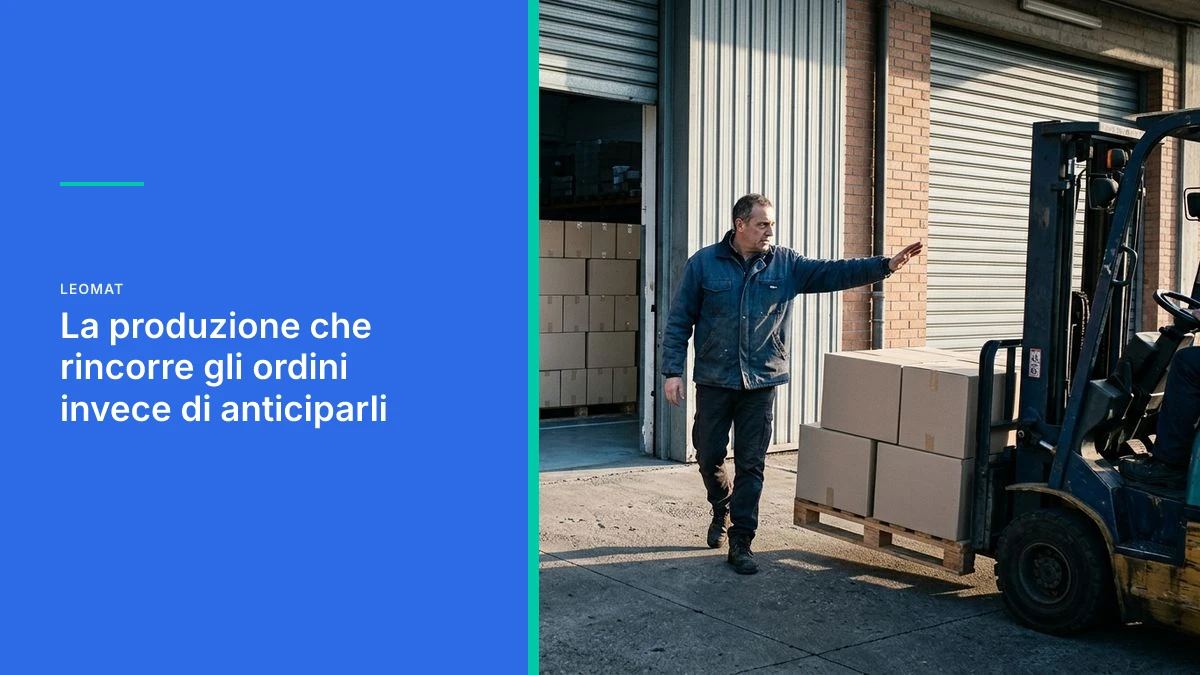
Production That Chases Orders Instead of Anticipating Them
Why your manufacturing SME is always working under pressure, and how predictive production automation changes the way you plan.
Predictive production automation: how to stop chasing orders
Predictive production automation is the set of processes and software tools that allows a manufacturing SME to plan production based on historical data, current orders, and seasonality, instead of reacting to orders as they arrive. It is not a generic ERP: it is a system that reads company data and turns it into operational decisions before the problem appears on the shop floor.
In many Italian SMEs, production still runs from one emergency to the next. The sales office receives an order, passes it to production, and production reorganizes everything it was already doing to make room for the new urgency. The management system, when one exists, records what has already happened: it does not help understand what will happen in two weeks. The connection between historical sales data, warehouse status, and remaining production capacity is missing, and that connection is precisely what a predictive system builds.
The problem: when production is always chasing orders
A production process that chases orders only discovers its workload once an order is already confirmed, and by that point every margin for optimization is already gone.
Consider a metalworking company that operates on a job-order basis. Every morning the production manager receives the previous day's order list and has to fit those orders in alongside the ones already queued. Raw materials are sometimes unavailable because no one planned for them in advance. The result is a constant manual reshuffling, made up of phone calls, spreadsheets, and decisions made under pressure. This is not a problem caused by incapable people: it is a process problem, one that lacks access to the right data at the right moment.
Recognizable symptoms
- Urgent orders that always override existing planning
- Raw material stocks managed by gut feeling or on a generic historical basis
- Quotes that require hours of manual work for each job
- Recurring overtime during the same periods every year
Chasing versus anticipating: what really changes in production processes
The difference between chasing and anticipating is not the technology itself, but the moment at which data is used to make decisions.
In a reactive model, data serves to record what has happened: how many units were produced, how much material was consumed, which orders were fulfilled. In a predictive model, the same data is read in advance to understand what will happen: which product lines will likely see higher demand next quarter, when to reorder critical raw materials, how to allocate shifts before they become an emergency. Making this leap does not require replacing the entire management system: it requires connecting existing data sources (orders, warehouse, production) with logic that processes that data continuously, not only on demand.
A system that records production is not predictive automation: it only becomes so when that data is used to decide before the problem arises.
How predictive production automation works
Predictive production automation works by connecting existing company data with custom-built software logic, without relying on generic no-code tools.
The starting point is almost always the same: map where the data lives (ERP, order sheets, warehouse, CRM) and identify which fields are missing or incomplete. A predictive system cannot work well if the field "average production time per product line" has never been filled in, or if the order history is fragmented across separate, unconnected files.
From there, the actual automation is built: not with no-code platforms assembled from predefined blocks, but with clean custom code written specifically for the company. This technical choice is not a matter of preference: a flow built from predefined blocks breaks easily when business processes change, whereas a custom-built automation can be adapted and extended without rethinking the entire structure every time a supplier or data format changes.
What is needed in practice
- A mapping of existing data and missing fields
- A system that updates forecasts continuously, not just monthly
- A direct integration with the company ERP, with no manual copy-paste steps
- A dashboard readable even by those without technical skills
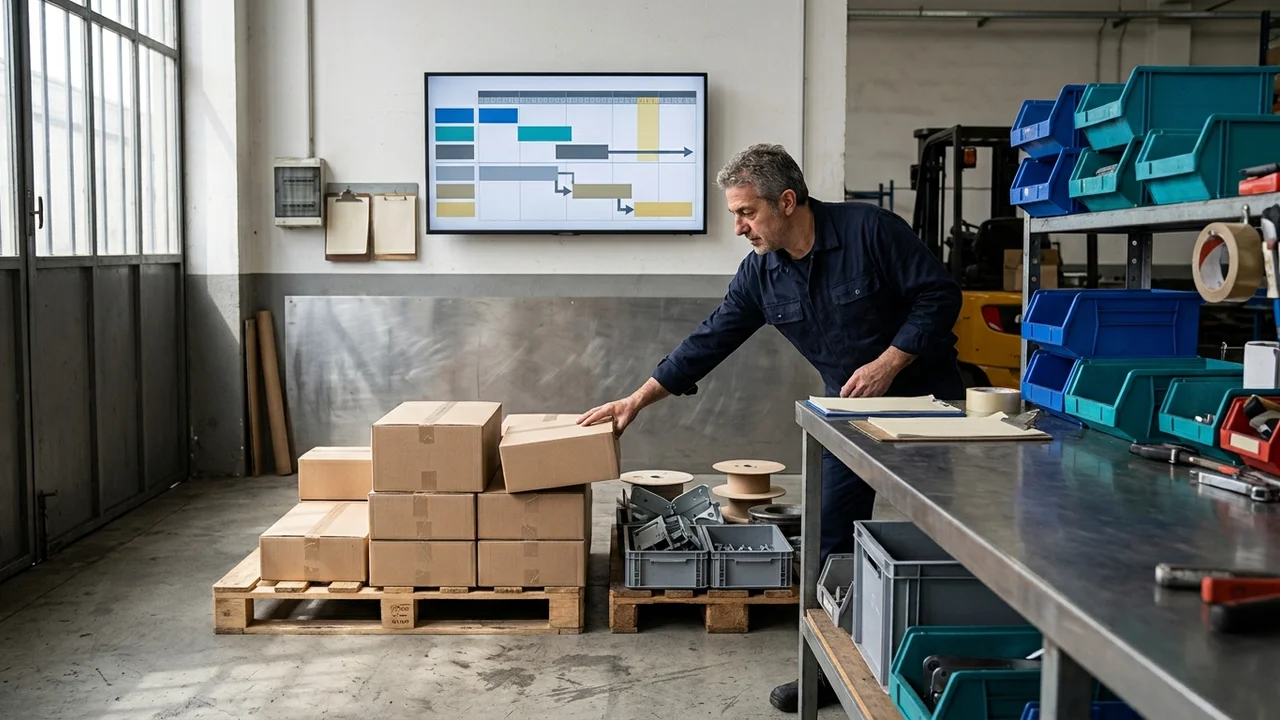
A concrete case: from manual drafting to a quote in a few clicks
With ERP Costruzioni, in the construction sector, Leomat reduced the time needed to produce a quote from 8 hours to 5 clicks, in 30 days.
The principle is close to that of predictive automation: removing a manual, repetitive task from a person and entrusting it to a custom-built system. The same approach applies to production planning: less time spent manually reconstructing information that the system could already have ready.
The growth-focused entrepreneur without an internal IT team
This is the typical situation for someone running a manufacturing SME with a few dozen employees: no internal IT manager, no desire to become a software expert, just the need for production to stop being constantly under strain. The value, seen from that perspective, is not "having artificial intelligence," but seeing less overtime, less material sitting idle in the warehouse, and quotes ready in minutes instead of hours.
Three steps to move from reactive to anticipatory production
The transition from reactive to predictive production is built in three phases: data mapping, custom automation development, and continuous integration with existing processes.
The first phase, mapping, requires understanding where the data is and how reliable it is: without this step, any automation would be working on incomplete information. The second phase is the actual development of the automation, written in clean custom code, not assembled from off-the-shelf tools that then limit future customization. The third phase is integration: the predictive system must communicate with the existing ERP, not replace it with a parallel environment that no one will actually use.
An automation that does not communicate with the existing ERP becomes a second system to manage, not a tool that simplifies work.
Company with seasonal inventory
A component manufacturer that sells mainly between March and June, for example, can use a predictive system to anticipate the reordering of critical raw materials before the peak, instead of discovering the shortage once the season has already begun.
Multi-job SME
A workshop that handles different jobs every week can use the same logic to estimate department workloads in advance, reducing the last-minute overrides that today are managed through phone calls.
How Leomat can help your production stay one step ahead
Leomat works on software automation, not machinery, plant equipment, or factory robotics: it works with SMEs on the transition from processes that chase orders to processes that anticipate them, by connecting sales, warehouse, and production data. The approach is based on custom management systems, built around the company's actual needs rather than standard modules forced to fit. The technical choice is clean code, not no-code platforms assembled from blocks: this makes it possible to truly integrate production, warehouse, and sales data into a single system that grows with the company, without over-engineering processes that do not require it. If you want to understand how this would work for your production, you can discover how Leomat builds custom automations for SMEs.
Frequently asked questions
What is predictive production automation?
It is a software system that uses the company's historical and current data (orders, warehouse, production) to anticipate operational decisions, such as material reordering or shift planning, instead of simply recording what has already happened.
Do you need an internal IT team to adopt it?
No. SMEs without a structured IT department can rely on an external partner who builds, integrates, and maintains the system, leaving the company only the day-to-day use of the predictive dashboard.
How long does it take to move from a reactive system to a predictive one?
It depends on the complexity of the existing data and how well integrated it already is. Timelines can only be estimated after reviewing the data and systems: the process starts with a small, useful slice that goes live quickly and is evaluated in the field.
Does predictive automation replace the management system I already use?
Not necessarily: in most cases it integrates with the existing ERP, adding the predictive component without forcing the company to change the system it already knows and uses every day.
Does it work for companies with few recurring orders?
Yes, but the logic changes: instead of relying solely on sales history, the system can draw on production capacity data and procurement lead times to anticipate bottlenecks, not just demand.
This post was created with AI.
Content (text, processing, quotations and images) generated or artificially manipulated by artificial-intelligence systems. Notice provided under the transparency obligations of Article 50 of Regulation (EU) 2024/1689 (AI Act), applicable from 2 August 2026.