Scheduled Maintenance in SMEs: How to Keep Track of Deadlines
Why maintenance recorded on unreliable calendars comes at a high cost for manufacturing SMEs, and how automation helps you avoid missing deadlines.
Scheduled Maintenance in SMEs: Why the Right Calendar Makes All the Difference
Scheduled maintenance is the set of planned checks and interventions on machinery and equipment designed to prevent failures before they occur. It only works if deadlines live within a system that surfaces them at the right moment, linked to real usage data. A paper diary or an Excel file forgotten in a shared folder alerts no one: the deadline exists, but nobody sees it.
In a manufacturing SME, maintenance is often recorded in three different places: the line manager's diary, an Excel file shared by email, and sometimes a sticky note on the machine itself. Nobody, not even the management system, has a single source of truth: everyone reads scattered, outdated data with no connection between actual operating hours and the intervention threshold. The result is that the deadline slips, the machine keeps running beyond the recommended limit, and the failure arrives at the worst possible moment.
The Problem: Maintenance Recorded on the Wrong Calendar
The problem is not forgetting maintenance, but recording it somewhere nobody checks at the right time. The most common cause is fragmentation between those who operate the machine, those who schedule interventions, and those who hold the data.
Anyone managing several machines across multiple production lines often has to mentally cross-reference different deadlines: routine maintenance every so many hours, fixed-interval safety checks, unplanned interventions reported verbally by the operator. Without a system that centralises this information, the responsibility of "remembering" falls on one person, and people take holidays, get sick, and have days full of other priorities.
Multiple Production Lines, Few Maintenance Staff
In this scenario, deadlines depend on the memory of one or two key people. If that person is absent, or simply overwhelmed by other urgent matters, the check is skipped and nobody notices until a failure occurs.
Managing Machines of Different Ages and Wear Cycles
New machines and older machines have different maintenance thresholds. Keeping them all in a single Excel sheet without automation means performing manual calculations that, over time, someone stops updating.
What an Unplanned Machine Stoppage Really Costs
An unplanned machine stoppage costs more than the simple repair time: it includes lost production, delayed deliveries, overtime to catch up, and often an emergency intervention that is more expensive than a planned one.
The mechanism is straightforward: a scheduled intervention can be organised outside peak hours, with the spare part already ordered and the technician booked in advance. An unexpected stoppage, on the other hand, halts the line at the worst moment, forces an urgent call to a technician (often at a premium rate), and creates a knock-on effect across all subsequent operations linked to that machine.
A machine that stops without warning does not just generate a repair cost: it generates a delay that ripples across every order that depended on that line.
- Production halted while waiting for the technician
- Spare parts purchased urgently at full price
- Customer deliveries postponed, with possible contractual penalties
- Overtime to recover the accumulated delay
- Accelerated wear on connected machines compensating for the stoppage
Why Excel, Diaries and Sticky Notes Are No Longer Enough in 2026
Excel, paper diaries and sticky notes are no longer sufficient because they do not automatically link machine usage data to the maintenance threshold, and they do not alert anyone in real time.
A spreadsheet is static: someone has to open it, check it, update it. If that person is busy elsewhere, the check does not happen. A machinery maintenance management system based on automation, by contrast, reads operating data (working hours, completed cycles, temperature if detected by connected sensors) and generates an automatic alert when the threshold approaches, without anyone needing to remember.
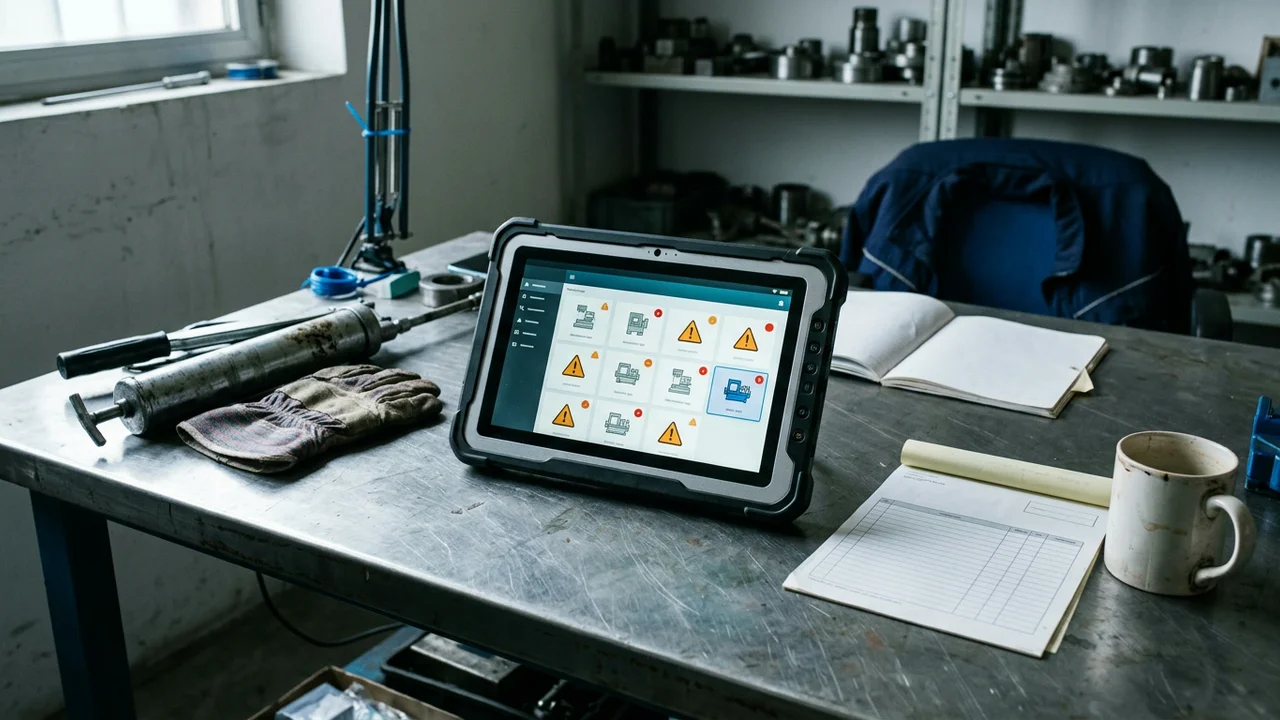
The Solution: AI Automation and a Tailored ERP to Keep Deadlines in Sight
The practical solution is to connect scheduled maintenance to a custom ERP that reads available usage data and notifies those managing the machines, reducing the manual handoff that today causes deadlines to be missed.
Leomat designs and builds custom management systems starting from the company's real processes, not from a generic template. This means the maintenance deadline no longer lives in a separate file, but inside the same system that manages orders, inventory and production: when the threshold is reached, the alert goes out automatically, to the right person, with the history of previous interventions already visible.
A useful in-depth look at this topic can be found in custom software for manufacturing SMEs, when off-the-shelf tools hold you back, which explains why a generic system often fails to cover the specific needs of a production line.
Those Who Have Little Time to Manually Track Every Deadline
Automating alerts means freeing up time currently spent manually checking multiple different sources, so it can be devoted to more important operational decisions.
Those Who Want to Connect Maintenance to Other Business Processes
A custom ERP does not manage maintenance in isolation: it connects it to spare parts inventory, estimates and production, as also described in 7 signs your software systems are not talking to each other.
A Real Case: From 8 Hours to 5 Clicks in Estimate Management with a Custom ERP
A concrete example of a custom ERP applied to a construction company reduced the preparation of an estimate from 8 hours to 5 clicks, in 30 days.
This case, delivered by Leomat for a construction company, illustrates the same principle applicable to maintenance: a process that today requires hours of gathering scattered data can be reduced to a few steps if the system is built around the company's real workflow, not around a standard module. The same approach, applied to scheduled maintenance, means moving from "manual checking of multiple sources" to "automatic alert with history already ready."
A custom management system should not add complexity: it is built on the company's real workflow, not on a generic module, and removes manual work wherever the process allows it.
How to Get Started: Concrete Steps to Digitalise Maintenance
The first concrete step is to map where maintenance deadlines currently live (diaries, files, people's memory) and to understand what machine usage data is already available.
From there, a system is built that centralises deadlines in a single place, generates automatic alerts and, where needed, integrates with other business processes already in use. There is no need to start from scratch or replace everything at once: you start from the most critical point, often the production line with the most unplanned stoppages, and expand from there.
- Map the current sources of maintenance deadlines
- Identify which machine data is already being collected
- Define intervention thresholds for each machine, starting from the manufacturer's guidelines and mandatory periodic checks, to be confirmed with the safety officer
- Build an automatic alert workflow linked to real data
- Extend the system to other connected business processes
How Leomat Helps SMEs Digitalise Maintenance
Leomat builds custom management systems that start from the company's real processes, without over-engineering solutions that nobody ends up using. The goal is not to sell a relabelled standard software package, but to understand where maintenance is currently getting lost and to build the workflow that makes it visible and automatic. Those who want to assess where to start can request a direct conversation at leomat.it, with no commitment.
Frequently Asked Questions About Scheduled Maintenance in SMEs
How Much Does It Cost to Implement an Automated Scheduled Maintenance System?
The cost depends on the complexity of the existing processes and the number of machines to manage. A custom ERP is built starting from the most critical point, avoiding over-engineering unnecessary features, so the investment remains proportionate to the company's actual needs.
Is Predictive Maintenance Relevant Even for Older Machines?
Yes, in its simplest form: even older machines can be connected to an alert system based on usage hours and cycles (which is scheduled maintenance; true predictive maintenance requires data on the machine's condition), without necessarily installing sophisticated sensors. The important thing is to have reliable minimum data on which to build intervention thresholds.
How Long Does It Take to Digitalise Maintenance Management?
It depends on the complexity of the current process and the machine data available: any figure given before reviewing them would be invented. As a reference from a different process, in the ERP Costruzioni case study, estimate preparation went from 8 hours to 5 clicks in 30 days.
Is an In-House IT Team Required to Manage These Systems?
No, the goal of a custom ERP built by an external partner is precisely to allow SMEs without an IT manager to use the system without needing to understand all the technical details behind it, with ongoing support from the technology partner.
This post was created with AI
Content (text, processing, quotations and images) generated or artificially manipulated by artificial-intelligence systems. Notice provided under the transparency obligations of Article 50 of Regulation (EU) 2024/1689 (AI Act), applicable from 2 August 2026.