Management Software for SMEs with AI Integration: When to Switch
Is your management software holding back your growth? Discover the concrete signs that indicate when it's time to move to a tailored ERP with integrated AI for your SME.
AI-integrated management software for SMEs: the signs it's time to change
AI-integrated management software for SMEs is a business operating system capable of automating workflows, analyzing data in real time and adapting to the company's specific processes, without requiring an in-house IT team. Unlike traditional management systems, an AI-ready platform communicates with other tools, learns from historical data and reduces repetitive manual work in a measurable way.
The management software market for small and medium-sized Italian businesses is undergoing a profound transformation. In Italy, however, many small and medium-sized enterprises continue to work with management systems installed years ago, often outdated and unable to communicate with new technologies. The result is an invisible brake on growth, made up of wasted hours, manual errors and decisions made without reliable data.
The signs that your current management system is holding back growth
If your team spends more time exporting data to spreadsheets than using it to make decisions, the management system is already an obstacle to growth, not a support tool.
Recognizing the signs of an outdated management system is not always straightforward, because teams often get used to working around the system's limitations. Parallel spreadsheets are created, tasks are duplicated, emails are sent to update data that should synchronize automatically. All of this has a real cost, even if it never appears in any budget line.
A typical example: every week someone manually cross-references warehouse data with incoming orders, using different programs that don't communicate with each other. When the systems are connected, this becomes a task that can be automated, freeing up that time for work that requires judgment.
The most common signs of an inadequate management system are:
- Data scattered across multiple tools that do not synchronize automatically (management system, spreadsheets, email, separate CRM).
- Manually generated reports requiring hours of work every week or month.
- Inability to integrate new tools such as e-commerce platforms, electronic invoicing systems or modern CRM solutions.
- No real-time visibility into inventory, projects, cash flow or margins.
- Stalled vendor updates or dependence on software that is no longer actively supported.
- Frequent errors from manual data entry that require after-the-fact checks.
- Slow response times when a customer asks about the status of an order or an accounting situation.
The hidden cost of operational inefficiency
Every hour spent doing things that an intelligent system could handle on its own is an hour taken away from growth. Even a few minutes of avoidable manual work per day per person, multiplied by the number of people and working days, adds up to an annual total of hours worth calculating. Multiplied by the hourly cost, it produces a figure to compare against the cost of a modern management system.
When the problem is not the staff, but the tool
A common mistake is to attribute operational inefficiencies to people, when the real bottleneck is actually the software. If your team is competent but slow, if data is always delayed, if decisions are made by intuition because there are no reliable reports, the problem is almost certainly structural. Changing people solves nothing if the tool remains the same.
What AI integration in SME management software really means
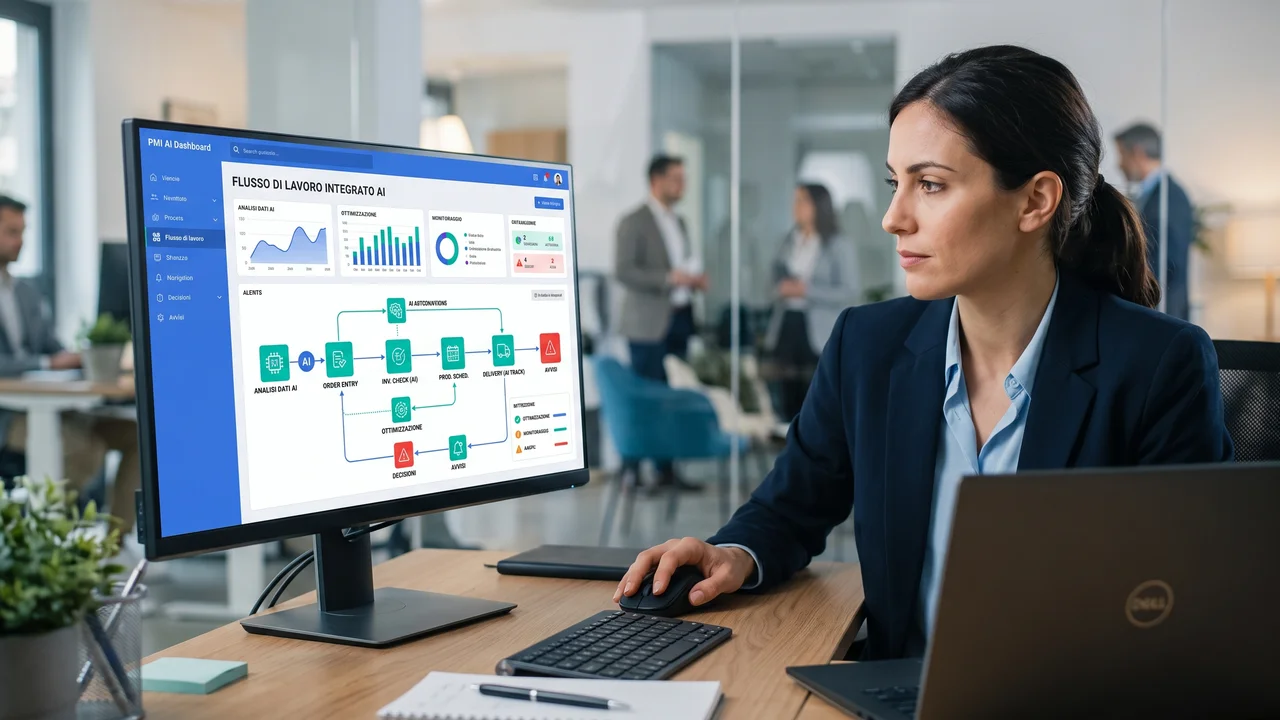
Integrating AI into an SME management system does not mean adding a chatbot: it means making the system capable of analyzing data, forecasting scenarios and automating operational decisions without continuous human intervention.
The term "integrated AI" is used very loosely in the software market. It is worth distinguishing between levels of real integration, because not all solutions offer the same operational value. A management system that displays an automatically generated chart is different from one that sends an alert when stock is about to run out, which is different again from one that automatically generates a purchase order based on forecast demand.
The levels of AI integration in a modern management system are structured across three degrees of depth:
- Level 1 (Automated reporting): the system aggregates and displays data without manual intervention. Useful, but not transformative.
- Level 2 (Alerts and suggestions): the system identifies anomalies, flags opportunities or risks and suggests actions. This reduces the cognitive load on management.
- Level 3 (Decision automation): the system autonomously executes predefined actions (reordering, sending documents, updating prices) based on rules and predictive models, with human confirmation for sensitive actions until the system proves reliable. This is where real operational savings are generated.
For an Italian SME without an in-house IT team, the realistic goal for 2026 is to reach Level 2 in the initial phase and scale toward Level 3 on specific processes, for example inventory management, quote generation or monitoring of upcoming payments.
Traditional management system vs AI-ready management system: concrete operational differences
The main difference between a traditional management system and an AI-ready one is not aesthetic: it lies in the system's ability to act on data, not just store it.
To understand the real distance between the two approaches, it is useful to look at concrete operational cases. Take the preparation of a quote, which with a traditional management system requires data collection, calculations and document formatting. In the ERP Costruzioni case study carried out by Leomat, preparing a quote went from 8 hours to 5 clicks, in 30 days.
The most relevant operational differences between the two types of system concern:
- Speed of document generation: the AI-ready management system produces quotes, orders and reports automatically, drawing on data already present in the system.
- Native integration with other tools: it connects via API with e-commerce platforms, CRM systems, electronic invoicing platforms and communication tools, without manual exports.
- Continuous updating: data is always current, not updated at the end of the day or the end of the week.
- Scalability without rewriting: modules are added as the company grows, without having to change the entire system each time.
- Pure code, fewer third-party tool dependencies: unlike solutions built on no-code platforms, a management system developed in pure code reduces dependencies on third-party platforms and allows genuine customization.
The problem with no-code solutions in business management systems
Some management solutions rely on no-code or low-code automation layers that introduce dependencies on third-party platforms, customization limitations and service interruption risks when those platforms change their policies or pricing. A management system developed in pure code, such as those built by Leomat, reduces these dependencies and leaves the company in control of its own system, even in sector-specific scenarios.
When it makes sense to move to a custom ERP with integrated AI
The right moment to move to a custom ERP with integrated AI is when the cost of inefficiency exceeds the cost of migration, or when planned growth requires an operational capacity that the current system cannot support.
There is no universal answer, because every SME has different processes, different volumes and different priorities. However, there are some objective conditions that make migration not only sensible, but necessary.
A common scenario: a service company grows, but the management system purchased when it was smaller can no longer handle the volume of projects, clients and documents. The system slows down, backups are manual, integrations with the new CRM are impossible without costly development work. The question is no longer "whether" to change, but "how" to do so without disrupting operations.
The key moments at which to seriously consider migration are:
- The company is growing and current processes cannot scale without hiring new people solely to manage data.
- New sales channels are being opened (e-commerce, marketplaces, export) that require integrations the current management system does not support.
- The current software vendor has not released significant updates in more than 12 months.
- An expansion, merger or certification is being planned that requires advanced traceability and reporting.
- Management makes important decisions without reliable data because reports take too long to produce.
Custom ERP vs standard ERP: which to choose for an SME
A standard ERP (such as those offered by large international vendors) covers the common needs of an SME well, but sector-specific or company-specific processes often require costly customizations or manual workarounds. A custom ERP, by contrast, starts from the company's actual processes and translates them into software logic, without forcing the company to adapt to the software. For SMEs with particular processes, such as manufacturers, construction firms or professional service providers, this difference can translate into significantly less manual work.
How to evaluate migration without disrupting business operations
A well-planned management system migration does not disrupt operations: it runs alongside them gradually, with parallel phases and a progressive rollout by functional area.
The most common fear among business owners considering a management system change is the "zero moment": the day the old system is switched off and the new one is switched on, with the risk that everything comes to a halt. This fear is understandable, but it is the sign of a poorly planned migration, not an impossible one.
A correct approach involves distinct phases, with parallel operation periods in which the old and new systems coexist, allowing the team to become familiar with the new tool without operational pressure. The rollout happens by module or by business area, starting with the least critical ones or those where the gain is most immediate and visible.
The typical phases of a management system migration for an SME are structured as follows:
- Phase 1 (Process mapping): analysis of current workflows, identification of bottlenecks and definition of requirements for the new system.
- Phase 2 (Configuration and development): building the custom management system, with internal testing and validation of migrated data. Duration depends on complexity.
- Phase 3 (Parallel operation): the new system runs alongside the old one on a subset of processes. The team learns without operational pressure.
- Phase 4 (Progressive go-live): gradual decommissioning of the old system by area, with active support from the technology partner during the first few weeks.
- Phase 5 (Continuous optimization): monitoring of KPIs, addition of AI modules and refinement of automations based on actual usage.
The role of the technology partner during migration
The difference between a successful migration and a failed one is almost never technical: it is relational. A technology partner who understands the SME's processes, who is present during critical phases and who guides the team in using the system is worth far more than a technically superior piece of software delivered without support. This is why Leomat works with a results-oriented approach, starting from a small, useful slice of the problem that goes into production quickly. Among the case studies: About Medically (85% faster document generation in 90 days) and ERP Costruzioni (from 8 hours to 5 clicks for a quote in 30 days).
Checklist: is your management system AI-ready, or is it time to change?
Answering this checklist honestly takes less than five minutes and can help you understand whether your current management system is still adequate or whether you are already paying the cost of obsolescence every day.
Use this checklist as a self-assessment tool. For each question, answer yes or no. If you get more than four negative answers, your management system is probably holding back your company's growth in a measurable way.
- Does your management system integrate natively with your CRM, electronic invoicing and the other tools you use every day?
- Can you obtain an up-to-date report on margins, inventory or cash flow in less than two minutes, without manual intervention?
- Does the system automatically alert you when something requires attention (low stock, upcoming payments, data anomalies)?
- Can your staff generate operational documents (quotes, orders, delivery notes) independently, without manual steps?
- Has your software vendor released significant updates in the last 12 months?
- Does the system scale without issues if the volume of orders, customers or employees doubles?
- Is the management system's data accessible on the go, from any device, without a VPN or installed software?
- Can you add new modules or features without having to replace the entire system?
If most of the answers are negative, it does not mean your team is working poorly. It means they are working with tools that were not designed for the operational context of 2026. The good news is that the upgrade path can be tackled in phases, starting from a small, useful part of the problem rather than a complete overhaul.
Frequently asked questions about AI-integrated SME management software
How much does it cost to move to an AI-ready management system for an SME?
The cost of a custom ERP for an Italian SME varies depending on the complexity of the processes and the number of modules required. Any figure given before examining the processes and systems would be invented: two projects that look identical can cost very differently. It is also important to factor in the cost of current inefficiency, to compare it against the cost of migration.
How long does it take to implement a custom management system?
Timelines depend on the complexity of the company and the number of processes to be covered. Any number given before examining the processes and systems would be invented. Leomat's method is to start from a small, useful slice of the problem, which goes into production quickly and can be evaluated in the field: in the ERP Costruzioni case study carried out by Leomat, preparing a quote went from 8 hours to 5 clicks in 30 days.
Is it possible to integrate AI into an existing management system without replacing it entirely?
In some cases yes, but it depends heavily on the architecture of the current system. If the management system exposes accessible APIs and the data is structured consistently, it is possible to add AI automation layers without a complete replacement. However, this solution has structural limitations: AI can do little if the underlying data is fragmented or of poor quality. A preliminary technical assessment is always necessary before deciding whether to upgrade or replace.
How do I know if my current management system is AI-ready?
An AI-ready management system must meet three basic conditions: expose documented APIs for integration with external systems, store data in structured format updated in real time, and support the execution of automated logic based on triggers. If your current system does not meet at least two of these conditions, it is likely that any AI integration will require a disproportionate investment relative to the results achievable.
What happens to historical data during migration to a new management system?
Migrating historical data is one of the most delicate phases of any management system change. An experienced technology partner plans this phase carefully, running the migration in test environments before go-live, verifying data consistency and keeping an archive of the old system accessible in read-only mode for a transition period. Historical data is also valuable for AI, because it is used to train predictive models on the company's specific patterns.
This post was created with AI
Content (text, processing, quotations and images) generated or artificially manipulated by artificial-intelligence systems. Notice provided under the transparency obligations of Article 50 of Regulation (EU) 2024/1689 (AI Act), applicable from 2 August 2026.