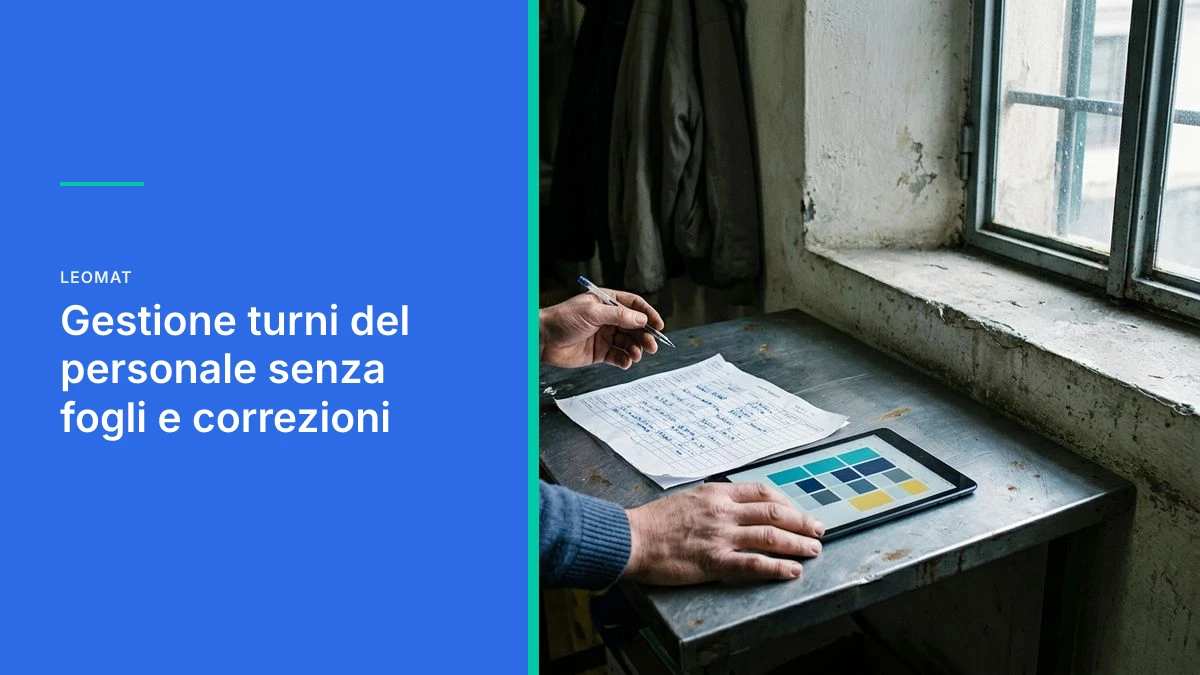
Staff Shift Management Without Paper and Corrections
Paper-based and spreadsheet schedules break down with every absence. Here are the warning signs, the hidden costs, and how a tailored process restores a single version of the plan.
Why staff shift management stays on paper and spreadsheets
Staff shift management is the process by which a company assigns schedules, coverage and substitutions to those who need to be on duty. When this work stays on paper, on a whiteboard or on a spreadsheet sent via messages, every change goes through phone calls, handwritten corrections and versions that do not match. The result is a fragile plan: absent staff are not replaced in time, people on holiday still appear on the rota, and the manager spends the week chasing confirmations instead of organising work.
In many Italian SMEs, shifts remain an analogue object because the method is familiar and requires no IT project. The problem is felt by those who every Monday reconstruct coverage from sheets, sticky notes and conversations. Three pieces of information are usually missing from the same place: who is available, which skills cover which time slot, and which version of the plan is the real one. As long as these pieces live in different channels, every absence becomes an emergency and the plan gets rewritten under pressure.
What improvising shifts every week really costs
Improvising shifts costs above all coordination time, coverage gaps and tension between those who work and those who organise.
The visible cost is the sheet that needs redoing. The hidden cost is the chain that starts from a change that was never communicated: an uncovered slot, an unplanned overtime shift, a waiting customer, a shift supervisor calling three people to fill a gap. In an SME this happens silently, because nobody counts the catch-up phone calls. People look at the payslip, not the time lost reconciling three versions of the same plan.
Those who close shifts on paper keep constraints in their heads that the sheet cannot check: minimum rest periods, skills, reduced hours, already-signed holiday requests. When the mind is tired, a constraint slips through. Then comes the complaint, the leave to recover, or the shift assigned to someone who cannot do it. No figure is needed to understand the mechanism: if the only memory is a person, the process is not repeatable and every week starts from scratch.
Paper does not fail because it is old: it fails because it does not alert, does not check constraints and does not hold a single source of truth.
The signals that the current method no longer scales
The method stops scaling when the plan changes faster than it can be communicated to everyone.
The first signals are operational, not technological. They arrive when the number of people, locations or time slots exceeds the memory of whoever keeps the register. At that point, staff shift planning becomes a full-time job disguised as a few minutes on Monday. The problems with paper-based shifts do not explode in a single day: they accumulate in copies, oversights and favours asked for in the evening.
- Two different sheets circulate on the same day and nobody knows which one is valid.
- Substitutions are finalised late, with messages that never make it into the plan.
- Holiday and leave requests sit on a separate calendar, so the rota ignores them.
- New starters learn the shifts by word of mouth, because the rules are never written down.
- The manager is the only person capable of making the week add up.
- Every workload spike, whether from sick leave, urgent orders or public holidays, reopens the chaos.
- Talk of shift management software continues, but the sheet is still printed out just in case.
Those who have little time to close shifts every week
For those with little time for the daily routine, sheets pile up precisely during the hours when work should have stopped. Monday starts with a plan, by Wednesday it is already outdated, and Friday is spent patching things up. The will is not lacking: what is missing is a single place where availability and coverage are updated together, without a new phone call for every gap and without copying names by hand from one list to another.
Those who cover a warehouse and production across multiple time slots
A warehouse or department covering three shifts, with people of different skills, cannot rely on a sheet that does not know whether two experienced operators are already on holiday. Here shift organisation is intertwined with production: if the person who knows a machine is absent, the line waits. The same applies in a laboratory or a continuous service, where a shift is not an abstract schedule but real coverage of the work.
Those who keep holiday, leave and substitutions on separate registers
When absences live on one register, shifts on another and substitutions in messages, the plan is always behind reality. Those who manage people across one or two sites see this every week: the change exists, but it has not reached the person who was supposed to show up. Digitalising does not mean putting everything into a well-known programme. It means making three lists that currently do not talk to each other finally align.
How a tailored automation simplifies shifts
A tailored automation collects availability, constraints and absences in a single flow, so the plan updates without rewriting the sheet by hand.
Automating work shifts is not a prettier calendar. It is a sequence of rules the company already uses verbally, made explicit: who can cover which role, which rest periods are untouchable, who has already worked the weekend, what happens when a leave request comes in. The software does not invent shifts in place of the manager: it removes the work of recopying, checking and notifying people.
In practice, it changes the point at which errors arise. Today an error arises when one person updates a sheet and another works from a copy. With a single process, the change lives in one place and whoever is on shift sees the same information. For an SME without an internal IT office, this matters more than a screen packed with features. What is needed is a flow that talks to data already present in the management system, not a new island to feed by hand. The same reasoning applies when evaluating a management system for SMEs with AI integration: you change when the data from daily work remains outside the system.
A shift plan is reliable only when a single true version exists, visible at the same moment to those who organise and those who work.
Why pure code holds up better than ready-made modules
A standard module adapts to the average company; the shifts of an SME follow exceptions that module does not know.
Off-the-shelf packages promise planning in a few clicks, then ask you to fit holiday requests, secondments, skills and internal agreements into fields that do not exist. You go back to the backup sheet. The pure-code approach goes in the opposite direction: you start from the real rules of the shift and write only what is needed, connected to data already in the company. You do not assemble visual building blocks from third parties that age and remain disconnected from the rest of the system.
This choice matters for those without an internal technical team. A flow written to measure can grow with a new site, a new contract or an internal constraint, without starting over from a catalogue of useless features. It is the same reason why many manufacturers, when ready-made tools slow them down, look for custom software for manufacturing SMEs instead of another sheet disguised as an application. Those who assess the budget often find the same obstacles described in the five budget mistakes that block automation in an SME: the tool is purchased, but the process is not funded.

Where to start to digitalise staff shifts
You start by listing the rules, exceptions and channels currently used to communicate the shift, not by choosing a screen.
The temptation is to open a product comparison. For an SME without technical staff on the team, a process map is more useful. First you write down what must remain true, such as minimum coverage, skills and notice periods, then you decide what a system can do and what remains a human decision. Only then does it make sense to talk about screens. If you reverse the order, you adapt the company to the programme and the sheets stay on as a backup "for special cases", which turn out to be all cases.
- Phase 1 (Mapping): list time slots, roles, sites and who can cover what.
- Phase 2 (Constraints): write down rest periods, reduced hours, holiday requests and rules that currently exist only in someone's head, verifying with the labour consultant which ones derive from law and collective agreements.
- Phase 3 (Channels): note where the source of truth currently lives, whether in a sheet, a noticeboard or messages.
- Phase 4 (Exceptions): collect the cases that break the plan, such as sick leave and workload spikes.
- Phase 5 (Human decision): define who approves a change and who is notified.
- Phase 6 (Connection): check whether absences and staff records already exist in the management system.
When holiday requests sit on one register and substitutions in messages, a hundred features are not needed. What is needed is for an approved holiday request to remove the person from the plan and for the substitute to receive the same information, without a third sheet. If this step is not clear, any screen will reproduce the disorder, just in different colours.
How Leomat brings order to the processes around shifts
Leomat builds automations and custom management systems in pure code, so shifts stop living on sheets disconnected from the rest of the company.
Technology should not be a privilege of large enterprises: it needs to be made concrete and measurable for those who want to grow without complicating their lives. Leomat works with Italian SMEs on AI automations, custom software solutions and intelligent workflow integration. Among the services offered is the development of custom management systems, useful when staff records, absences and planning need to live in the same system rather than on parallel registers.
The approach is to write only what is needed, without over-engineering. A concrete example of this method, applied to another repetitive process, is ERP Costruzioni in the construction sector: drafting a quote went from 8 hours to 5 clicks in 30 days. It is not a project about shifts, and it is honest to say so. It does show, however, what happens when a lengthy, manual, exception-filled task is brought into a flow written around the company's real rules. The same principle applies to staff shift management: fewer copies, a single source of truth, human decisions where they are needed.
Behind this is a software engineering firm based in Naples, which designs and builds custom web software and the entire environment in which it runs. The point for those who organise shifts is not the showcase: it is having a partner who starts from the Monday morning process and translates it into code, without requiring an internal IT office.
Frequently asked questions about shift management
What is staff shift management in an SME?
It is the way time slots, roles and substitutions are assigned to those who need to be on duty. In an SME it includes skill constraints, rest periods, holiday requests and minimum coverage requirements. If these facts are not held together, the plan becomes a continuous negotiation. A good process makes a single version of the shift visible and leaves decisions, not recopying, to the manager.
Why do paper-based shifts create errors even in small companies?
Because paper does not alert those on shift and does not cross-reference absences with coverage. Even with few people, two copies of the sheet are enough to send someone in on the wrong day. Substitution messages never make it into the plan, so the following week starts from a list that is already out of date. A small company is not immune: it simply has less margin when a slot is left uncovered.
Is dedicated shift management software needed, or is the management system enough?
It depends on where the data currently lives. If holiday requests, staff records and attendance are already in the management system, what is often needed is a flow that uses them, not a new island. A standalone shift programme fed by hand simply reproduces the sheet. Dedicated software is worth considering when coverage constraints are numerous and the management system cannot express them. In either case, the company's real rules come before the screen.
How do you move from sheets to a digital process without stopping work?
You run both in parallel: map the rules and exceptions, choose a pilot site or department, and keep the sheet only as a check for a few weeks. When the digital version matches the real one, you switch off the paper. You do not change everything the following Monday. You reduce the double work, then eliminate it. The transition fails if people are asked to fill in two systems indefinitely.
Does artificial intelligence replace the person who makes the shifts?
No. It can help suggest coverage, flag a missed constraint or prepare a notification, but approval remains human. Shifts touch agreements, skills and relationships between colleagues. A useful automation removes recopying and oversights; it does not decide on behalf of someone who knows the department. If a suggestion does not match the facts on the ground, it should not be published as a final shift.
This post was created with AI
Content (text, processing, quotations and images) generated or artificially manipulated by artificial-intelligence systems. Notice provided under the transparency obligations of Article 50 of Regulation (EU) 2024/1689 (AI Act), applicable from 2 August 2026.