
The Excel-based warehouse that is costing you online sales
If your stock still lives in a spreadsheet, every day you risk overselling, cancelled orders, and lost customers: here is why it happens and how to fix it.
Warehouse management on Excel and ecommerce, lost sales: the problem nobody sees until it's too late
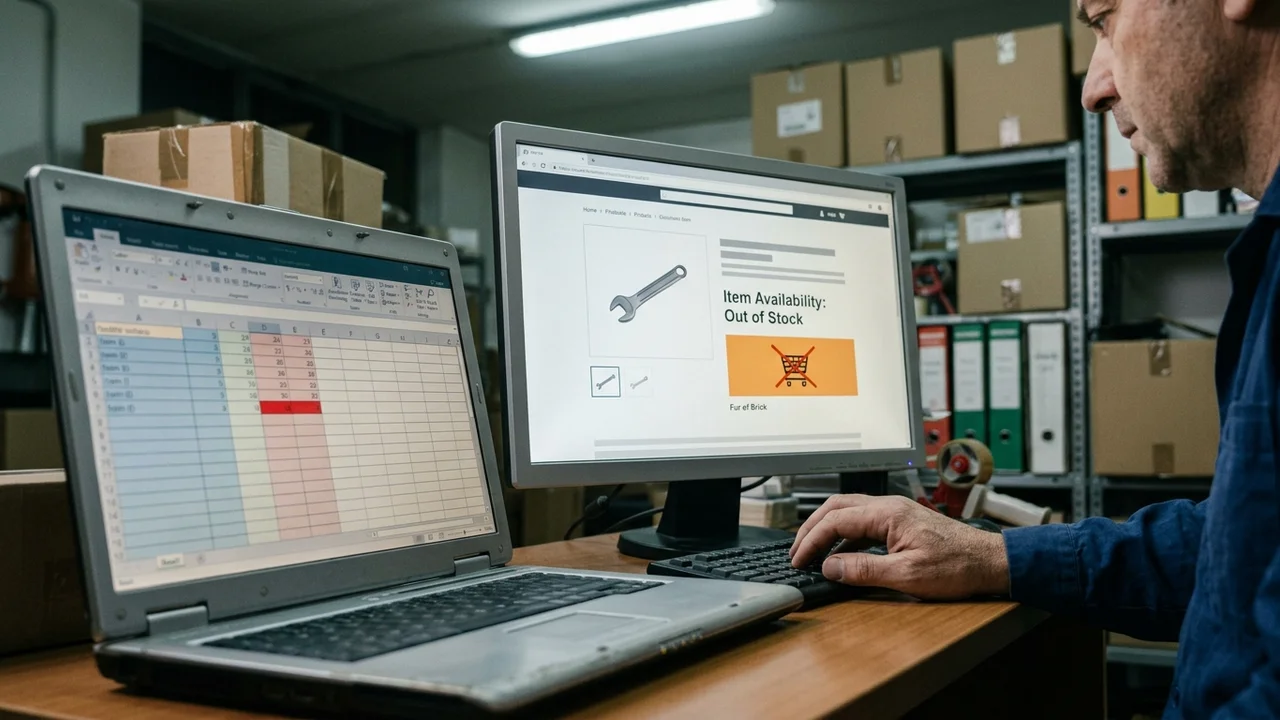
Managing a warehouse on Excel in an ecommerce business means that real stock and the inventory shown online almost never match in real time. Every sale, return or replenishment must be updated manually, and in the time between the physical operation and the file update, the website keeps selling products that may no longer be available. The result is overselling, cancelled orders and dissatisfied customers.
The mechanism is straightforward: the Excel file does not communicate with the ecommerce platform, the management system, or any connected marketplaces. Each sales channel reads a different stock level, updated by different people at different times. When a product is sold on a marketplace but the file is not touched for hours, the website keeps selling it even though it is already out of stock. This is not an isolated human error: it is a structural limitation of a spreadsheet that was never designed to synchronise with anything.
How many sales you actually lose with a warehouse on Excel
Every mismatch between real stock and online stock translates into an order at risk of cancellation, a customer waiting for a refund and a negative review that weighs more heavily than a single missed sale.
The problem is not just the lost order itself. It is the time the sales team spends writing apology emails, handling refunds and explaining to customers why the product they ordered is unavailable. All this manual work, born from an avoidable mistake, accumulates week after week and becomes a hidden fixed cost embedded in business processes.
- Confirmed orders that are subsequently cancelled due to lack of real stock.
- Team time spent managing returns and refunds instead of selling.
- Negative reviews linked to unexpected delays or cancellations.
- Customers who abandon their cart after a previous negative experience.
Overselling and cancelled orders: the hidden cost of the spreadsheet
Overselling occurs when the same product is sold across multiple channels without a system that updates availability in real time across all of them simultaneously.
With Excel, stock updates depend on whoever physically opens the file and edits it. If a warehouse operative is busy, if someone is on leave, if the file is saved with a delay, the risk of selling the same item twice increases. This is not a question of the competence of the people involved: it is a structural problem with a tool that was never built to handle real-time flows.
An ecommerce business that updates stock manually does not have a warehouse problem: it has a synchronisation problem between systems that do not communicate with each other.
Those who manage multiple sales channels simultaneously
Anyone selling on their own website, marketplaces and perhaps also a physical store multiplies the risk of misalignment across every channel. Each channel reads stock in its own way, and without a central point that updates all of them together, the margin for error grows in proportion to the number of active channels.
Those with a broad catalogue of hundreds of product lines
More product lines mean more rows to update manually, a greater likelihood of typing errors and more time wasted searching for the right product in the file. A catalogue that grows from a few dozen to hundreds of items makes the Excel spreadsheet progressively more fragile and harder to manage.
Why stock misalignment gets worse as the ecommerce business grows
As order volumes increase, the time available to update the file manually decreases precisely at the moment when greater accuracy is needed most.
This is a common paradox among small and medium-sized businesses: warehouse management on Excel works reasonably well at low volumes and becomes unsustainable exactly when the business starts to scale. More orders mean more updates to carry out, more people involved in the process and more opportunities for error. Without a system that automatically synchronises physical stock with online stock, revenue growth brings with it a proportional increase in operational risk.
The solution: automatic warehouse-ecommerce synchronisation in pure code
A custom-built system in pure code connects the warehouse, ecommerce platform and marketplaces in a single flow, updating stock without manual intervention, within the timeframes each channel allows.
Unlike no-code or low-code solutions assembled with third-party tools, a custom-built system makes it possible to manage business-specific logic: reorder thresholds, channel priorities, stock allocation rules when multiple simultaneous orders arrive. Pure code also provides greater long-term stability, because it does not depend on external platforms that may change their rules or restrict integrations.
Those who want to automate without having to learn a complex tool
The team does not need to learn how to use a complicated new management software: a custom system integrates where the team already works, updating data automatically in the background.
Those with little time for internal training
Anyone without an in-house IT manager needs solutions that work immediately, without weeks of training. A well-designed automation reduces the workload rather than adding to it.
A Leomat case study in another area: ERP Costruzioni
With ERP Costruzioni, drafting a quote went from 8 hours to 5 clicks, in 30 days.
The ERP Costruzioni case concerns the preparation of quotes, not warehouse management, but the underlying principle is the same that applies to stock synchronisation: wherever there is a repetitive manual process prone to errors and wasted time, a custom system in pure code can automate it, giving time back to the team and reducing operational risk.
Automating does not mean adding complexity: it means removing every manual step from the process that could generate an error.
Where to start: the first steps towards a warehouse that is always up to date
The first concrete step is to map where stock is currently updated manually and to understand which sales channels read that data.
There is no need to start with a large-scale project: it is enough to identify the points where misalignment causes the most problems, such as the channel with the most orders or the best-selling product, and begin there. Even a brief analysis phase makes it possible to understand what level of automation is genuinely needed, without over-engineering a process that may simply require a direct connection between two systems.
- List all the sales channels that read the same stock.
- Identify who updates the file today and how frequently.
- Check which products generate the most overselling cases.
- Evaluate a custom synchronisation system for the critical channels.
- Monitor the results in the first weeks after activation.
To better understand how well-designed automation changes day-to-day work, it may also be useful to read how AI is applied in practice to warehouse management in manufacturing SMEs, or to explore why no-code tools show their limitations precisely in the most critical processes. Those who lose orders outside working hours may find useful insights in this article on automated overnight order management.
How Leomat can help you solve the misaligned warehouse problem
Leomat works with small and medium-sized businesses to build custom automations, developed in pure code rather than with third-party no-code tools, to provide stability and adaptability to the specific needs of each company. Among the services offered is the development of custom ERP systems, designed to connect internal processes, including the warehouse, without over-engineering what already works. Leomat's approach always starts with a concrete analysis of the company's real processes, to propose only the automation that is genuinely needed, without adding unnecessary complexity. If your ecommerce business is still caught between an Excel spreadsheet and the online storefront, you can find out how Leomat builds custom solutions for SMEs starting from your specific situation.
Frequently asked questions about warehouse Excel management and lost sales in ecommerce
How can I tell if my Excel-based warehouse is causing me to lose sales?
A clear signal is how often you receive orders that you then have to cancel due to lack of real stock. If this happens more than a few times a month, or if the team regularly spends time managing returns linked to incorrect availability, the Excel file is probably no longer able to keep pace with the actual volume of sales.
Does automatic stock synchronisation work with multiple connected marketplaces?
Yes, a custom-built system can connect the company's own website, marketplaces and other sales channels simultaneously, updating stock across all of them with every movement, within the timeframes each marketplace allows. The allocation logic between channels must be defined according to the company's specific priorities.
Is an in-house IT team needed to manage a warehouse-ecommerce synchronisation system?
No, a well-designed system in pure code is built to operate without requiring daily in-house technical expertise. The team continues to work with the tools it already knows, while the automation handles data updates in the background.
How long does it take to move from Excel to an automated system?
It depends on the complexity of the channels and processes involved. An initial analysis phase makes it possible to define a realistic timeline, avoiding over-engineering the solution relative to the company's actual needs.
This post was created with AI
Content (text, processing, quotations and images) generated or artificially manipulated by artificial-intelligence systems. Notice provided under the transparency obligations of Article 50 of Regulation (EU) 2024/1689 (AI Act), applicable from 2 August 2026.