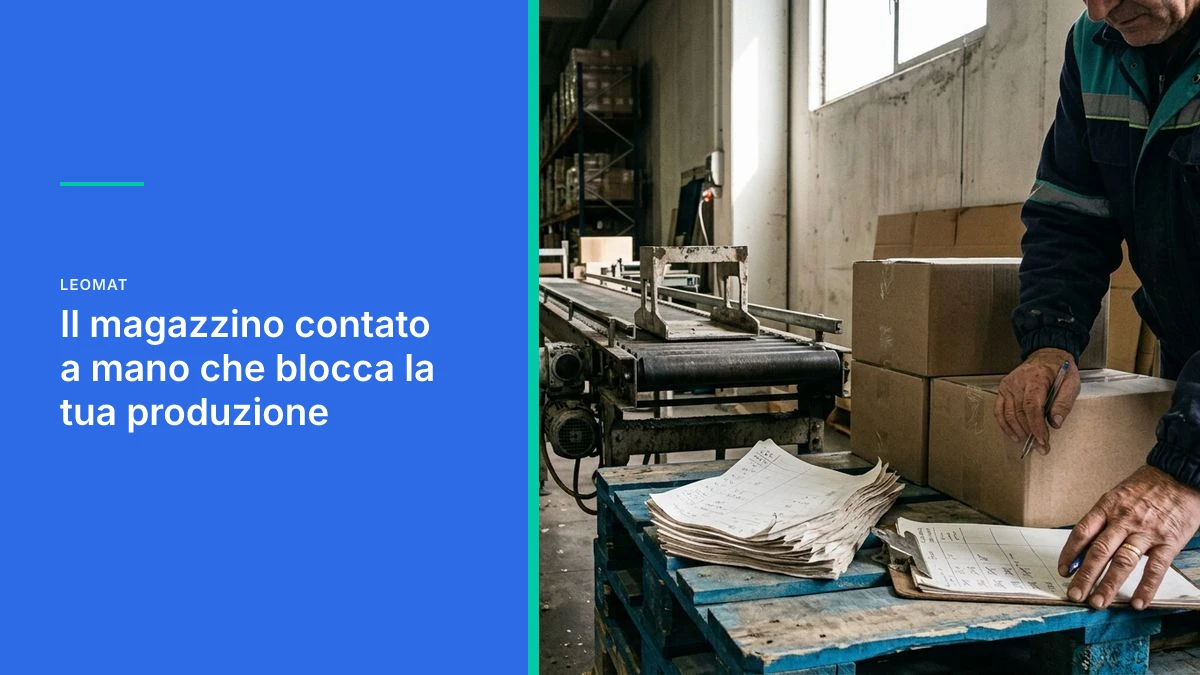
The manually counted warehouse that is stalling your production
If production is waiting on manual inventory counts, the problem is not the warehouse: it is the process. Find out how to unblock it with automation.
Manually managed warehouse and halted production: the signal you need to hear
When a manufacturing SME counts its warehouse by hand, production stops every time a stock availability confirmation is needed. This happens because the actual inventory data exists only in a warehouse worker's head or on an Excel spreadsheet that is always behind, and every operational decision must wait for someone to physically go and check.
The mechanism is easy to understand by observing what happens along the internal supply chain: the production order is issued, the purchasing office asks for stock confirmation, the warehouse responds with a physical walk through the shelves, and only then can production resume. In many SMEs this process lacks real-time data: the management system records movements at the end of the day, not at the moment they occur, and this disconnect between recorded data and actual data is what causes the stoppage.
Why it happens: the invisible signals of a manually managed warehouse
A manually managed warehouse shows clear warning signs before it brings production to a halt: stock recorded in the system but not actually available, duplicate reorders, and material that cannot be found even though it is present.
The first signal is the discrepancy between the quantity in the system and the actual quantity: this occurs when a pick is recorded after the operation rather than during it. The second is the duplicate reorder, which arises when two people check the same material using different sources (a file, a notebook, memory) and do not find the same number. The third, more subtle signal is the dead time an operator spends physically searching for a component because the system does not tell them exactly where it is.
- System stock quantities that differ from the physical quantities found on the shelf
- Production orders on hold while awaiting availability confirmation
- Duplicate reorders for materials already present in another area
- Operator time spent searching instead of producing
- Warehouse reports updated only at the end of a shift or the end of the week
The person who lives with this problem every day
Consider a mechanical workshop with a warehouse of components and raw materials. Every morning the production manager asks the warehouse to confirm the materials needed for the day's orders, and every time the answer comes only after a physical walk through the shelves. This is a common situation when warehouse data exists outside the production flow.
The real impact: delays, errors and lost margins in production
A manually managed warehouse does not only generate visible delays, it also produces hidden costs that accumulate at every stage of production.
The most obvious delay is the one affecting delivery to the end customer, but behind it lies a less visible effect: production scheduling becomes reactive rather than planned. If you do not know with certainty what you have available, you cannot organise shifts in advance, you cannot negotiate with suppliers with enough lead time, and you end up managing every day as an emergency.
A warehouse that does not communicate with production in real time is not just slow: it is a constant source of decisions made without actual data.
The cost of operator time
In a company with multiple production lines, every minute spent searching for material or verifying availability is a minute taken away from an activity that generates value. Multiplied across several people and several shifts, this time becomes a silent cost item that no balance sheet records as such, yet it shows up in the margins.
The solution: custom AI automation in pure code for the warehouse
Warehouse automation works when it connects physical movement directly to digital data, with no intermediate steps left to human memory.
Leomat works on solutions developed in pure code, not on third-party no-code or low-code tools: this makes it possible to build automation that is truly tailored to the company's specific workflow, without forcing the process into a standard tool. Pure code allows the warehouse, the management system and production to be connected directly, so every movement can be recorded when it happens, not at the end of the day.
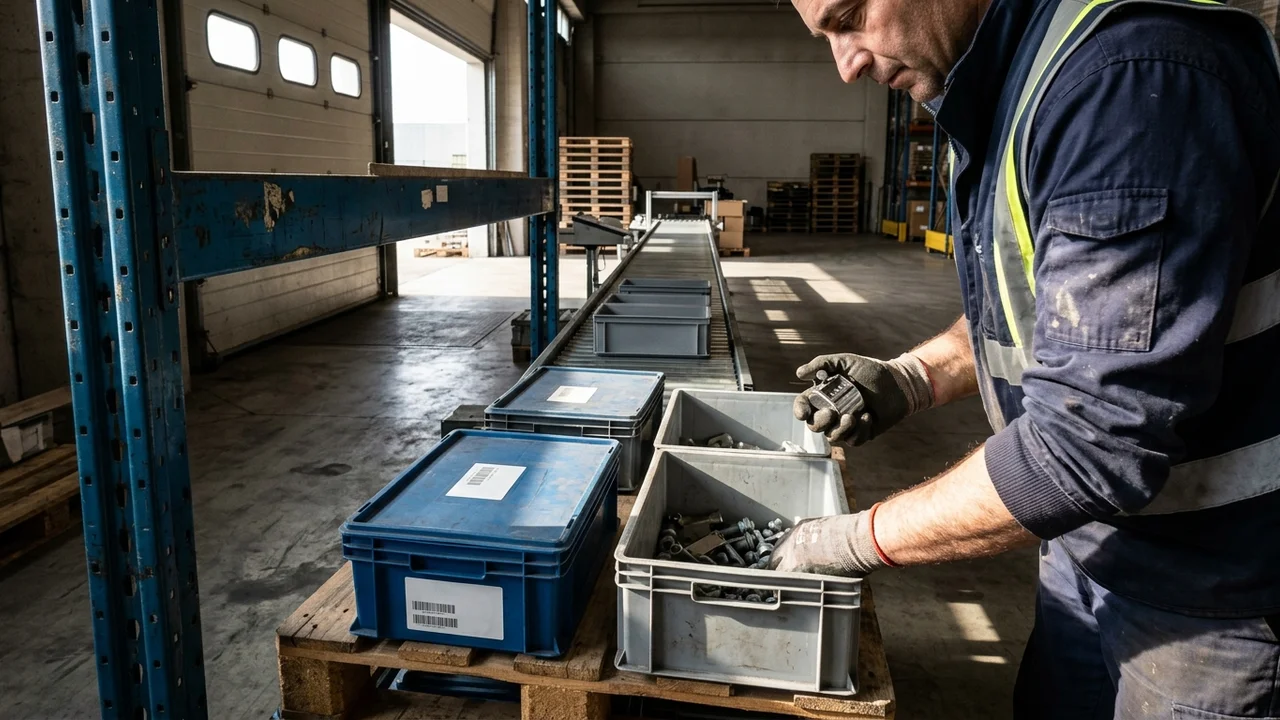
How it works in practice: from manual counting to real-time control
The transition from manual counting to automated control happens by mapping the actual warehouse flow and building custom automation, not by installing generic software.
The first step is understanding where the disconnect between recorded data and actual data originates: it is often at the point of picking, not at reordering. The second step is designing automation that captures that exact moment, connecting the warehouse and production without manual intermediate steps. The third step is integrating this flow with the existing management system, so the company does not have to replace its entire setup, only the point where it currently loses time and data.
- Analysis of the actual warehouse flow, not just the management system in use
- Identification of the exact point where data is lost or arrives late
- Design of custom automation in pure code
- Integration with existing systems without over-engineering the process
- Operational testing with the warehouse and production team before go-live
A second scenario: the small multi-reference manufacturer
Consider a company that produces components on order and manages many different references across raw materials and semi-finished goods. Without automated control, every new order requires a manual verification that can take hours. With an automated flow connected to production, the same verification becomes an immediate consultation of actual data.
A concrete case: measurable results with Leomat
In the construction sector, a custom automation solution made it possible to move from manually drafting a quote to a process completed in just a few clicks.
The ERP Costruzioni case built by Leomat shows how a process that required eight hours of manual work was reduced to five clicks in thirty days. It is not a warehouse case, but the principle is identical: when a company replaces a manual process with a custom-built automated flow, the time recovered shows up in daily operations, not only in end-of-month figures.
The time a company recovers by automating a manual process is not a theoretical saving: it is time that becomes available for producing, not for verifying.
Where to start: the first steps to unblock production
The first concrete step is not buying software, it is mapping exactly where the manual warehouse is slowing down production.
Before any automation, an honest picture of the current process is needed: how many minutes are lost every day to manual checks, how many times a production order is left waiting, how many duplicate reorders were placed in the last quarter. This mapping, even done internally with pen and paper, is already the first step toward a tailored solution.
Questions to ask before automating
Which materials generate the most counting errors? Which departments wait the longest for an availability confirmation? Answering these questions helps identify where automation will deliver the most immediate benefit, rather than automating everything without any priority.
How Leomat helps SMEs unblock production
Leomat works with companies and SMEs to transform manual processes, such as warehouse counting, into custom automated flows built in pure code rather than with standardised tools. The goal is not to sell generic software, but to understand where the process truly stalls and to design a solution that adapts to the company without over-engineering what already works. Those who want to build a custom ERP to manage warehouse, production and orders in a single flow can discover how Leomat builds custom AI automation for SMEs.
Frequently asked questions
Why does a manually managed warehouse halt production?
Because stock data is not updated at the moment material is picked or used. Production must wait for a physical verification before it can proceed, and this generates idle time that accumulates every day, especially when production orders are numerous.
How much does it cost to automate the warehouse of an SME?
The cost depends on the complexity of the current process and the level of integration required with the systems already in use. There is no standard solution: custom automation is designed after analysing exactly where the problem originates, to avoid paying for features the company would never use.
Is warehouse automation only for large companies?
No: even an SME can benefit from it, especially when discrepancies are currently corrected by hand and there is no internal IT team. Custom automation, without over-engineering, allows even a company with a few dozen employees to have real-time control.
Is it better to use standard software or a custom solution?
It depends on the process. Standard software may be sufficient for simple needs, but when the production flow has specific characteristics, a custom solution in pure code avoids forcing the company into a process that does not fit, and integrates more effectively with existing systems.
Where do you start to understand whether your warehouse needs automation?
By mapping the current process: how many minutes are lost every day to manual checks, how many times production is left waiting for stock confirmation, how many duplicate reorders have occurred in recent months. This data, even when collected internally, already indicates where automation would deliver the greatest benefit.
This post was created with AI.
Content (text, processing, quotations and images) generated or artificially manipulated by artificial-intelligence systems. Notice provided under the transparency obligations of Article 50 of Regulation (EU) 2024/1689 (AI Act), applicable from 2 August 2026.