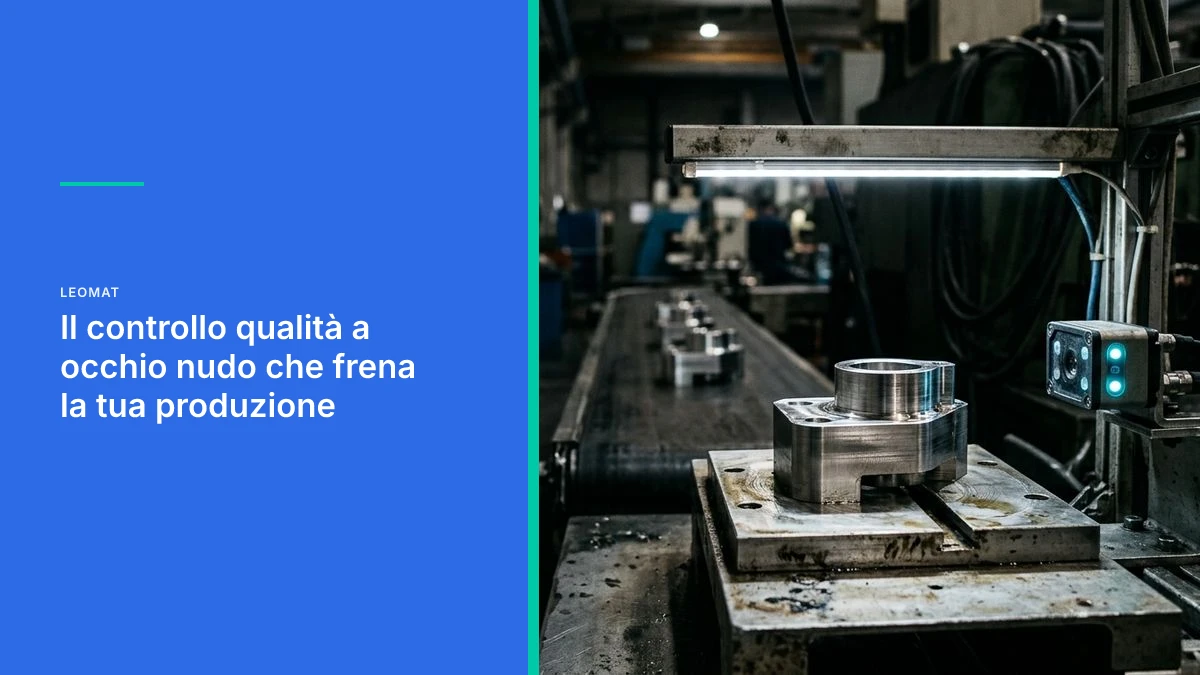
The naked-eye quality control that is slowing down your production
Why manual quality control slows down production and raises hidden costs, and how automation can help make it more consistent.
Automated quality control in manufacturing: why the human eye is no longer enough
Automated quality control in manufacturing refers to the set of AI technologies that replace or support manual visual inspection on production lines. A system of this kind analyzes images or process data in real time, identifies defects and rejects before they move downstream, and frees operators from a repetitive task that currently absorbs time and generates errors that are difficult to trace.
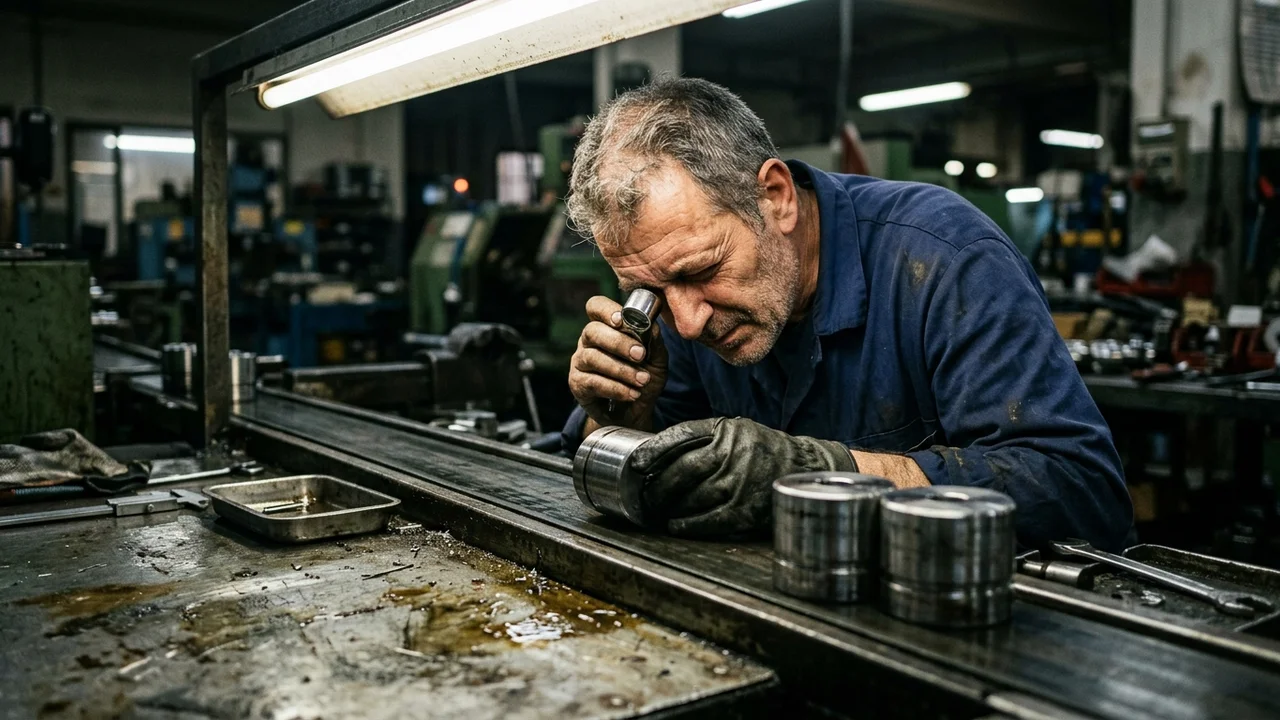
In many manufacturing SMEs, quality control still relies on a person who looks at the part, compares it against a mental standard, and decides whether it passes or not. The mechanism works as long as volumes are low and attention remains high, but with long shifts and increasing pace the eye grows tired, judgment criteria vary from one operator to another, and defects slip through unnoticed until the next stage of production or, worse, after shipment.
Why manual visual inspection slows production and raises hidden costs
Manual visual inspection slows production because every part requires dedicated human time, and it raises hidden costs because undetected defects generate rework, returns, and disputes that surface weeks later.
The problem is not just the slowness of the inspection itself. It is that the judgment criterion is not written down anywhere: it lives in the mind of whoever is doing the checking that day. Changing shifts means changing standards, and this produces variability that no report can explain until someone goes looking for the root cause by hand, part by part.
Companies that produce short runs with many variants
A company that frequently changes tooling or configuration struggles to maintain consistency in its checks, because each variant requires the operator to mentally recalibrate what is acceptable and what is not.
Companies with night shifts or weekends running on reduced staffing
During lower-staffing hours, quality control is often skipped or done on a sample basis, allowing more rejects to pass through than anyone realizes.
What happens when defects are discovered too late
When a reject is discovered downstream, in the warehouse or by the customer, the cost of intervention grows because it involves logistics, returns, communication, and sometimes contractual penalties, not just the wasted material.
A defective part caught immediately costs the time of a single reject and a note in the log. The same part discovered after final assembly costs disassembly, replacement of connected components, and a delay on delivery. If it reaches the customer, reputational damage is added to the equation, and for an SME with a concentrated customer portfolio that weighs more heavily than any balance sheet figure shows.
A defect not caught on the line does not disappear: it moves downstream and changes form, becoming a return, a dispute, or a penalty.
- Rework on already-assembled parts, with disassembly and additional time
- Unplanned machine downtime to correct the upstream problem
- Customer disputes that extend payment collection timelines
- Loss of material that cannot be recovered
- Erosion of commercial trust on repeat supply relationships
The solution: tailored AI automation for quality control
AI automation for quality control uses cameras or sensors connected to a model that recognizes defects according to criteria defined once and applied consistently, with a margin of error that must be measured and managed.
The difference compared to off-the-shelf software purchased as a black box is that a custom-built system starts from the actual defects on your line, not from a generic list of anomalies designed for a different sector. This can mean fewer false alarms and less time spent teaching the system what to ignore.
Companies with little time to train new quality control staff
An automated system does not require the same learning curve as a new operator: the criterion is already encoded and remains stable even with staff turnover.
A workshop managing mixed batches with different tolerances
With criteria configured for each part type, the system automatically applies the correct threshold without anyone having to remember it from memory each time.
How Leomat addresses the problem with pure code and real cases
Leomat builds custom software automations in pure code: it handles the processes that people carry out on computers, not machines and industrial equipment.
In quality control, this means working on the digital side of the process, from written acceptance criteria through to the management system that tracks orders. A concrete example is the project completed for ERP Costruzioni, where automation brought the preparation of a quote from 8 hours down to 5 clicks in 30 days: the same logic applies to quality control, namely eliminating a manual bottleneck by replacing it with a reliable, repeatable digital process.
A written, shared quality criterion does not change its mind mid-shift, and this reduces one of the most costly sources of variability.
For those who want to understand how to set up a similar project correctly without wasting budget, it may be useful to read the most common budget mistakes that block automation in an SME, or to explore why custom software works better than a ready-made tool in a manufacturing context.
Concrete steps to digitize quality control in your company
Digitizing quality control requires first a mapping of recurring defects, then the selection of inspection points, and finally integration with the existing production flow.
There is no need to start from scratch with a massive project. The most practical approach is to isolate the production stage where the majority of rejects are concentrated and automate that stage first, measuring results before extending the system to the rest of the line.
- List the most frequent defects from recent months, using real data where available
- Identify the point on the line where a defect costs the least when caught immediately
- Define clear, measurable criteria, not subjective impressions
- Integrate the system with the existing management software without duplicating data, and verify with a legal advisor or labor consultant whether the cameras also capture workers in frame
- Measure results for at least one month before extending the project
Those who also manage their warehouse using manual methods will find it useful to read how manual warehouse counting slows production, a problem that is often linked to the same type of operational inefficiency.
How Leomat can help you build the quality control system you need
Leomat focuses on software automation, not industrial automation: the part it can build is the part that lives on the computer, meaning recording defects in a structured way, making acceptance criteria written and shared, and connecting this data to the management system that tracks orders and supplies. If you want to understand where to start, you can discover how Leomat works with Italian SMEs on concrete, measurable automation projects.
Frequently asked questions about automated quality control
How much does it cost to automate quality control in a small company?
The cost varies considerably depending on the number of inspection points and the complexity of the defects to be recognized. A custom project makes it possible to start from a single critical stage, keeping the initial investment contained and measuring results before extending the system.
Is an in-house IT team needed to manage an AI quality control system?
No, provided the system is designed with the people who will actually use it in production in mind. A well-designed custom project integrates the automation into existing workflows without requiring specialized technical skills from operational staff.
Does automated inspection completely replace operators?
In most cases it works alongside staff, handling the repetitive part and leaving people to make the more complex decisions or deal with the exceptions that the system flags but cannot resolve on its own.
How long does it take to see concrete results?
It depends on the complexity of the line and the quality of the starting data: any timeframe given before seeing the situation would be invented. Starting from a single critical stage makes it possible to measure in the field whether rejects decrease, before extending the system.
This post was created with AI
Content (text, processing, quotations and images) generated or artificially manipulated by artificial-intelligence systems. Notice provided under the transparency obligations of Article 50 of Regulation (EU) 2024/1689 (AI Act), applicable from 2 August 2026.