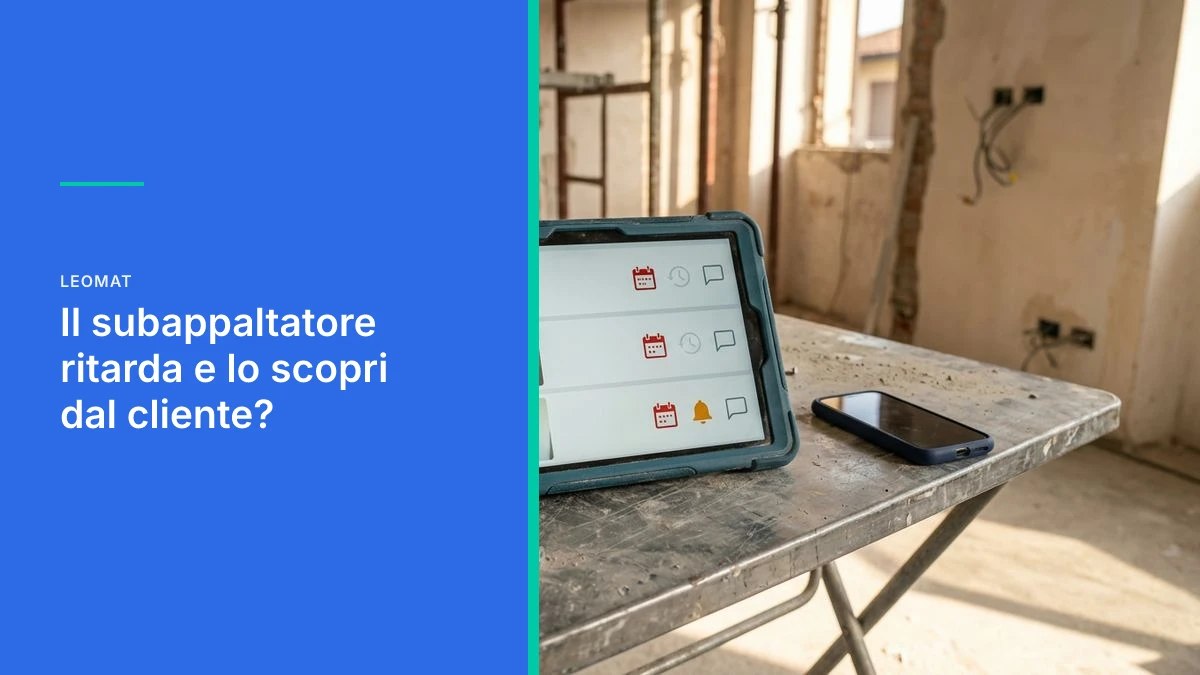
The subcontractor is late and you find out from the client?
Subcontractor delays often surface only when the client calls. Status, deadlines, and reminders go into one place, with one person making decisions.
Checking subcontractor delays before the client calls
To know whether a subcontractor is running late before the client calls, every external assignment lives in a single list: company, deadline, last update, and who needs to act. When the date approaches and no feedback has arrived, the coordinator receives an alert and finds the follow-up message already prepared. A person reads the context and decides whether to write, call, or revise the plan. Checking subcontractor delays is this daily comparison, not a phone call made after the client has already complained.
In many companies, subcontracting lives outside the management system. The date is in a message, the status in a phone call, the company name in a spreadsheet that is not updated on the same day. The coordinator discovers the gap when the client asks where the material, the installation, or the inspection is. At that point there is no room left to move a crew or give a calm heads-up: what remains is a late explanation. What is missing is a single place, readable by whoever needs to decide, not goodwill.
Why the delay is only discovered when the client calls
The delay stays invisible as long as no one compares the promised date with a written update.
The client's call does not create the delay: it makes it public. Until that moment the external company can be stalled over a material, a permit, or another job, and inside the company only the person who took the last call knows about it. If that person is on site, absent, or buried in messages, the news never reaches whoever needs to reschedule the work.
Typically the subcontractor does not write the status in the same place where the company reads its deadlines. They promise verbally, confirm by message, and then the thread is lost. When the client calls, the history has to be reconstructed in reverse: who said what, and when. That reconstruction comes too late for the site and too soon for trust.
Coordinators managing multiple sites who receive updates verbally
Someone overseeing several jobs at once cannot keep every promise in mind. An update given over the phone is only useful if someone writes it in the same list as the deadline. Otherwise the old date still exists the next day, and the new information stays in one person's memory. Here, control means a place where a spoken update becomes a row: date, company, what is missing, next check.
Those who outsource installations and systems and track dates on a spreadsheet
Those who outsource installations, systems, or specialist work often have a spreadsheet with company names and end dates. The spreadsheet does not say whether the last update is recent or already outdated. A future date, without a fresh update, looks like everything is on track. That is where the delay hides, until the client asks.
Where the progress status of subcontracted work gets lost
Progress status gets lost when it lives in different places that do not update together: phone calls, messages, and spreadsheets.
No single channel is wrong on its own. A phone call is fast, a message leaves a trace, a spreadsheet is easy to share. The problem is that they do not talk to each other. A follow-up sent by email does not move the date on the spreadsheet. A new date given verbally does not appear in the message a colleague will read later. Whoever opens only one channel sees one piece, and that piece can be outdated.
The same fragmentation affects orders, confirmations, variations, and minutes. If the variation that shifts the deadline is in one attachment and the official date is in another file, monitoring the progress status of subcontracted work becomes a search. This kind of overlap is also where managing commercial documents without hunting through email can help.
- The deadline promised to the client, kept separate from the date requested from the subcontractor.
- The last written update: who provided it, on which day, with which new date.
- What is still missing to close: material, site access, drawing, inspection, or another progress status.
- Who internally needs to act, and who at the external company is the point of contact.
- Whether the follow-up has been sent and whether it received a reply.
Those who chase follow-ups across messages and phone calls
Whoever handles follow-ups manually repeats the same steps: find the last message, check whether the date is still valid, write, and make a note to check again. If the systems do not update each other, that step leaves no trace in the right place. It is the same disconnect that occurs when software tools do not talk to each other: the truth is in the most recent message, not in the management system.
A delay known before the deadline can still be rescheduled; the same delay discovered through the client's phone call is already a trust problem.
The single point that shows every externally assigned job
A single point is needed where every external assignment has a deadline, a last update, and a responsible person, all visible without opening email.
It is not an archive of everything. It is the morning view: what is due soon, what has no recent update, who needs to make the next move. Contracts and attachments can remain linked. The decision should not depend on opening many message threads.
For subcontractor management in an SME, this point can live in the management system, if it already tracks jobs and suppliers, or in an application built around the actual process. A generic program often requires adapting the site to fit the module. When dates, variations, and inspections do not fit, people go back to the spreadsheet. That is the limitation that becomes visible when off-the-shelf tools slow down a process that is not standard.
- Separate the date promised to the client from the date requested from the company, and show the gap.
- Treat an assignment as having no news if its last update is old relative to how close the deadline is, even if the end date is still in the future.
- Link each row to an internal responsible person, so the alert does not end up in a mailbox nobody opens.
- Keep the history of updates, not just the latest date, to avoid reconstructing the phone call from memory.
Software for managing external suppliers, in this sense, is not a list of contact records. It is the place where the status changes when reality changes, and where a colleague sees the same row as the person who spoke with the company. Legal obligations regarding subcontracting should be verified with a trusted professional: this discussion covers only the operational control of dates.
Deadline alerts and follow-ups with a person who decides
The alert signals a deadline with no update; the follow-up is sent only after a person has read the context and confirmed.
Automating supplier follow-ups removes the repetitive part: remembering the date, preparing the message with the assignment and deadline, noting that a follow-up is pending. It should not invent a new date, promise a penalty, or resolve a dispute. Those statements commit the company. The message is prepared, and a person confirms before it is sent, especially if the text changes an existing commitment.
An agent that acts on data can read the list, identify rows with no update, and propose the text. At first it works under supervision: the process is observed to check whether it selects the right rows, whether the tone matches the company's style, and whether it does not mix up one site with another. Autonomy grows only where that behaviour proves reliable. For sensitive actions, human confirmation remains in place.
Those with little time for the daily follow-up routine
Coordinators do not have a free morning to reread every email thread. A useful routine is short: open the rows with no news, read the proposed follow-up, confirm, correct, or call. The time freed up is not a promise of results. It is the time currently lost searching for the last message before even deciding what to write.
Where to start this week
Write the list of still-open jobs: company, date requested, date promised to the client, last useful message, name of whoever is handling the matter. There is no need to reconstruct the entire archive. Then decide that every update, even a verbal one, becomes a row before the day closes, and that the follow-up is prepared automatically but does not go out without confirmation. Without this habit, even a well-built program reads outdated data.

The automated follow-up prepares the message and signals the deadline; the decision to press further, renegotiate, or notify the client stays with a person.
How Leomat builds this control over external work
Leomat designs web applications around the company's actual process and keeps agents under supervision, with human confirmation on sensitive actions.
The studio builds the system and the environment in which it runs: application, infrastructure, repeatable deployment, backups, recovery, monitoring, and ongoing correction. If the management system, email, and spreadsheets do not talk to each other, the real work lies in making them communicate, not in adding another isolated list. Artificial intelligence acts as a multiplier; architecture, quality, and security remain choices verified by a person.
Agents act on data. Every action is observed. Autonomy increases only where it proves reliable, and sensitive actions always require confirmation. Security is designed from the start, from access control to data separation, with data remaining within the agreed perimeter. If a step is not worth automating, that is said upfront, not after the fact.
Among the services offered are custom management systems built around the company's actual process. The starting point is the process as it exists today. On the Leomat software engineering studio website, the initial conversation produces an approach, an architecture, and a realistic estimate, without timelines invented before the work has been seen.
Frequently asked questions about delay control
The answers below concern daily control: phone calls, spreadsheets, software for external suppliers, and human confirmation on follow-ups.
How can I check subcontractor delays without calling every day?
There is no need to call every company every morning. A list is needed where every assignment has a deadline, a last update, and a responsible person. The alert is triggered when the deadline approaches and the row has no recent update. At that point, only those who genuinely have no news are called or messaged. The phone call remains useful for complex cases. It stops being the only way to find out that a date is no longer valid. The difference comes from the single place where, when a reply arrives, someone writes it down immediately.
Is a spreadsheet enough for subcontractor management in an SME?
It is enough when the rows are few, a single person updates them, and no one needs to receive an alert. As soon as the sites multiply, the spreadsheet shows the end date but does not show whether that date is still credible. It does not prepare the follow-up, does not keep the history of updates, and does not distinguish the date promised to the client from the date requested from the company. It can remain the starting point from which to copy open jobs. It is not the control mechanism, if control needs to arrive before the client's phone call.
What should software for external suppliers on subcontracting do?
It should show, for every externally assigned job, the company, deadline, last update, what is missing, and who needs to act. It should separate the date promised to the client from the date agreed with the subcontractor. It should flag rows with no news before the deadline becomes a delay the client already knows about. Documents can remain linked, but the morning decision should not depend on email. If the program forces variations and inspections to be left out, people go back to the spreadsheet and control breaks down again.
Can an agent send follow-ups to suppliers on its own?
It can prepare the follow-up and indicate which row has no update. Sending it, especially if the text touches a date or the relationship with the company, remains a human confirmation. At first the agent works under supervision: the process is observed to check whether it selects the right rows and whether the tone matches the company's style. Autonomy grows only where that behaviour proves reliable. A wrong follow-up commits the company as much as a phrase said over the phone. That is why whoever knows the site stays in the loop and does not step out of it.
This post was produced with AI
Content (text, processing, quotations and images) generated or artificially manipulated by artificial-intelligence systems. Notice provided under the transparency obligations of Article 50 of Regulation (EU) 2024/1689 (AI Act), applicable from 2 August 2026.