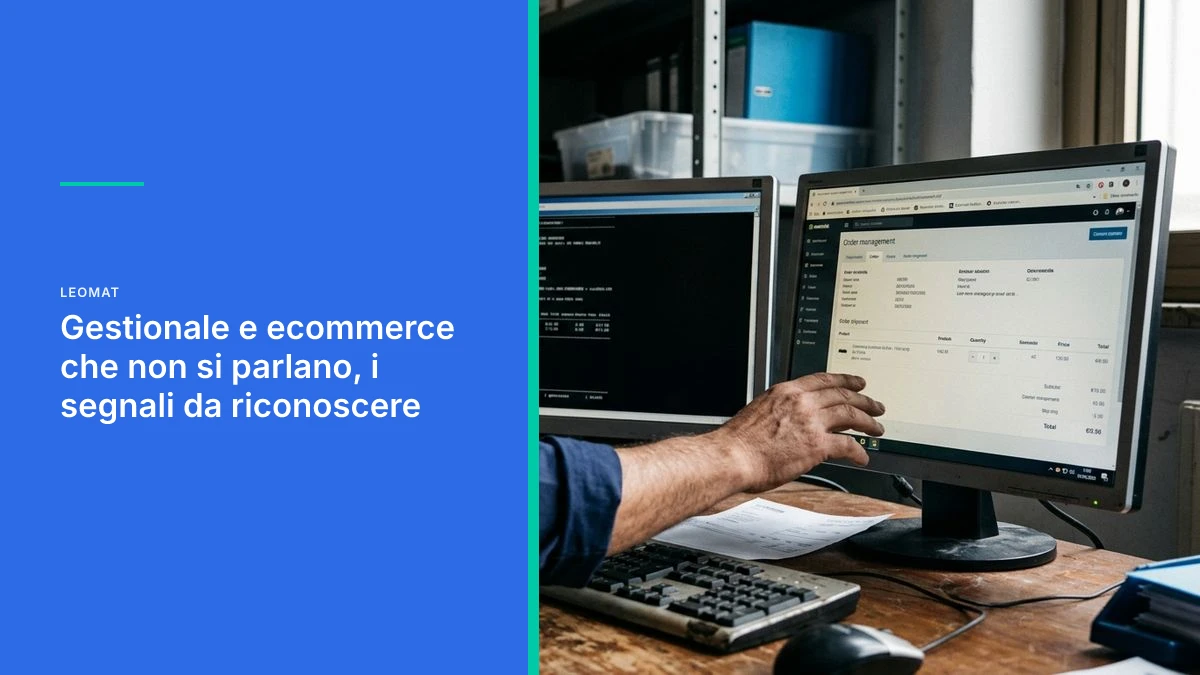
When your management software and ecommerce stop communicating, the warning signs to recognize
Five concrete signs of misalignment between your management software and ecommerce platform, and how to fix it with tailored automations.
When your ERP and ecommerce don't talk to each other: the warning signs every SMB should recognize
When your ERP and ecommerce don't communicate, order data, inventory levels, and customer records remain siloed in two systems that never update each other. The result is a constant manual reconciliation effort, stock errors, misaligned prices, and reports that never match. Recognizing the warning signs early prevents lost sales and wasted hours every week.
In many small and medium-sized businesses, the ERP comes before the ecommerce platform, or the other way around, and the two worlds end up connected through stopgap solutions: manual exports, intermediate spreadsheets, generic plugins downloaded and never properly configured. When you analyze the data flow between the two systems, you often find missing required fields, such as a unique SKU code or a consistent customer ID, that prevent any real synchronization. Without that consistency, every automation built on top is fragile and breaks the moment either piece of software receives an update.
Sign 1: you enter orders manually twice
If every ecommerce order has to be retyped manually into the ERP, you are paying in labor hours for something an automated integration would handle in real time.
This is the most visible sign and also the most costly in terms of time. The people handling administration end up spending part of their day transcribing orders from one platform to the other, with a real risk of typos on quantities, addresses, or product codes. As volumes grow, this work becomes a bottleneck that holds back growth instead of supporting it.
Those who manage orders across multiple channels at the same time
Businesses selling on a proprietary ecommerce store and marketplaces simultaneously often find themselves multiplying this work for every active channel, with the risk of losing track of which orders have already been recorded in the ERP.
Sign 2: online inventory doesn't match actual warehouse stock
Ecommerce inventory synchronization that doesn't work leads to sales of out-of-stock products and unhappy customers waiting for refunds.
Inventory misalignment is one of the most insidious signs because it stays invisible until it creates a problem with the end customer. A product sold online that appears available but is already out of stock forces you to handle a refund or a delay, causing real reputational damage. The ERP should update the ecommerce platform with every warehouse movement, not once a day through a manual export.
An ecommerce store showing inventory that isn't synchronized with actual warehouse stock isn't a stock problem, it's a trust problem with the customer.
Sign 3: prices and price lists are misaligned between the two systems
When a price list changes in the ERP but isn't immediately reflected in the ecommerce store, the customer sees a different price from the correct one and trust erodes.
Seasonal promotions, B2B volume discounts, or simply a supplier price list update are all fertile ground for errors when the two systems don't communicate. Businesses managing complex price lists, with differentiated prices by channel or customer type, risk generating negative margins without even noticing until the end of the month.
Those working with B2B and B2C price lists on the same ecommerce store
Businesses selling to both consumers and companies under different pricing conditions need a synchronization logic that respects the rules of each channel, not just a generic base price update.
Sign 4: customer data and invoices are duplicated or incomplete
If the same customer exists under two different profiles across the ERP and the ecommerce platform, every sales and revenue report starts from a distorted figure.
Customer data duplication is a sign that is often underestimated because it doesn't block day-to-day operations, but it silently corrupts every subsequent analysis. Invoices issued with incomplete data, duplicate records, shipping addresses that haven't been updated: these are all symptoms of the same underlying problem, the absence of a single source of truth across systems.
- Customer records created twice with small differences in name or address
- Invoices that don't exactly match the order recorded online
- Purchase history fragmented across the two systems, impossible to view in one place
- Missing or incorrect tax details that complicate end-of-month accounting

Sign 5: reports don't add up and you're making decisions in the dark
When the sales figures in the ERP don't match those in the ecommerce platform, every strategic decision is based on partial or contradictory data.
This is the final sign, the one that usually appears when the first four have already been present for some time. A business owner deciding whether to increase production, change suppliers, or invest in marketing needs reliable numbers. If ecommerce revenue doesn't reconcile with what's recorded in the warehouse, every decision becomes a leap in the dark.
- Check whether the two systems share the same unique product code
- Verify how frequently inventory is updated between the systems
- Map where customer record duplications originate
- Identify which reports produce different numbers from each other
Those with little time for daily control routines
Businesses without an internal IT team, where the ecommerce is managed alongside other operational responsibilities, often postpone checking for these signs until the problem becomes too large to ignore.
Those selling online with a catalog of a few dozen product lines
Even with a limited catalog, the lack of synchronization between ERP and ecommerce forces recurring manual work just to keep prices and availability up to date.
Integrating your ERP and ecommerce is not an isolated IT project: it is the foundation on which every operational decision in the business is built.
How Leomat integrates ERP and ecommerce with tailored automations
Leomat addresses this kind of misalignment starting from a simple principle: genuinely understanding how a company's processes work before proposing a solution. The approach is based on custom pure code, without relying on generic no-code tools that often break at the first update and don't adapt to the specific logic of each SMB. Among the concrete solutions available is the development of custom ERP systems, designed to create a stable connection between ERP, ecommerce, and warehouse according to the company's real needs, not according to a standard template.
One example of how this approach translates into concrete results is the ERP Costruzioni case, where automating the quote drafting process reduced it from 8 hours to 5 clicks in 30 days. The same logic applies when eliminating double entry between ERP and ecommerce: identify the real point of friction and build a stable automation around it. If you recognize one or more of these signs in your business, you can explore how Leomat designs tailored integrations for SMBs starting from a concrete analysis of your processes.
To better understand how this kind of misalignment also manifests in other areas of the business, it may be useful to read 7 signs your software systems aren't talking to each other, or, if the issue mainly concerns overnight order management, the article on automated ecommerce order management. Those who struggle primarily with warehouse control may find useful insights in the manually counted warehouse that brings production to a halt.
Frequently asked questions about ERP and ecommerce that don't communicate
How do I know if my ERP and ecommerce aren't truly integrated?
The clearest sign is the need to intervene manually on orders, inventory, or prices more than once a day. If an update made in one system isn't automatically reflected in the other within a few minutes, you most likely don't have a real integration, only a partial or manual connection.
Do you need an internal IT team to integrate ERP and ecommerce?
No, a structured internal IT team is not required. An external technology partner can handle the entire integration starting from an analysis of existing processes, without requiring any technical expertise inside the company for implementation or day-to-day management.
How long does an ERP ecommerce integration project take for an SMB?
Timelines vary depending on the complexity of the systems involved and the number of processes to connect. It isn't possible to give timeframes before seeing the systems in question: the work starts from a specific area, such as order or inventory synchronization, and a broader integration is structured in phases.
Does automatic warehouse synchronization work across multiple sales channels?
Yes, a well-designed integration can manage multiple channels simultaneously, updating inventory levels in real time across each of them. The key is building a centralized logic that treats the ERP as the single source of truth for available stock.
This post was created with AI
Content (text, processing, quotations and images) generated or artificially manipulated by artificial-intelligence systems. Notice provided under the transparency obligations of Article 50 of Regulation (EU) 2024/1689 (AI Act), applicable from 2 August 2026.