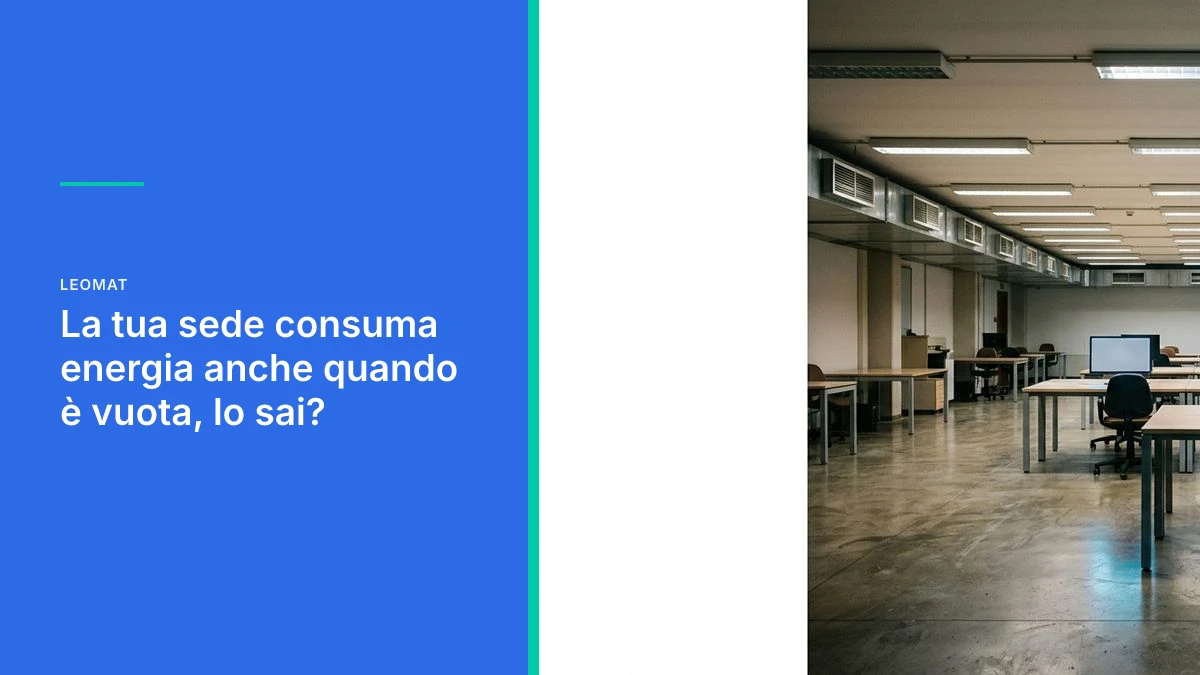
Your facility consumes energy even when it's empty, did you know that?
Lights, HVAC systems, and machinery keep running outside business hours. Find out what it's really costing you and how AI-driven automation can reduce energy waste in your organization.
Energy savings in company buildings: the hidden cost nobody monitors
Energy savings in a company building are not just about utility bills: they concern everything that draws power when nobody is in the office. Lighting, climate control and machinery often remain active outside working hours because no system shuts them down automatically, generating a continuous, silent waste that weighs on operating costs without management ever noticing.
In most manufacturing and service SMEs, the electrical system and the HVAC system still operate on manual logic: a switch, a generic timer, or the goodwill of whoever locks up last. A presence sensor or a thermostat connected to intelligent logic reads the actual state of each space (occupied, empty, in transition) and acts accordingly, without anyone having to remember to do it.
Why it happens: lighting, HVAC and machinery without intelligent control
Energy waste almost always originates from systems that run on a fixed schedule rather than responding to the actual occupancy of spaces.
A timer sets the same switch-off time every day, but production does not always finish at the same hour: overtime, a shift that runs late, a department that closes early. The result is that the system stays on "just to be safe" far longer than necessary, or shuts off while someone is still working, creating further operational inefficiencies.
- Lighting active in common areas, warehouses and offices even at night or on weekends
- Climate control continuing to run in empty spaces
- Machinery on standby drawing power without producing anything
- Systems managed with fixed timers that do not adapt to actual shift patterns
What this waste really costs your SME
The real cost of energy waste is measured by comparing consumption during closed hours with consumption during active hours: if the difference is small, the building is consuming energy even when it is not needed.
No generic statistical estimate is needed to understand the problem: simply look at the electricity consumption curve for a working day and compare it with that of a day when the building is completely closed. If the two graphs look too similar, it means that a large part of the system is running idle. This is data that every company can read directly from its own meter or from the energy supplier's software, without needing to rely on external figures.
A building that consumes almost as much when closed as it does during opening hours does not have a tariff problem: it has a control problem.
Companies with a single production department and fairly regular hours
In this case the waste is often concentrated in the lighting and HVAC of offices and common areas, which are simpler to automate with presence sensors and intelligent scheduling rules.
Companies managing multiple shifts or variable hours across different departments
Here the problem shifts to machinery and production lines that remain on standby between shifts: what is needed is control that follows actual occupancy, not a fixed timetable.
The solution: sensors and AI automation for company buildings
Presence, temperature and consumption sensors connected to automation logic allow the building to react on its own to what is actually happening, not to a preset schedule.
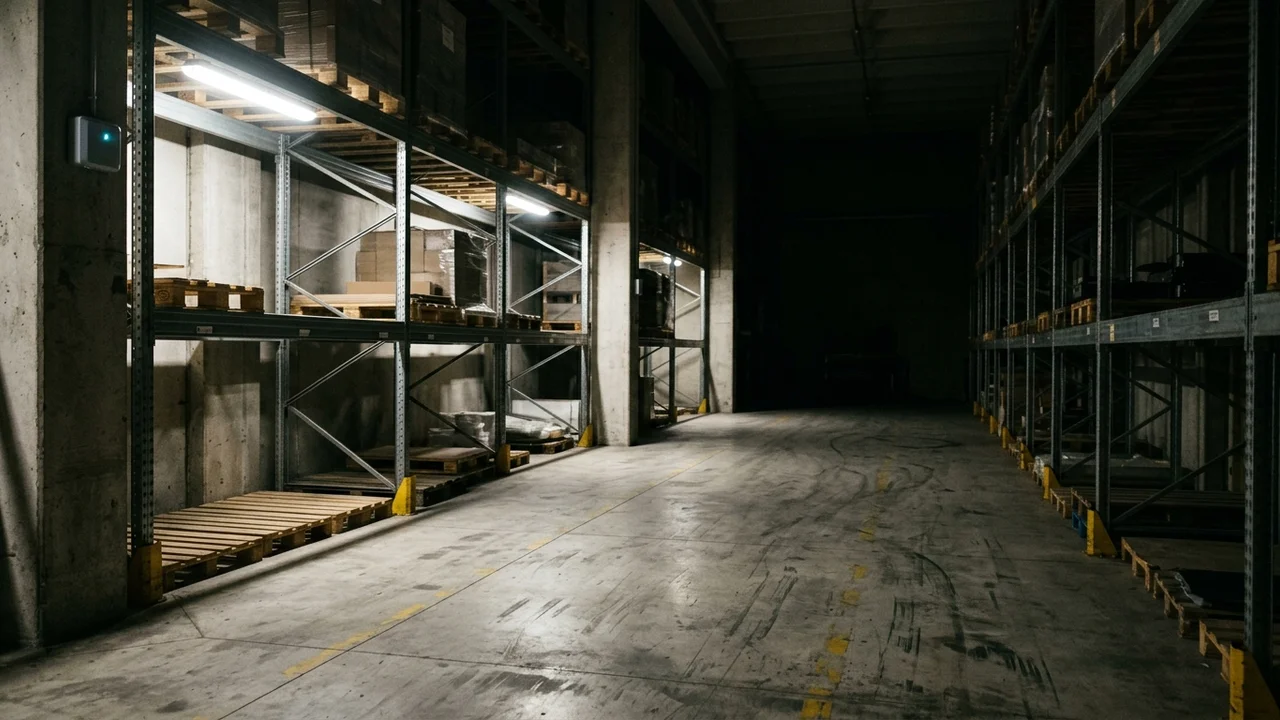
A presence sensor in a warehouse can switch off the lighting after just a few minutes of actual absence. A temperature sensor can reduce heating in a closed area over the weekend. A system that reads machinery consumption can flag when a system remains on for no reason. Taken together, this data provides a concrete basis for deciding where to intervene first, without cutting anything that production genuinely needs.
- Map the spaces with the greatest variability in occupancy
- Install presence, temperature and consumption sensors at critical points
- Connect the data to logic that automatically decides when to switch systems on and off
- Monitor consumption over time to verify the actual effect of the rules set
How Leomat designs bespoke automation with pure code
Leomat builds automations for SMEs using bespoke pure code, without relying on third-party no-code or low-code platforms, to guarantee stable solutions tailored to each individual company building.
This technical choice is not a minor detail: it means that every automation rule (when to shut down a line, how to manage a space with variable hours, how to make different sensors communicate with each other) is written specifically for the company, rather than forcing processes into a generic template. This is the same approach Leomat brings to other operational areas of SMEs, from order management to automated invoicing.
A sensor connected to custom-written logic does not follow a schedule: it follows what is actually happening in the building.
Companies that want to start with a single department before extending the project
It is possible to launch energy automation in a pilot area, verify the effect on consumption, and then extend the logic to the rest of the facility, without having to redesign everything from scratch.
Companies that already have management software but no control over energy consumption
In these cases the sensor automation can be connected to the existing software, so that energy data becomes part of the same operational dashboard already in use, a topic also covered in when to change your SME management software.
What you can do right now to start saving
The first concrete step is to observe the building's actual consumption outside working hours and identify the areas where the system is running unnecessarily.
There is no need to start with a large project: simply choose the area with the most obvious waste, perhaps a warehouse or a department with regular hours, and test a first sensor system connected to automation rules there. The results observed in that area become the basis for deciding where to extend the intervention, without over-engineering a process that, in other departments, may not need it.
Those who want to understand how to set up similar automations without an in-house IT team can also read SME process automation without an IT manager: what actually works, or explore why pure code outperforms no-code tools even in building automation projects.
How Leomat can help your company reduce energy waste
Leomat approaches building automation as a natural extension of its focus on SME operational efficiency: sensors, control logic and integrations written in pure code, designed around the individual building rather than a standard model. The same bespoke approach is already at the core of the custom ERP for your company offering, where every process is shaped around the client's real needs rather than fitted into generic software. One example of this method applied in another sector is the ERP for Construction case, where drafting a quote went from 8 hours to 5 clicks in 30 days: the same logic of concrete simplification can be applied to the energy control of a company building.
Frequently asked questions about energy savings and company building automation
How much does it cost to install energy efficiency sensors in a company?
The cost depends on the number of spaces to be covered and the type of sensors chosen (presence, temperature, consumption). It is advisable to start with a pilot area to assess the real investment before extending the project to the entire building.
Does energy automation work even without an in-house IT team?
Yes, it is designed precisely for companies without a structured IT department: the control logic is designed to measure and integrated into existing systems, without requiring internal technical expertise for day-to-day management.
Does the electrical system need to be replaced in order to automate it?
In most cases no: the sensors integrate with the existing system and the control logic is added as an intelligent layer, without any invasive work on the building's electrical structure.
How long does an energy automation project take?
It depends on the complexity of the building and the number of areas involved. A pilot project covering a single department requires a short timeframe, while extension to the entire facility should be assessed case by case based on the results observed.
Does automation only reduce costs, or does it improve other aspects as well?
In addition to savings on consumption, a well-designed sensor system improves operational control of the building, flags anomalies (systems that remain on for no reason) and provides useful data for planning preventive maintenance.
This post was created with AI
Content (text, processing, quotations and images) generated or artificially manipulated by artificial-intelligence systems. Notice provided under the transparency obligations of Article 50 of Regulation (EU) 2024/1689 (AI Act), applicable from 2 August 2026.